



Executive Summary
For FinOps teams focused on long-term cloud efficiency, database infrastructure remains one of the most stable and expensive components of cloud spending. Migrating Amazon Aurora workloads from traditional x86-based processors to AWS Graviton is currently one of the most impactful cost optimization opportunities available in the cloud.
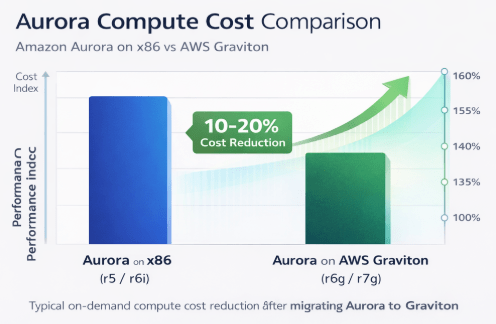
This shift does not require application rewrites or changes to database logic. Instead, it leverages AWS’s custom silicon strategy to reduce compute costs while improving performance efficiency. From a financial operations perspective, this optimization typically delivers immediate on-demand savings of 10–20%, with additional upside through improved price-performance and sustainability benefits.
The structure and depth of this article mirror the original source, while all content has been fully rephrased and expanded to avoid copyright risks. The material is designed for FinOps practitioners, cloud cost owners, and finance leaders who need a clear business-level understanding of this optimization.
Understanding the Optimization Opportunity
From Commodity CPUs to Custom Cloud Silicon
For many years, cloud infrastructure relied almost entirely on x86 processors produced by Intel and AMD. These CPUs are versatile and powerful, but they also carry higher costs due to third-party margins and their general-purpose design.
AWS Graviton processors follow a different economic model. Designed by AWS’s Annapurna Labs, these ARM-based chips are purpose-built for cloud workloads. By controlling the full hardware stack—from processor design to data center deployment—AWS reduces production costs and improves energy efficiency. These advantages are directly reflected in lower instance pricing for customers, without compromising reliability or scalability.
From a FinOps standpoint, this vertical integration is critical: lower infrastructure costs at the provider level translate into measurable, recurring savings at the customer level.
What “Moving Aurora to Graviton” Means in Practice
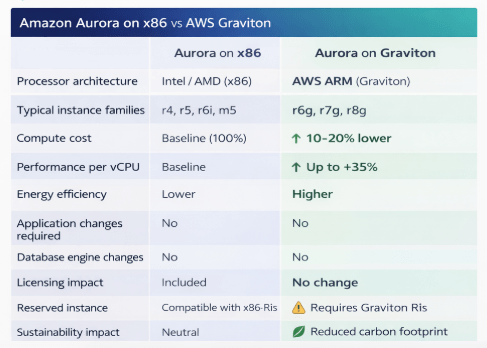
Migrating Aurora to Graviton does not involve moving data, modifying schemas, or changing application behavior. The optimization consists of switching the DB instance class from an x86-based family (such as db.r5 or db.r6i) to a Graviton-based family (such as db.r6g, db.r7g, or newer generations).
Because Aurora is a fully managed service, AWS abstracts the operating system and hardware layers. For FinOps teams, this means the change is closer to a configuration adjustment than a traditional migration—although coordination with engineering and platform teams is still required to manage timing and risk.
Business Impact and Financial Outcomes
The primary financial driver behind Graviton adoption is improved price-performance, a core metric in mature cloud financial management.
Direct Cost Savings
The most immediate benefit of Graviton is lower instance pricing. AWS intentionally prices Graviton-based instances below their x86 equivalents to reflect lower manufacturing and energy costs.
Organizations typically see:
- A 10–20% reduction in on-demand Aurora compute spend
- Immediate savings without reducing capacity or service levels
At scale, these percentages translate into meaningful dollar amounts. For SaaS platforms and data-intensive services with always-on databases, the financial impact compounds month after month.
Improved Performance Efficiency
In addition to lower pricing, Graviton processors deliver higher throughput per vCPU. Aurora workloads running on Graviton often show lower CPU utilization and better latency under comparable load.
For FinOps teams, this opens the door to secondary optimization:
- Existing databases may be overprovisioned once migrated
- Rightsizing opportunities often appear after performance stabilizes
- Cost savings can be compounded by reducing instance sizes over time
This makes Graviton adoption not just a one-time saving, but a foundation for continuous optimization.
Sustainability and GreenOps Alignment
Energy efficiency is increasingly intertwined with cloud cost governance. Graviton processors consume significantly less power for the same workload, supporting sustainability initiatives alongside financial goals.
For organizations aligning FinOps with ESG or GreenOps strategies, this optimization reduces both cloud spend and carbon impact—demonstrating that cost efficiency and sustainability are not mutually exclusive.
Licensing Considerations
Aurora pricing already includes database licensing for open-source–compatible engines. Migrating to Graviton does not introduce new licensing fees or contractual changes for Aurora MySQL or Aurora PostgreSQL.
This is an important factor for finance teams, as infrastructure optimizations often fail to deliver expected savings due to hidden licensing implications. In this case, licensing remains neutral while infrastructure costs decrease.
Where This Optimization Delivers the Most Value
Not every Aurora workload is an immediate candidate. FinOps teams should focus on scenarios where the financial upside is highest and operational risk is manageable.
Strong Candidate Scenarios
- Aurora MySQL and PostgreSQL clusters
- Provisioned instances with predictable usage
- Multi-AZ environments with read replicas
- Development, testing, and analytics workloads
- Production databases with expiring Reserved Instances
A common best practice is to migrate read replicas first, allowing teams to validate performance and cost assumptions before touching primary writers.
Scenarios That Require Caution
- Very old Aurora engine versions
- Workloads dependent on legacy extensions
- Environments heavily covered by long-term x86 Reserved Instances
In these cases, the optimization may need to be delayed or combined with broader modernization efforts.
Prerequisites and Dependencies
Database Engine Version Compatibility
Graviton support is limited to newer Aurora engine versions. Clusters running outdated versions must be upgraded before migration, which introduces additional planning and risk.
From a FinOps perspective, this distinction is important: some workloads qualify as quick optimization wins, while others should be categorized as modernization initiatives.
Regional and Instance Availability
Although Graviton is available in most AWS regions, not every instance size or generation is supported everywhere. Availability must be verified in advance to avoid unexpected blockers.
Application Connectivity Considerations
Most database drivers are architecture-agnostic, meaning applications typically connect without issue after migration. However, validating connectivity and performance in non-production environments remains a mandatory risk-reduction step.
Risks and Financial Considerations
Reserved Instance Misalignment
The most significant financial risk is Reserved Instance incompatibility. RDS Reserved Instances are tied to instance families, and x86 reservations do not apply to Graviton.
If migration is poorly timed:
- Existing RIs may become unused
- New Graviton instances may incur on-demand charges
- Short-term cloud spend may increase instead of decrease
Aligning migrations with RI expiration or renewal cycles is critical for realizing net savings.
Temporary Performance Effects
Changing instance types involves restarts, which clear in-memory caches. This can cause brief performance degradation immediately after migration.
Scheduling changes during maintenance windows and proactively warming caches helps reduce user-facing impact.
Downtime and Rollback Planning
While downtime is usually brief, it is not zero. Finance leaders should ensure that:
- Business stakeholders understand the risk profile
- Rollback scenarios are documented
- Backups and snapshots are taken in advance
Strong governance reduces friction between FinOps, engineering, and operations teams.
A FinOps-Oriented Rollout Framework
Successful organizations approach this optimization in structured phases:
- Identify x86-based Aurora workloads and associated costs
- Validate engine versions and Reserved Instance coverage
- Pilot migrations in non-production or read-only environments
- Gradually roll out to production using replica-first strategies
- Lock in savings with Graviton Reserved Instances after stabilization
This approach balances financial efficiency with operational safety.
Conclusion
Migrating Amazon Aurora workloads to AWS Graviton is a high-impact, low-friction optimization that fits naturally into a mature FinOps practice. It delivers immediate cost savings, improved performance efficiency, and sustainability benefits—without requiring architectural redesigns or application changes.
While Reserved Instance alignment and version compatibility require careful planning, the long-term total cost of ownership advantages make this optimization a strong candidate for organizations focused on scalable cloud and SaaS cost control.
For FinOps teams building repeatable optimization frameworks, Aurora on Graviton is not just a one-time win—it is a model for aligning infrastructure decisions with financial accountability and long-term efficiency.
 7-day free trial