



Kubernetes is an operational marvel that lets your teams ship software faster and more reliably. However, its dynamic, multi-tenant nature creates a significant business problem: a near-total loss of cost visibility. When dozens of teams share clusters, it becomes almost impossible to know who is spending what. This leads to over-provisioning, waste, and budget surprises that land squarely on your desk. Effective kubernetes cost governance isn’t about restricting engineers; it’s about creating a system of visibility, ownership, and accountability that makes cost an input to engineering decisions, not an afterthought.
Key takeaways
- Visibility precedes control: You cannot govern what you cannot see. The first step is always allocating 100% of cluster costs to specific teams, services, or products.
- Ownership drives optimization: Once a team sees their specific costs, they are empowered to manage them. This shifts accountability from a central platform team to the engineers building the services.
- Right-sizing is the biggest win: A recent Datadog report found that 83% of container costs were associated with idle resources, with a significant portion coming from workload idle—requesting more CPU and memory than a service needs.
- Implement a 5-step framework: A structured approach moving from visibility to policy-driven governance provides a clear path to sustainable cost control.
Why Cloud Cost Governance Is Your Problem
As an engineering leader, you are measured on outcomes: shipping features, maintaining uptime, and managing your budget. Uncontrolled Kubernetes spending directly threatens that third metric. When the monthly cloud bill arrives, “Kubernetes” is often a single, opaque line item that can’t be mapped back to business value. This makes it impossible to calculate the cost-per-feature, justify headcount, or forecast accurately.
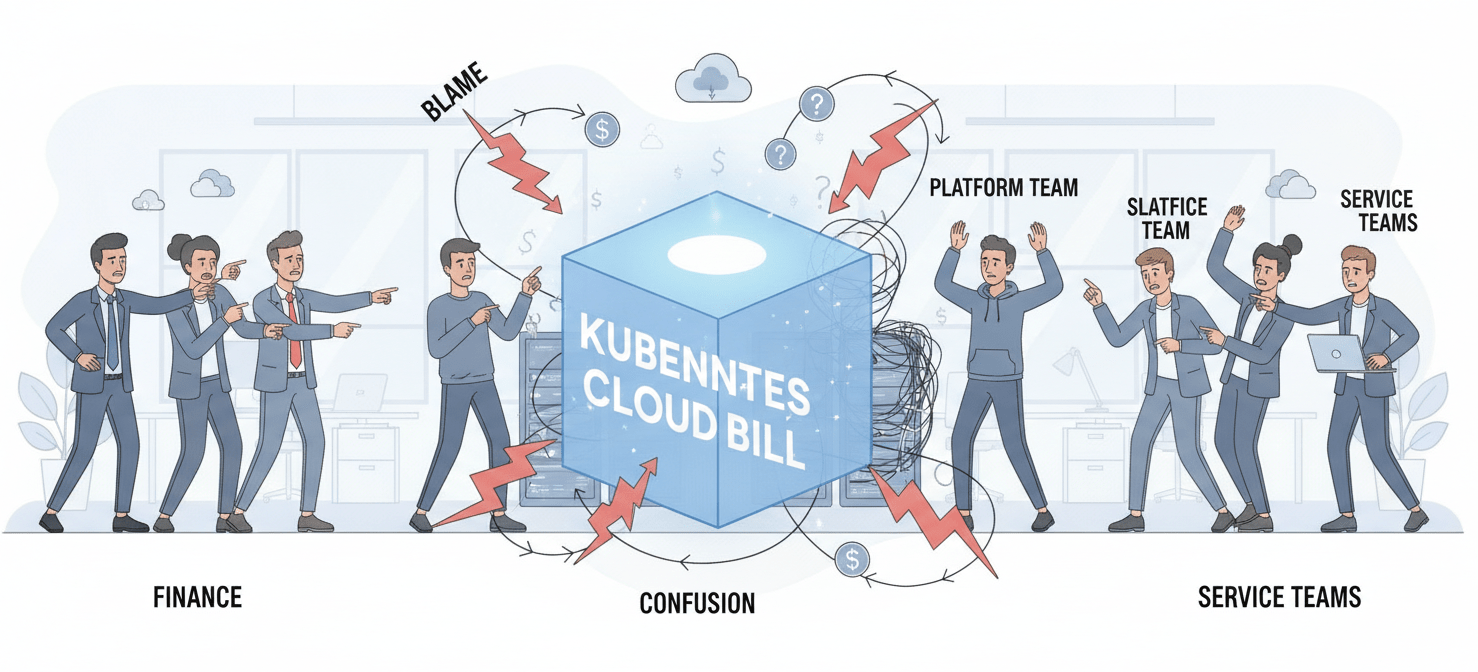
Furthermore, this lack of clarity creates friction. Finance teams see a growing, unpredictable expense. Platform teams are blamed for costs they don’t directly control. Meanwhile, service teams have no incentive to be efficient because they never see the bill for the resources they consume.
This isn’t a technical problem; it’s a process and ownership problem. Solving it requires a framework that makes costs visible, assigns ownership, and empowers teams to make trade-offs between performance, reliability, and cost. It’s about creating a culture of cost-awareness, not just a dashboard.
Step 1: Visibility and Allocation
The foundational step in any governance strategy is visibility. You must be able to break down the shared cluster bill and attribute every dollar of spend to a specific team, application, or business unit. This process, often called cost allocation, is the bedrock of accountability.
From Shared Bill to Team-Specific Insights
Achieving this requires a tool that can map underlying cloud provider costs (like EC2 instances and EBS volumes) to the Kubernetes workloads running on them. Tools like Kubecost or OpenCost can be deployed directly into your clusters to analyze resource consumption and assign costs based on namespace, labels, and other Kubernetes-native concepts. The goal is to move from a single, monolithic bill to a detailed breakdown that shows, for example, that the “payments-api” service in the “production” namespace cost $1,500 last month.
This detailed view allows you to answer critical questions:
- What is our most expensive microservice?
- How much does our staging environment cost versus production?
- Is the cost of a feature proportional to the revenue it generates?
Without this data, any attempt at optimization is just guesswork.
Step 2: Establish Ownership and Accountability
Once you have visibility, the next step is to assign ownership. This is where you transition from a technical exercise to a management process. Each cost line item must have a name next to it—an engineering manager or a team lead who is responsible for that component of the budget.

Showback vs. Chargeback
There are two primary models for establishing this accountability:
-
Showback: In this model, you simply “show” the costs back to the teams that incurred them. It’s an informational process designed to build awareness. You provide dashboards and reports so teams can see their consumption, but the budget remains centralized. For most organizations, this is the right place to start. It builds trust in the data and gives teams time to understand their spending patterns without immediate financial pressure.
-
Chargeback: This is a more formal accounting process where the costs are actually transferred to the business unit’s budget. The team’s cost center is billed for their cloud usage, making it a real line item on their P&L. This creates the highest level of accountability but requires extremely high confidence in your cost allocation data. A premature move to chargeback with inaccurate data can create significant internal friction.
For engineering managers, the goal is to create an engineering team cloud budget. Start with showback. Work with your teams to refine the allocation model until everyone trusts the numbers. This process alone often drives significant optimization as engineers see their resource consumption for the first time.
Step 3: Set Budgets and Alerts
With visibility and ownership in place, you can now move from reactive analysis to proactive management. This means setting clear budgets and automated alerts to prevent cost overruns before they happen.
A budget should be a collaborative process between you, your team leads, and your finance partners. Based on the historical data from your allocation tool, you can set realistic targets for each team or service.
However, a budget without enforcement is merely a suggestion. Therefore, you must implement automated alerts that trigger when spending exceeds a certain threshold or when costs spike unexpectedly. These alerts should be sent directly to the owning team via Slack or another messaging platform. This shortens the feedback loop, allowing engineers to address a potential issue—like a logging loop or an autoscaling misconfiguration—in minutes rather than waiting for a monthly bill review.
Step 4: Optimize Resource Usage
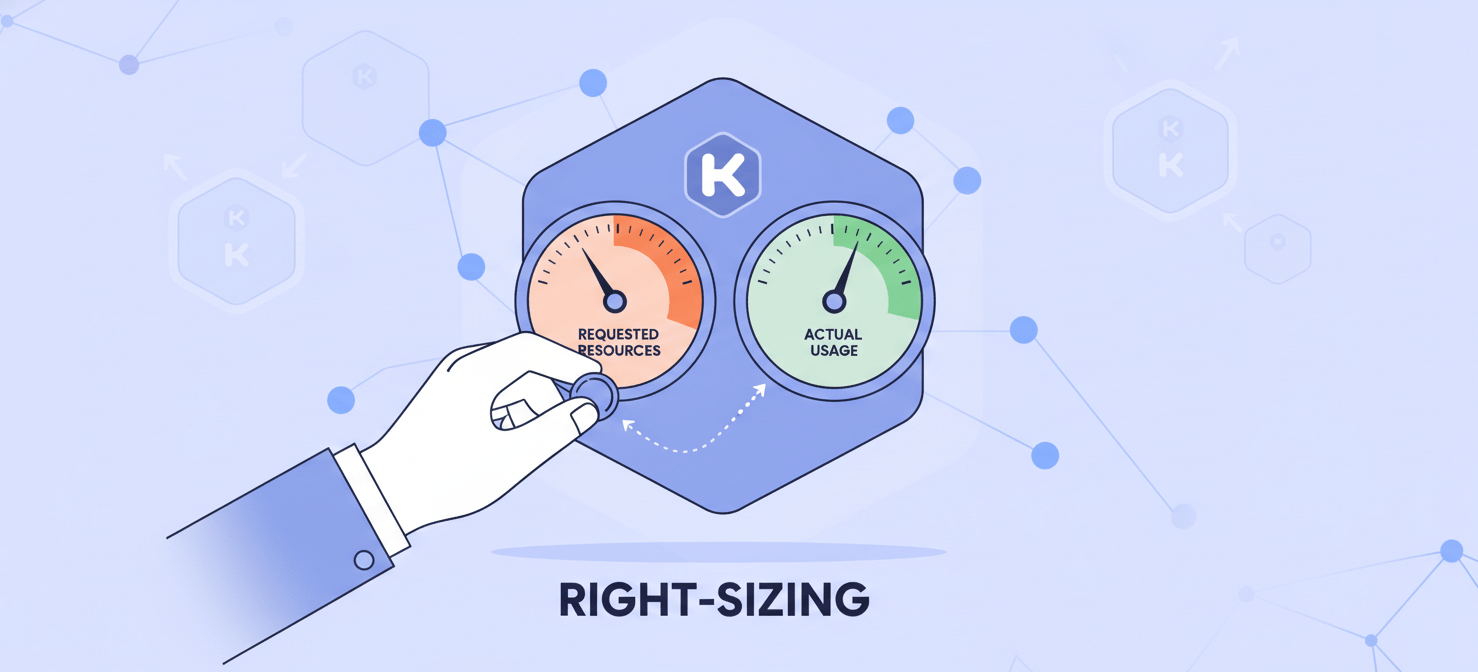
This is where your teams can have the most immediate impact on the bottom line. Most Kubernetes cost waste comes from a mismatch between requested resources and actual usage. Engineers, wanting to ensure reliability, often request far more CPU and memory than their applications need. This practice of “right-sizing” is a critical discipline for cost control.
Tuning Requests and Limits
Every container in Kubernetes can have a resource request (the minimum it needs to run) and a limit (the maximum it’s allowed to consume).
- Over-provisioning requests is the most common form of waste. If a service requests 2 CPU cores but only ever uses 0.5 cores, you are paying for 1.5 cores of idle capacity.
- Setting limits too high can also be problematic, though it’s more of a reliability risk. If a container has a memory leak, a high limit allows it to consume node resources until the node itself becomes unstable.
Your teams should use monitoring tools like Prometheus to analyze the actual historical usage of their pods. Based on this data, they can tune the requests to be closer to the 95th percentile of actual usage, leaving a small buffer for spikes. This ensures pods are scheduled efficiently while dramatically reducing idle resource waste.
Step 5: Implement Kubernetes Cost Governance Policies
The final step is to codify your governance rules into automated policies. This moves your organization from manual review and best-effort right-sizing to a system where cost-efficient practices are enforced by default. This is the core of a mature kubernetes cost governance strategy.
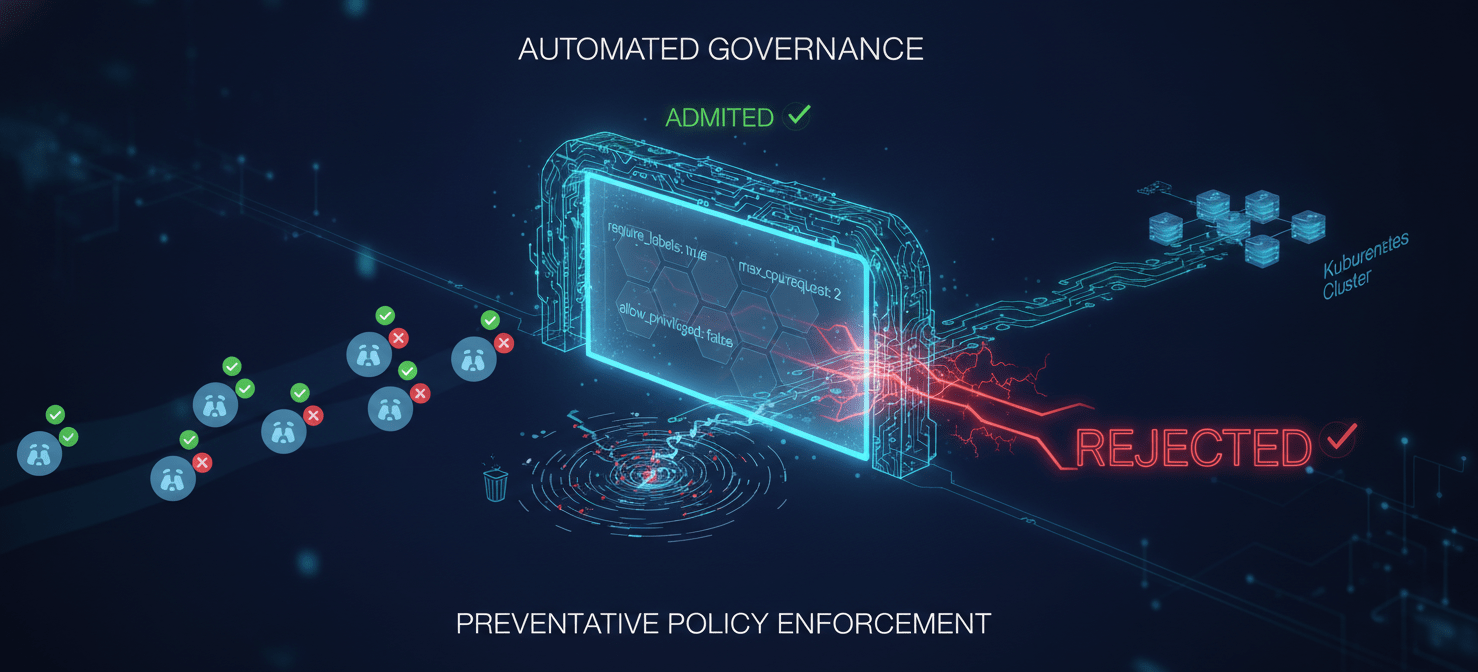
Using policy-as-code tools like Kyverno or OPA Gatekeeper, you can create rules that are automatically enforced at the cluster level. These policies can prevent common sources of waste and enforce your team’s standards for resource management.
Examples of cost governance policies include:
- Requiring resource requests and limits: Reject any new workloads that do not have
requestsandlimitsset. - Mandating ownership labels: Ensure every new namespace or deployment has a
team-ownerlabel. - Setting maximum resource requests: Prevent developers from requesting an excessive amount of CPU or memory that could starve other applications.
By embedding these rules into the CI/CD pipeline or as admission controllers in the cluster, you make cost governance a seamless part of the development workflow, not an extra chore.
Conclusion
Kubernetes doesn’t have to be a blank check written to your cloud provider. As an engineering manager, you can transform it from an opaque cost center into a well-governed, efficient platform. The process begins with visibility—understanding who is spending what. From there, you can establish clear ownership, giving your teams the data and accountability they need to manage their engineering team cloud budget effectively. By systematically right-sizing workloads and embedding your standards into automated policies, you can control costs without stifling innovation. Ultimately, strong kubernetes cost governance isn’t about saving a few dollars; it’s about building a more accountable, data-driven, and operationally excellent engineering culture. The bill is coming either way; it’s better to know who it’s for.
To truly transform your Kubernetes spending into a well-governed, efficient platform, you can create your free Binadox account today or book a demo to see our solutions in action.
 7-day free trial