



The rapid adoption of Large Language Models (LLMs) is creating a new, complex, and often unpredictable category of cloud expenditure. Unlike traditional cloud services, LLM costs are driven by token-based pricing, variable inference loads, and compute-intensive training, making them difficult to forecast and control. As your organization scales its AI initiatives across multiple cloud providers like AWS, Azure, and Google Cloud, managing this spend becomes exponentially more challenging. This is where effective multi cloud cost management tools become essential for maintaining financial governance and maximizing the return on your AI investments.
These specialized platforms offer the visibility and control necessary to track, analyze, and optimize LLM-related costs across your entire cloud estate. Without a dedicated solution, you risk significant budget overruns and an inability to connect AI spending with actual business value. This article explores the top tools designed to bring clarity and control to your multi-cloud LLM spend.
Key takeaways
- LLM costs are unique due to token-based pricing and variable workloads, making traditional cloud cost tools insufficient.
- Effective tools provide unified visibility across all cloud and AI providers, granular cost allocation, and AI-specific optimization recommendations.
- Implementing a robust multi-cloud cost management strategy can reduce LLM inference spending by 50-80% through techniques like model routing and caching.
- The right platform transforms cost data into actionable business insights, connecting every dollar of AI spend to products, features, and customers.
The Unique Challenge of Managing LLM Costs in a Multi-Cloud Environment
Managing cloud costs is already a complex discipline, but the introduction of LLMs adds several new layers of difficulty. Traditional cloud resources often have predictable consumption patterns, whereas LLM operations are highly dynamic and can fluctuate dramatically based on user interaction and model complexity. This unpredictability is a core challenge for FinOps teams.
Why Traditional Cloud Cost Tools Fall Short
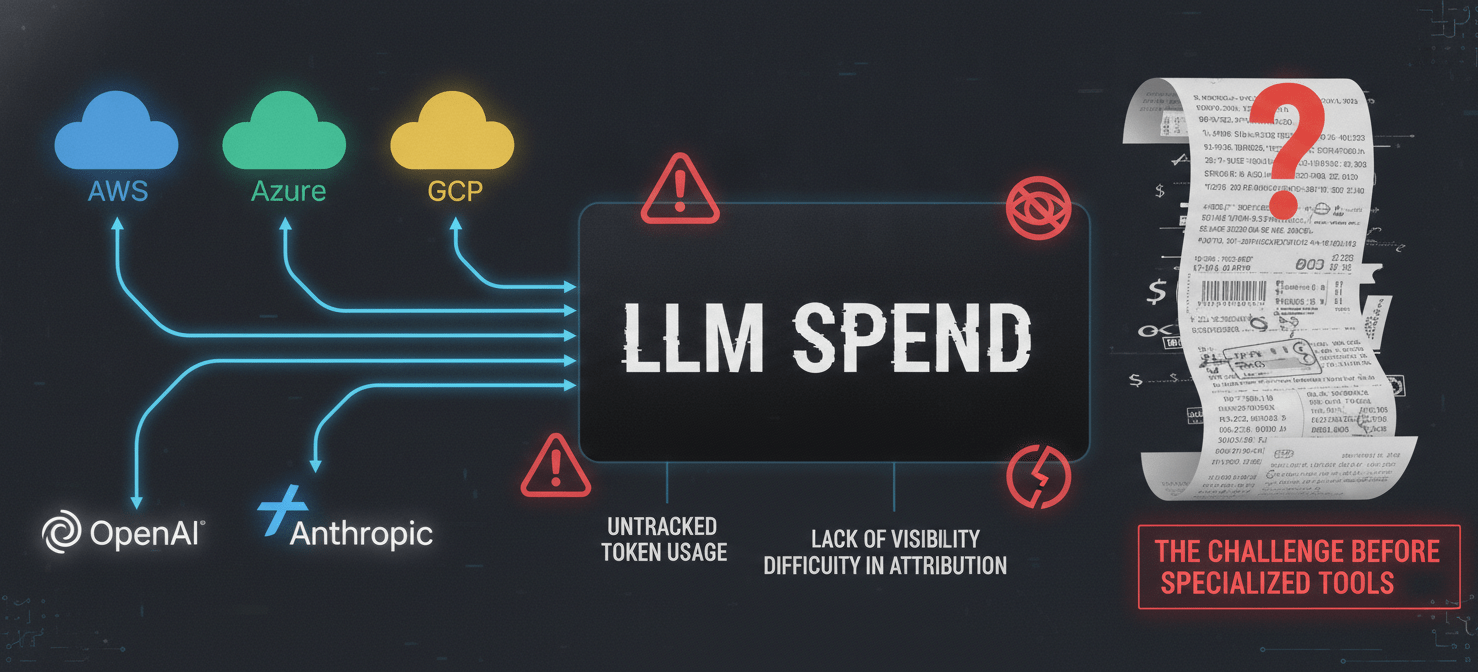
Standard cloud cost management platforms were built to track virtual machines, storage, and databases—resources with relatively stable, time-based pricing. They often struggle with the unique cost structures of AI and LLMs for several reasons:
- Token-Based Pricing: Most LLM providers charge per token processed (both input and output). This is a usage metric that traditional tools are not designed to track or forecast effectively. A long prompt or a verbose model response can significantly increase costs on a per-query basis.
- Lack of Granular Tagging: API-based services from providers like OpenAI or Anthropic do not have the same resource tagging capabilities as IaaS resources like an AWS EC2 instance. This makes it incredibly difficult to allocate costs back to the specific team, project, or feature that incurred them.
- Multi-Provider Complexity: Your teams may use different models from various providers (e.g., OpenAI’s GPT-4, Google’s Gemini, Anthropic’s Claude) alongside models hosted on AWS Bedrock, Azure AI, or Vertex AI. Reconciling and normalizing cost data from these disparate sources is a significant manual effort without a specialized tool.
- Hidden Infrastructure Costs: Beyond the direct API costs, LLM operations consume significant underlying infrastructure, including high-memory GPU instances for training and inference, extensive storage for model weights and datasets, and data transfer fees. A comprehensive view must connect all these cost components.
The “Black Box” of AI Spend
Without the right tools, LLM spending can become a “black box,” where finance and leadership see a rapidly growing bill but have little insight into what is driving it. It becomes impossible to answer critical business questions, such as:
- Which product feature is generating the most AI-related costs?
- What is our cost per customer for AI-powered interactions?
- Is our investment in a more powerful, expensive model yielding a proportional increase in value?
This lack of visibility hampers strategic decision-making and can lead to reactive, across-the-board budget cuts that stifle innovation. Effective multi-cloud cost management platforms are designed to illuminate this black box, providing the clarity needed to manage LLM spend proactively.
Key Features to Look for in Multi-Cloud Cost Management Platforms for LLMs
When evaluating multi-cloud cost management tools to handle your LLM spend, it’s crucial to look beyond standard features. The right platform must address the specific challenges posed by AI workloads. Here are the essential capabilities to prioritize.
Unified Visibility and Cost Ingestion
The foundational feature is the ability to aggregate cost and usage data from every source into a single, unified view. This must include:
- Major Cloud Providers: Full integration with AWS, Azure, and Google Cloud to capture the costs of underlying infrastructure like GPUs and managed AI services (e.g., Amazon SageMaker, Azure Machine Learning).
- Direct AI/LLM Providers: Native connectors for APIs from OpenAI, Anthropic, Cohere, and others. This allows the platform to ingest token-level data directly from the source.
- Data and SaaS Platforms: Integration with platforms often used in AI workflows, such as Snowflake, Databricks, and MongoDB, to provide a complete picture of the total cost of operations.
This unified dashboard prevents the need to manually reconcile different billing formats and provides a single source of truth for all AI-related expenditures.
Granular Cost Allocation and Attribution
Because native tagging is often insufficient for LLM services, a powerful tool must offer advanced allocation capabilities. Look for features like:
- Virtual Tagging: The ability to apply business context and create rules that allocate untaggable or shared costs without requiring engineering teams to change their code.
- Unit Cost Analysis: The platform should help you move beyond total spend and calculate key business metrics, such as cost per customer, cost per feature, or cost per API call. This connects spending directly to business value.
- Showback and Chargeback: Robust reporting that allows you to accurately show or charge back AI costs to the specific departments or business units that consumed them, fostering accountability.
AI-Specific Optimization and Anomaly Detection
A top-tier platform won’t just show you the costs; it will help you reduce them. This requires intelligence that understands the nuances of LLM workloads.
- Model Routing Recommendations: The tool should analyze usage patterns and suggest routing queries to smaller, less expensive models when appropriate. For example, a simple classification task doesn’t require the power (and cost) of a flagship model like GPT-4.
- Prompt and Token Analysis: Some advanced tools can provide insights into prompt efficiency, highlighting opportunities to shorten prompts or limit response lengths to reduce token consumption.
- Anomaly Detection: AI-powered alerting that goes beyond simple budget thresholds. It should be able to detect unexpected spikes in cost per model, per user, or per feature, indicating potential issues like inefficient code or unintended usage.
Forecasting and Budgeting
Given the volatility of LLM costs, accurate forecasting is critical for financial planning. The platform should use historical data and machine learning to predict future spend, allowing you to set realistic budgets. It should also provide real-time budget tracking with alerts to prevent overruns before they happen. This transforms FinOps from a reactive to a proactive discipline.
Top Multi Cloud Cost Management Tools Reviewed
Several platforms have emerged to tackle the unique challenges of managing AI and LLM spend in a multi-cloud world. Here is a review of the top contenders, highlighting their strengths in this specific domain.
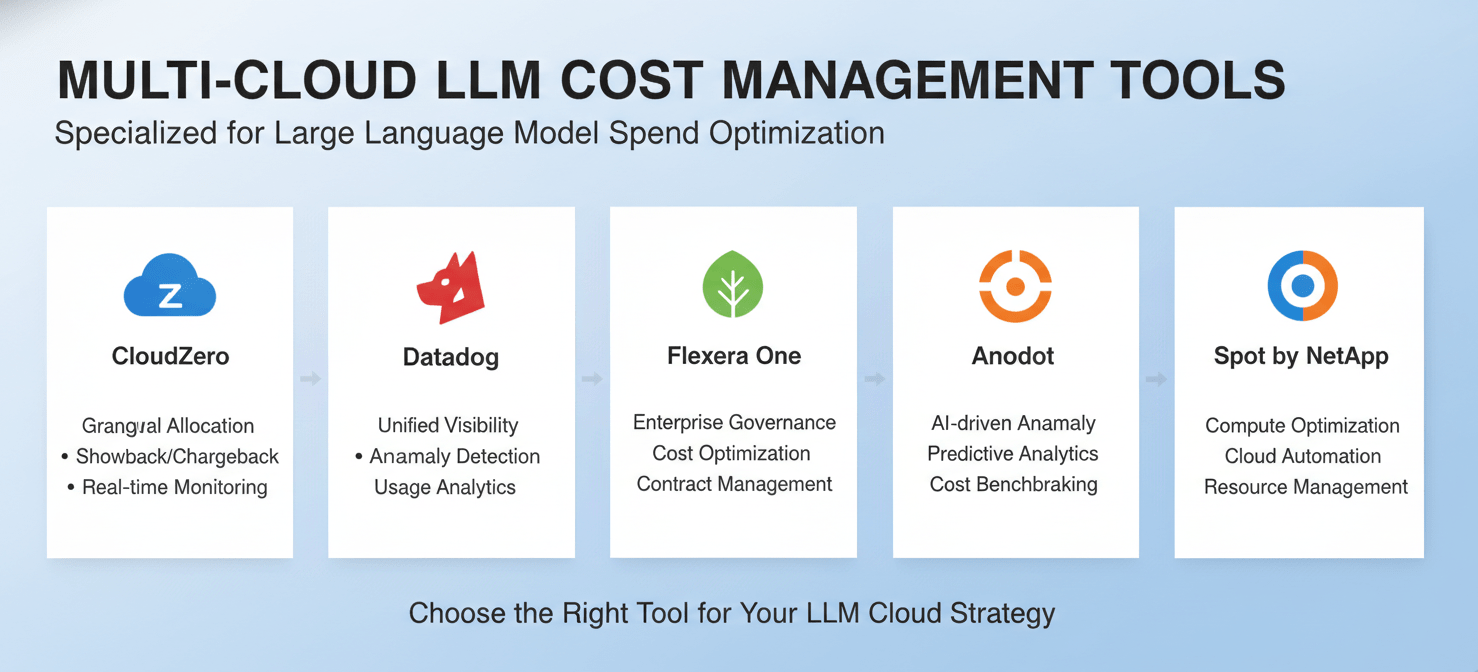
CloudZero
CloudZero is a cloud cost intelligence platform designed to provide granular visibility by mapping costs to business dimensions, such as products, features, and customers. This makes it particularly well-suited for understanding the ROI of AI spend.
- Key Strengths for LLM Spend: CloudZero excels at allocating costs from untaggable sources, a common issue with LLM APIs. Its unit cost telemetry allows you to measure metrics like “cost per AI interaction” or “cost per tenant,” which is crucial for SaaS companies leveraging LLMs. The platform unifies spend from cloud providers, SaaS tools like Snowflake and Databricks, and direct AI providers into a single view.
- Pricing Model: CloudZero’s pricing is typically based on a percentage of your annualized cloud spend, with tiered pricing that offers better rates for higher spending. They emphasize a predictable subscription model without monthly overage charges.
Datadog Cloud Cost Management
Already a leader in observability, Datadog has extended its capabilities into cost management, offering a unified platform to correlate cost data with performance metrics.
- Key Strengths for LLM Spend: Datadog’s “AI Costs” feature provides a centralized view of spend across providers like OpenAI, Anthropic, Amazon Bedrock, and Google Gemini. Its key advantage is the ability to analyze AI spend alongside infrastructure and application performance data. This allows you to see not just what you’re spending, but how that spend impacts latency and user experience. The platform also helps standardize tagging across different AI providers for consistent attribution.
- Pricing Model: Datadog’s pricing is modular and usage-based. Infrastructure monitoring starts at a per-host, per-month fee, while other services like APM and Log Management have their own pricing metrics. Cloud Cost Management pricing is also based on analyzed spend.
Flexera One
Flexera One is a comprehensive IT management platform that includes robust multi-cloud cost optimization capabilities, extending from on-premises environments to the cloud.
- Key Strengths for LLM Spend: Flexera provides strong multi-cloud visibility and automated cost allocation, which is essential for enterprises with complex, decentralized cloud environments. It can ingest and normalize billing data from all major cloud providers, providing a complete view of both direct AI service costs and the underlying infrastructure spend. Its policy-based governance engine can help enforce cost-saving measures automatically.
- Pricing Model: Flexera’s pricing is customized and often based on the number of managed assets or as a percentage of managed cloud spend. They typically engage in enterprise-level contracts rather than offering transparent, self-service pricing.
Anodot
Anodot combines cloud cost management with AI-powered anomaly detection, making it highly effective at identifying unexpected cost spikes in real-time.
- Key Strengths for LLM Spend: Anodot’s core strength is its machine learning-based monitoring. It can automatically learn your normal spending patterns for LLM services and alert you instantly when costs deviate, helping you catch issues like runaway agentic workflows or inefficient queries before they result in a massive bill. It provides a unified platform for all cloud and SaaS spend, including AWS, Azure, and GCP.
- Pricing Model: Anodot’s pricing is customized based on the volume of metrics being monitored and the specific use case. For cloud cost management, pricing can be a flat fee based on tiers of annual cloud spend.
Spot by NetApp
Spot by NetApp focuses heavily on optimizing compute infrastructure, which is a major cost component for organizations that self-host or fine-tune open-source LLMs.
- Key Strengths for LLM Spend: Spot excels at optimizing the cost of GPU instances through the use of spot instances, reserved instances, and savings plans. Its AI-powered engine automates the process of provisioning the most cost-effective compute resources for training and inference workloads without sacrificing performance. This is ideal for teams running LLMs on Kubernetes clusters across multiple clouds.
- Pricing Model: Spot’s pricing is typically a percentage of the savings it generates for you, creating a model where you only pay for the value delivered.
Best Practices for Optimizing LLM Costs with Management Tools
Deploying a powerful tool is only the first step. To truly control your LLM spend, you need to integrate the tool’s capabilities into a broader FinOps strategy. This involves a collaborative effort between finance, engineering, and product teams.
Establish a FinOps Culture for AI
The principles of FinOps—visibility, allocation, and optimization—are more critical than ever in the age of AI. Your goal is to empower engineering teams to make cost-conscious decisions without slowing down innovation.
- Create Visibility: Use your chosen tool to create dashboards that are accessible to everyone. When an engineer can see the cost impact of their code in near real-time, they are more likely to build efficiently.
- Assign Ownership: Every dollar of AI spend should have a clear owner. Use the allocation features of your tool to assign costs to specific teams or projects, making them accountable for their consumption.
- Foster Collaboration: FinOps is a team sport. Schedule regular reviews with stakeholders from finance, engineering, and business units to analyze spending trends, discuss optimization opportunities, and align on budgets.
Implement Technical Optimization Strategies
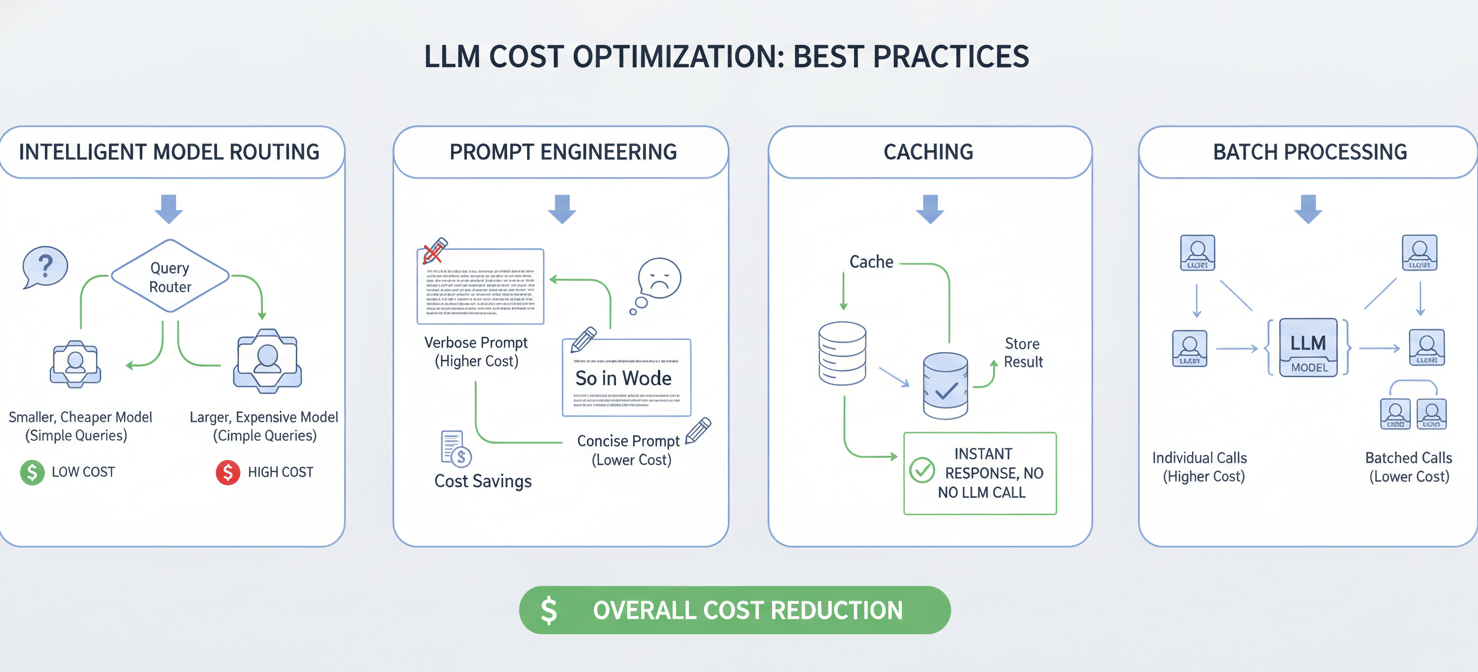
Your multi-cloud cost management platform will identify opportunities, but your engineering team needs to implement the changes. Here are some of the most effective technical strategies:
- Intelligent Model Routing: Not every task requires the most powerful (and expensive) LLM. Use a lightweight classifier to analyze the complexity of a prompt and route it to the most cost-effective model that can handle the task. This single strategy can cut API costs by 40-70%.
- Prompt Engineering and Compression: Be concise. Shorter, more efficient prompts reduce input token counts. Similarly, instruct the model to provide brief, structured responses (like JSON) instead of verbose prose to cut down on output tokens.
- Implement Caching: Many user queries are repetitive. Implementing a semantic caching layer can store the results of common prompts, avoiding redundant API calls. This can lead to savings of over 90% on cache hits for some providers.
- Batch Processing: For non-urgent tasks, take advantage of batching. Many LLM providers offer significant discounts (up to 50%) for processing requests in batches rather than in real-time.
Continuously Monitor and Refine
Cost optimization is not a one-time project; it’s an ongoing process.
- Set Up Proactive Alerts: Use the anomaly detection features in your tool to get immediate notifications of unusual spending. Don’t wait for the end-of-month bill to discover a problem.
- Regularly Review and Adjust: Your usage patterns will evolve as you roll out new AI features. Use the analytics in your platform to regularly review your model mix, caching effectiveness, and routing logic.
- Evaluate Cost-Quality Trade-offs: The cheapest model is not always the best. There is a constant trade-off between cost, latency, and the quality of the model’s response. Use your data to make informed decisions about where to invest in higher-cost models for the best user experience and where to save with more economical alternatives.
The Future of Multi-Cloud Cost Management for AI
As AI becomes more deeply integrated into business operations, the tools for managing its cost will also evolve. We are moving toward a future of more autonomous and intelligent FinOps.

AI-Powered FinOps
The next generation of cost management platforms will use AI to not only identify but also to automate optimization. Imagine a system that can:
- Dynamically adjust model routing in real-time based on traffic patterns and API pricing changes.
- Automatically rewrite inefficient prompts to reduce token consumption without altering the meaning.
- Predict budget overruns with greater accuracy and even suggest specific preventative actions.
These “cost-aware agents” will become essential partners for FinOps teams, handling much of the tactical optimization work and freeing up humans to focus on strategy.
Deeper Integration with Observability
The line between cost management and performance monitoring will continue to blur. To understand the true ROI of AI, you must be able to connect every dollar of spend to its impact on application performance, user engagement, and business outcomes. Future platforms will provide a seamless view that links a spike in API costs to a new feature deployment, a drop in user satisfaction, and a corresponding change in revenue.
A Shift Towards Business Value Metrics
Ultimately, the conversation around cloud costs must shift from “How much are we spending?” to “What value are we getting for our spend?” The most advanced multi cloud cost management tools are already facilitating this shift by focusing on unit economics. As this capability matures, it will become standard practice to measure and report on AI initiatives not in terms of their cost, but in terms of their contribution to margin, revenue, and customer lifetime value. This will enable organizations to invest in AI with confidence, knowing that their spending is directly tied to strategic business growth.
Conclusion
The explosive growth of LLMs has introduced a powerful but expensive new variable into the cloud cost equation. The days of managing this spend with spreadsheets or traditional cloud cost tools are over. The unique, token-based pricing and unpredictable nature of AI workloads demand a new class of specialized multi cloud cost management tools.
These platforms provide the essential trifecta of visibility, allocation, and optimization needed to bring AI spend under control. They unify data from disparate cloud and AI providers, attribute costs to the correct business contexts, and provide actionable recommendations to improve efficiency. By implementing one of these tools and embedding it within a robust FinOps culture, your team can move from reactive cost containment to proactive value creation. The goal is not simply to cut costs, but to ensure that every dollar invested in AI is driving a measurable return. In the end, failing to manage your LLM spend is not just a financial risk; it’s a strategic one that could leave you outmaneuvered by more efficient competitors.
To transform your LLM spend from a financial risk into a strategic advantage, explore how a dedicated multi-cloud cost management platform can help; you can easily start a free trial or book a demo to see its capabilities in action.
 7-day free trial