



For enterprise architects and staff engineers, the choice between serverless and virtual machines is not merely about picking a compute service. It’s a foundational architectural decision with far-reaching implications for cost, operational models, and long-term platform strategy. While both AWS Lambda and EC2 can run application code, they represent fundamentally different approaches to resource management, billing, and total cost of ownership (TCO). Understanding the nuanced financial and operational trade-offs is critical for designing a cost-effective, scalable, and maintainable cloud platform. This serverless vs ec2 cost architecture analysis moves beyond simple price comparisons to evaluate the structural impact of each model on your enterprise.
Key takeaways
- For most API workloads with fewer than 20 million monthly requests, Lambda often proves more cost-effective than even reserved EC2 instances once mandatory components like load balancers and API gateways are factored in.
- Total Cost of Ownership (TCO) for serverless can be 38-57% lower than a comparable server-based model due to significant reductions in development and maintenance overhead.
- EC2 pricing is multifaceted, with options like Savings Plans and Reserved Instances offering up to a 72% discount over On-Demand rates for predictable workloads.
- Serverless adoption shifts operational focus from infrastructure management (patching, scaling) to code and deployment efficiency, directly impacting DevOps team structure and skillsets.
The Illusion of ‘Pay-for-What-You-Use’
The core value proposition of serverless computing, particularly AWS Lambda, is its consumption-based pricing model. You are billed for the number of requests and the duration your code executes, measured in gigabyte-seconds. When your code isn’t running, you pay nothing. This stands in stark contrast to EC2, where you pay for provisioned capacity by the hour or second, regardless of whether the CPU is idle or fully utilized.
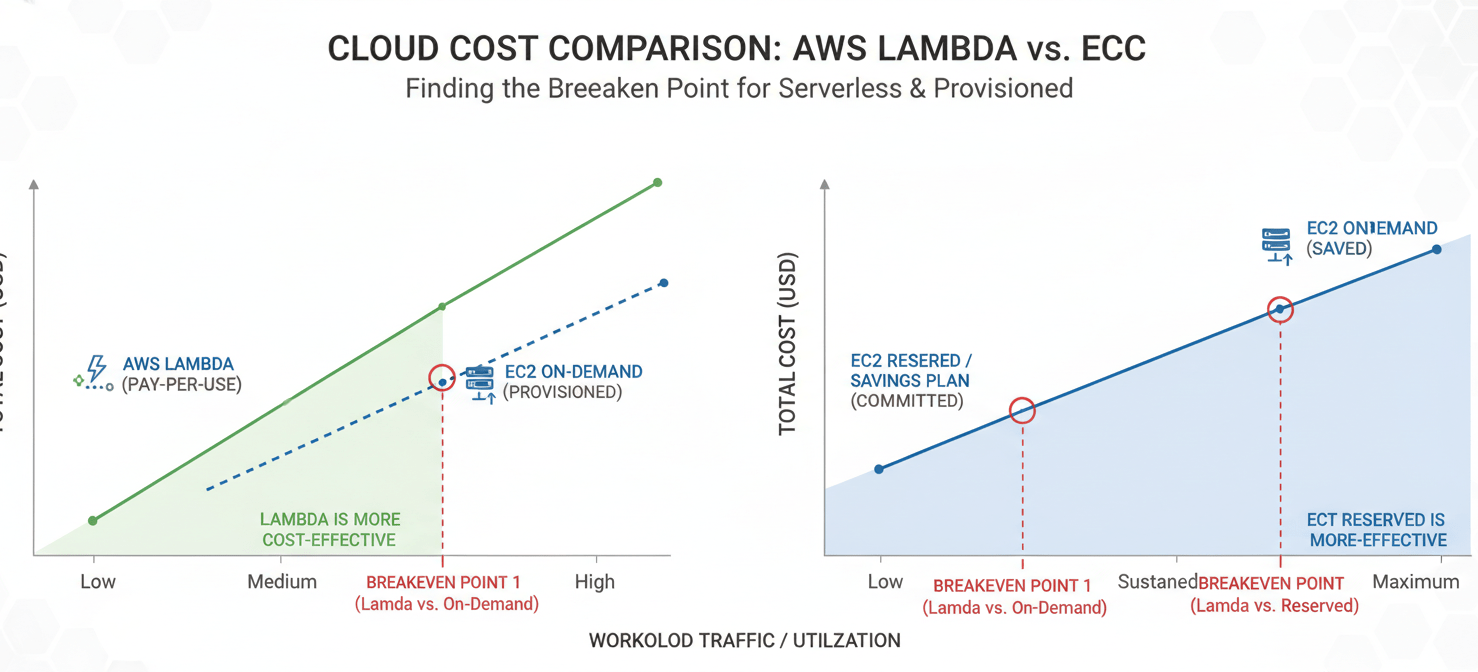
For workloads with intermittent or unpredictable traffic, the serverless model offers clear advantages. An EC2 instance sized for peak traffic will sit idle much of the time, incurring costs without delivering value. However, for sustained, high-volume traffic, the economics can invert. The per-request and duration-based premium of Lambda can exceed the cost of a right-sized, continuously running EC2 instance.
Deconstructing the Pricing Models
- AWS Lambda: The cost is a combination of two primary metrics: requests and duration. AWS charges a flat fee per million requests (e.g., $0.20) and a fee per GB-second of compute time. This model is highly efficient for spiky workloads but can become expensive for long-running, compute-intensive tasks.
- Amazon EC2: The pricing is based on instance uptime. The model you choose has a significant impact on cost.
- On-Demand: The most flexible and most expensive option, ideal for unpredictable workloads without long-term commitments.
- Savings Plans & Reserved Instances: These offer substantial discounts (up to 72%) in exchange for a one- or three-year commitment to a certain level of usage. This is the most cost-effective approach for stable, predictable applications.
- Spot Instances: Leveraging spare AWS capacity, Spot Instances can provide discounts of up to 90% but can be terminated with little notice, making them suitable only for fault-tolerant, interruptible workloads.
The breakeven point is often higher than simple calculations suggest. A fair comparison must include the cost of an Application Load Balancer for EC2 and an API Gateway for Lambda, which can significantly alter the equation.
Total Cost of Ownership: Beyond the Sticker Price
A pure infrastructure cost comparison provides an incomplete picture. As an enterprise architect, your analysis must extend to the Total Cost of Ownership (TCO), which encompasses infrastructure, development, and ongoing maintenance costs. It is here that the serverless vs ec2 cost architecture analysis reveals its most significant differences.
Operational Overhead and “Hidden” Costs
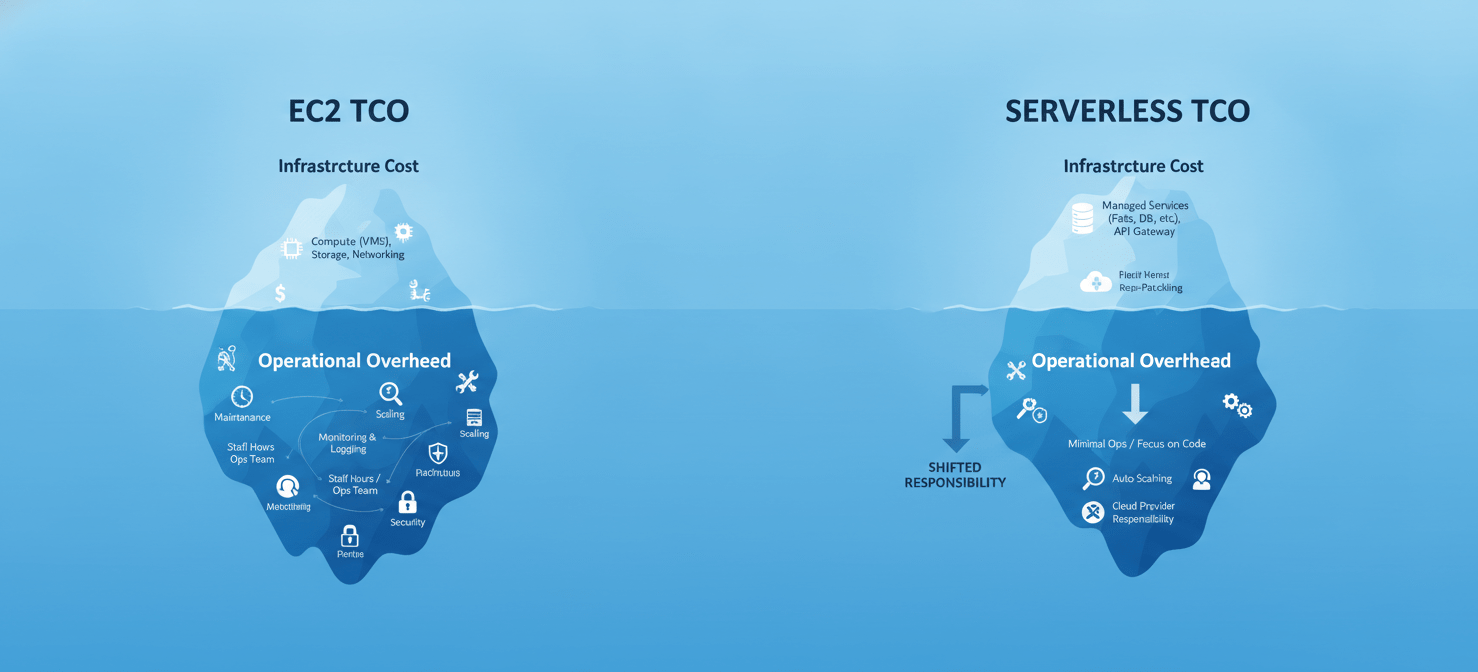
EC2 instances require active management. Your teams are responsible for:
- Operating system patching and security updates.
- Configuring and managing auto-scaling groups.
- Right-sizing instances to match workload demands.
- Monitoring for health, performance, and security vulnerabilities.
This operational burden translates directly to staff hours and, therefore, cost. Serverless abstracts away this entire layer of infrastructure management. The cloud provider handles patching, scaling, and server maintenance, freeing your platform and DevOps teams to focus on application logic and business value instead of infrastructure upkeep. This reduction in operational overhead is a primary driver of the lower TCO often seen in serverless adoption.
However, serverless introduces its own set of “hidden” costs and complexities:
- Logging and Monitoring: While services like CloudWatch are integrated, high-volume logging can become a significant expense, with costs for ingestion, storage, and querying.
- Networking: Functions requiring access to resources within a VPC can incur additional costs for NAT gateways or VPC endpoints.
- Distributed Complexity: Debugging and tracing requests across multiple serverless functions and managed services can be more complex than troubleshooting a monolithic application on a single EC2 instance.
Architectural Impact on Headcount and Skillsets
The choice between serverless and EC2 is not just a technical decision; it’s an organizational one. It directly influences the structure of your DevOps and platform engineering teams and the skills they need to succeed.
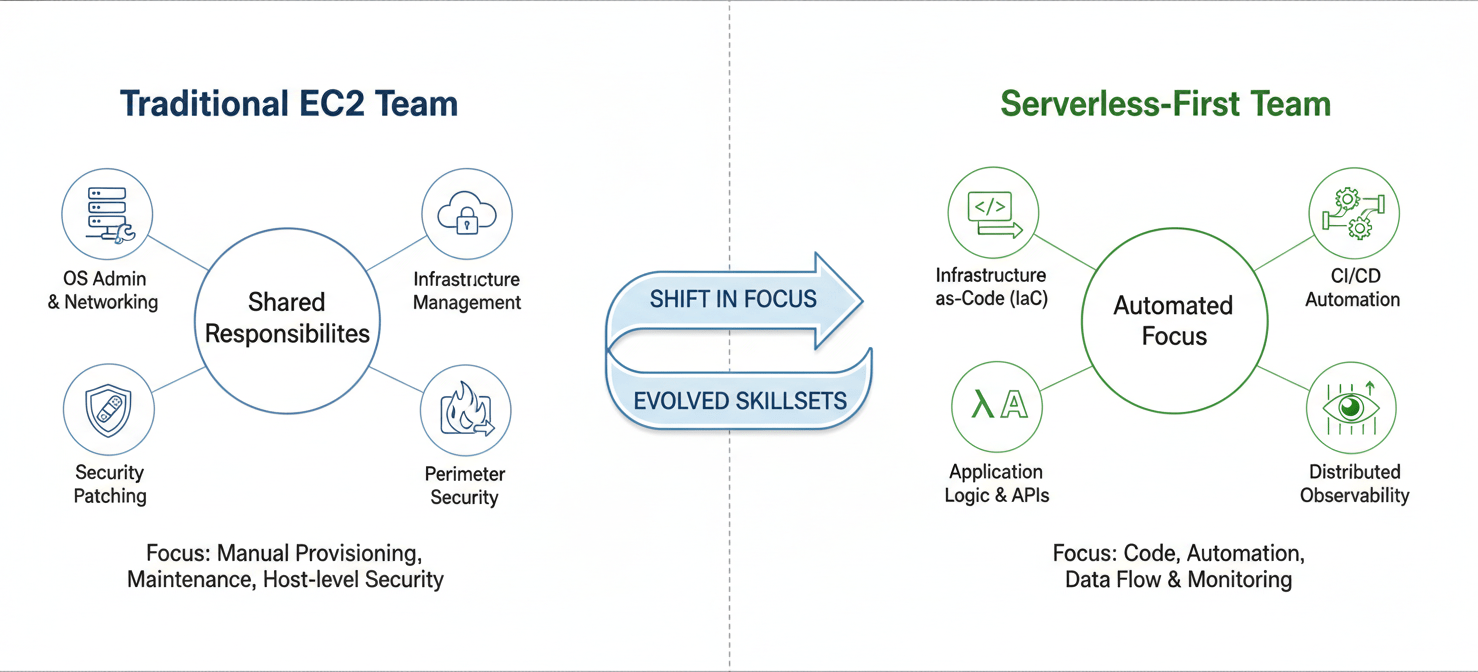
A traditional EC2-based environment necessitates a team with deep expertise in infrastructure management, network configuration, security hardening, and OS-level administration. The focus is on maintaining the health and availability of the underlying virtual servers.
Conversely, a serverless-first strategy shifts the focus dramatically. With the infrastructure managed by the provider, the operational burden is significantly reduced. This allows teams to concentrate on higher-value activities like improving deployment pipelines, automating business logic, and optimizing application performance. The required skillset moves from systems administration towards proficiency in Infrastructure-as-Code (IaaC), CI/CD automation, and application-level monitoring. This can lead to smaller, more agile teams that can deliver features faster.
This shift doesn’t eliminate the need for operational expertise but reframes it. Instead of managing servers, the team manages service configurations, IAM policies, and the intricate dependencies of a distributed system.
Performance as a Cost-Driver: Latency and Throughput
In any system, performance is a feature, but in cloud architecture, it’s also a direct cost lever. Latency and throughput characteristics of serverless and EC2 models have distinct financial implications.
The Cold Start Problem
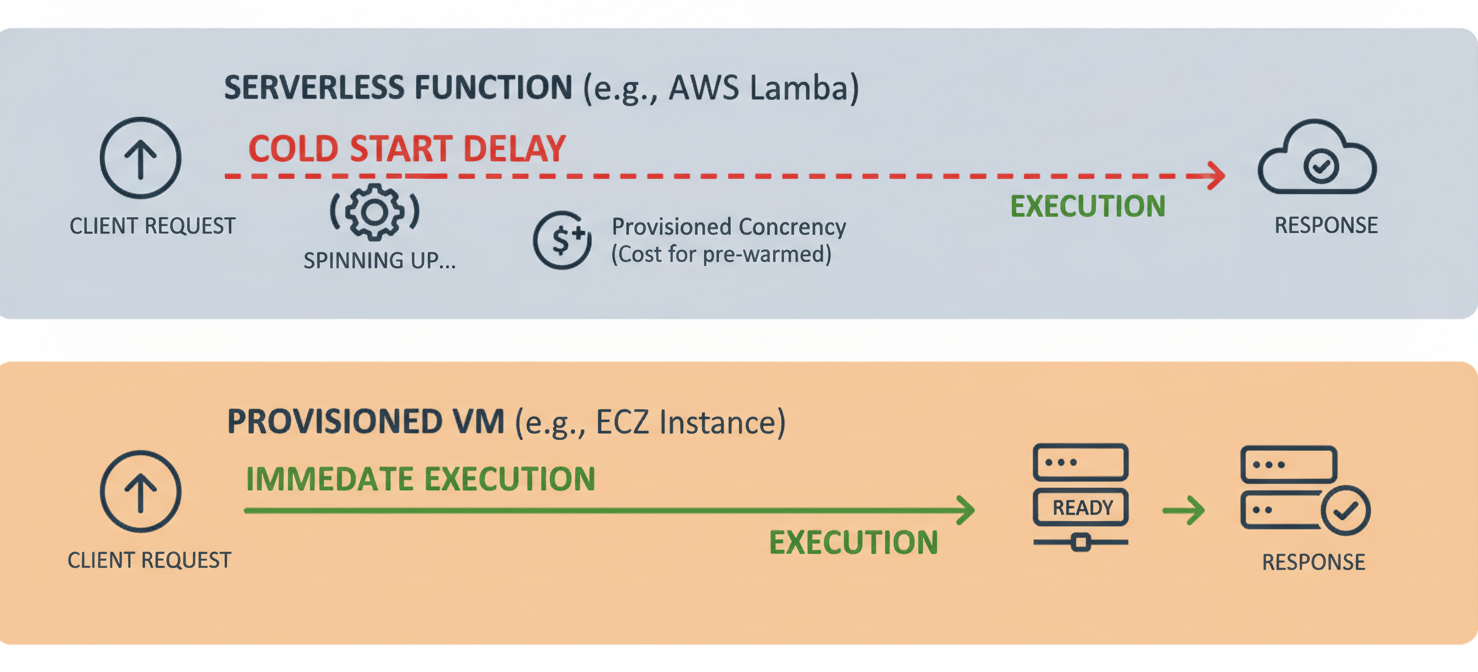
For serverless functions, the most discussed performance characteristic is the “cold start.” This is the latency incurred when a new execution environment must be created to serve a request. While often affecting less than 1% of invocations in typical workloads, this added latency can be unacceptable for user-facing APIs with strict performance SLAs.
Mitigating cold starts involves strategies that carry their own costs:
- Provisioned Concurrency: This feature keeps a specified number of function environments pre-warmed and ready to execute, eliminating cold starts at the cost of paying for provisioned capacity. However, enabling it broadly can be prohibitively expensive.
- Memory Allocation: Increasing a function’s allocated memory also increases its CPU power, which can reduce initialization time. This requires careful tuning to find the optimal balance between performance and cost.
EC2 Performance and Right-Sizing
With EC2, performance is a matter of provisioning. You select an instance type from a vast menu optimized for general purpose, compute, memory, or storage-intensive workloads. The primary challenge and cost-driver is “right-sizing”—continuously matching the instance capacity to the workload’s actual demand.
Overprovisioning leads to wasted spend, while underprovisioning results in poor performance and potential service degradation. This is an ongoing optimization task that requires robust monitoring and analysis. Furthermore, newer generation instances, particularly those based on AWS Graviton processors, can offer significantly better price-performance, making instance selection a critical and recurring cost optimization activity.
Standardization vs. Specialization in a Multi-Cloud World
For an enterprise architect, technology choices must align with the broader strategy for vendor consolidation, standardization, and potential multi-cloud postures.
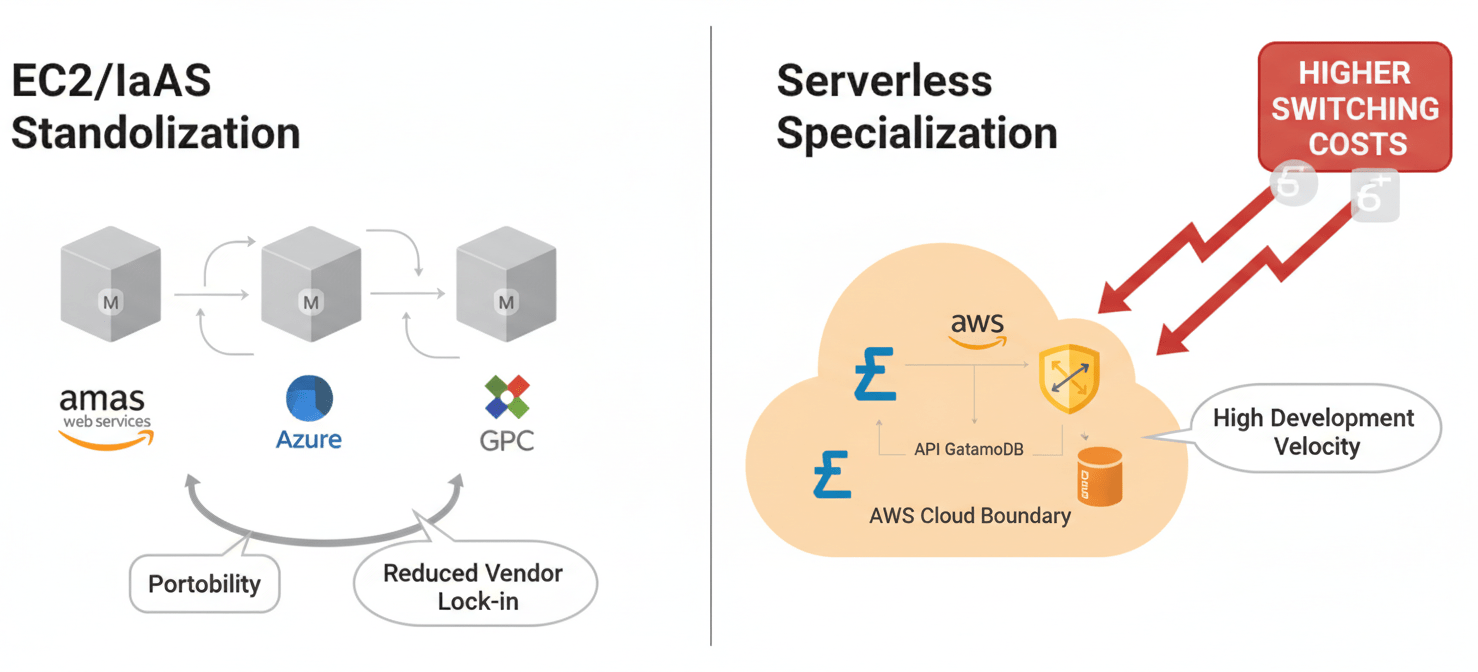
EC2, representing the Infrastructure-as-a-Service (IaaS) model, offers a more standardized, vendor-agnostic primitive. A virtual machine is a universal concept. An application architected to run on EC2 can, with some effort, be migrated to Azure VMs or Google Compute Engine. This portability can be a strategic advantage, reducing vendor lock-in and providing leverage in negotiations.
Serverless functions, on the other hand, are a higher-level abstraction deeply integrated into the provider’s ecosystem. AWS Lambda is tightly coupled with services like API Gateway, IAM, and DynamoDB. While this integration provides significant development velocity, it also increases switching costs. Migrating a complex serverless application from AWS to another cloud provider is a non-trivial undertaking.
Therefore, the decision involves a strategic trade-off. Do you prioritize the operational efficiency and development speed of a deeply integrated serverless platform, accepting the higher vendor dependency? Or do you standardize on the more portable, but operationally intensive, IaaS model to maintain maximum flexibility in a multi-cloud landscape?
Conclusion
The debate over Serverless vs. EC2 is not about which is “cheaper” in a vacuum. It is a question of which cost architecture best aligns with your workload characteristics, operational model, and strategic goals. For workloads that are spiky, event-driven, or in early stages of development, the serverless model’s elimination of idle capacity costs and operational overhead is compelling. For stable, high-traffic applications where performance is paramount and usage is predictable, a right-sized EC2 fleet with Savings Plans can offer a lower infrastructure bill.
Ultimately, the most effective enterprise platforms will not be exclusively one or the other. They will be hybrid environments where workloads are placed intelligently. The critical task for the enterprise architect is to look beyond the per-hour instance price and the per-millisecond function cost. You must analyze the total cost of ownership, the impact on team structure, and the long-term strategic implications. A successful serverless vs ec2 cost architecture analysis doesn’t yield a single winner; it produces a framework for making informed, deliberate decisions that balance cost, agility, and control for each component of your enterprise portfolio. The goal isn’t just to save money, but to invest it where it generates the most value—and avoiding a 2 a.m. patching emergency is a form of value that is hard to quantify but easy to appreciate.
To effectively implement a cost-optimized cloud strategy, consider how Binadox can streamline your operations by starting a free trial, or for a deeper dive into tailored solutions, you can book a personalized demo.
 7-day free trial