



Your AI feature is live, and the initial user feedback is promising. However, a new line item on your burn-down chart is growing faster than your user base: the API bill from your LLM provider. For a founder or CTO, every dollar counts, and an unmanaged AI spend can shorten your runway alarmingly. Effective startup LLM cost control isn’t about avoiding AI; it’s about implementing it smartly and sustainably. This means shifting focus from simply shipping a feature to managing its unit economics with the same rigor you apply to cloud hosting or payroll.
Key takeaways:
- Choosing a smaller, faster model for 80% of your queries can cut costs by over 90% compared to using the most powerful model for everything.
- Implementing a simple caching layer can eliminate 20-30% of redundant API calls, directly reducing your monthly bill.
- Calculate your Cost Per User (CPU) for your AI feature before scaling to ensure the feature’s economics are viable for your business model.
The Unit Economics of Your AI Feature
Before you can control costs, you must understand them. An LLM-powered feature is not a one-time engineering expense; it’s an ongoing operational cost that scales with usage. Therefore, you need to determine the unit economics of each AI interaction. Your goal is to calculate the Cost Per Query (CPQ) or, even better, the Cost Per Active User (CPAU) for your feature.
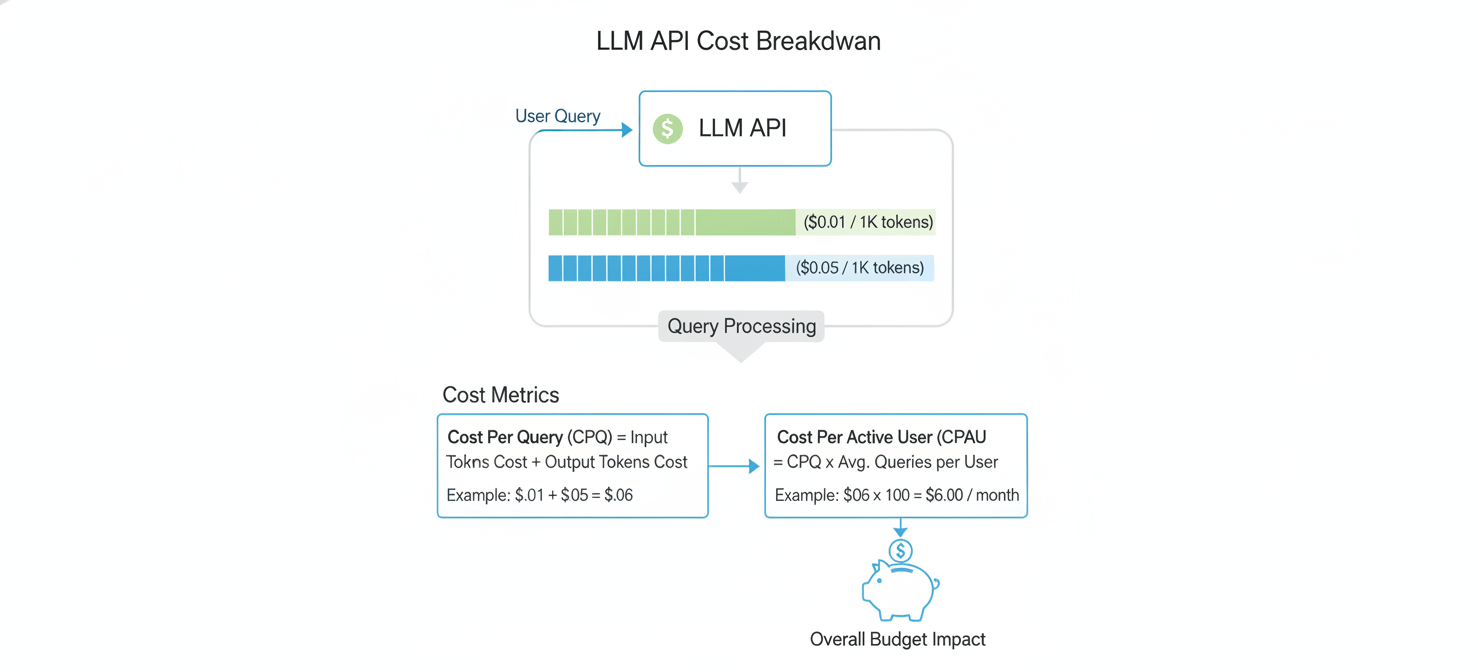
First, break down the cost of a single API call. Providers like OpenAI and Anthropic price their models based on the number of tokens processed, separating costs for input (the prompt you send) and output (the model’s response). For example, as of early 2024, OpenAI’s GPT-4o costs $5.00 per million input tokens and $15.00 per million output tokens. In contrast, Anthropic’s Claude 3 Haiku is significantly cheaper at $0.25 per million input tokens and $1.25 per million output tokens.
Calculating Your Cost Per Query
To calculate your CPQ, you need to analyze your average usage.
- Average Input Tokens: How long are the prompts your application sends?
- Average Output Tokens: How long are the typical responses you receive?
Let’s say your feature summarizes articles. Your average input is 3,000 tokens, and the average output summary is 500 tokens.
-
Using GPT-4o:
- Input cost: (3,000 / 1,000,000) * $5.00 = $0.015
- Output cost: (500 / 1,000,000) * $15.00 = $0.0075
- Total CPQ: $0.0225
-
Using Claude 3 Haiku:
- Input cost: (3,000 / 1,000,000) * $0.25 = $0.00075
- Output cost: (500 / 1,000,000) * $1.25 = $0.000625
- Total CPQ: $0.001375
This simple calculation reveals a greater than 16x cost difference. Once you have your CPQ, you can multiply it by the average number of queries per user per month to understand the feature’s direct impact on your runway.
Your First Line of Defense: Prompt Engineering & Model Choice
The most immediate and impactful way to manage LLM costs is by optimizing what you send to the API and which API you send it to. This is the core of lean AI development. Your engineering team’s instinct might be to use the largest, most capable model for everything to ensure the best results. However, this is often overkill and a significant cost driver.
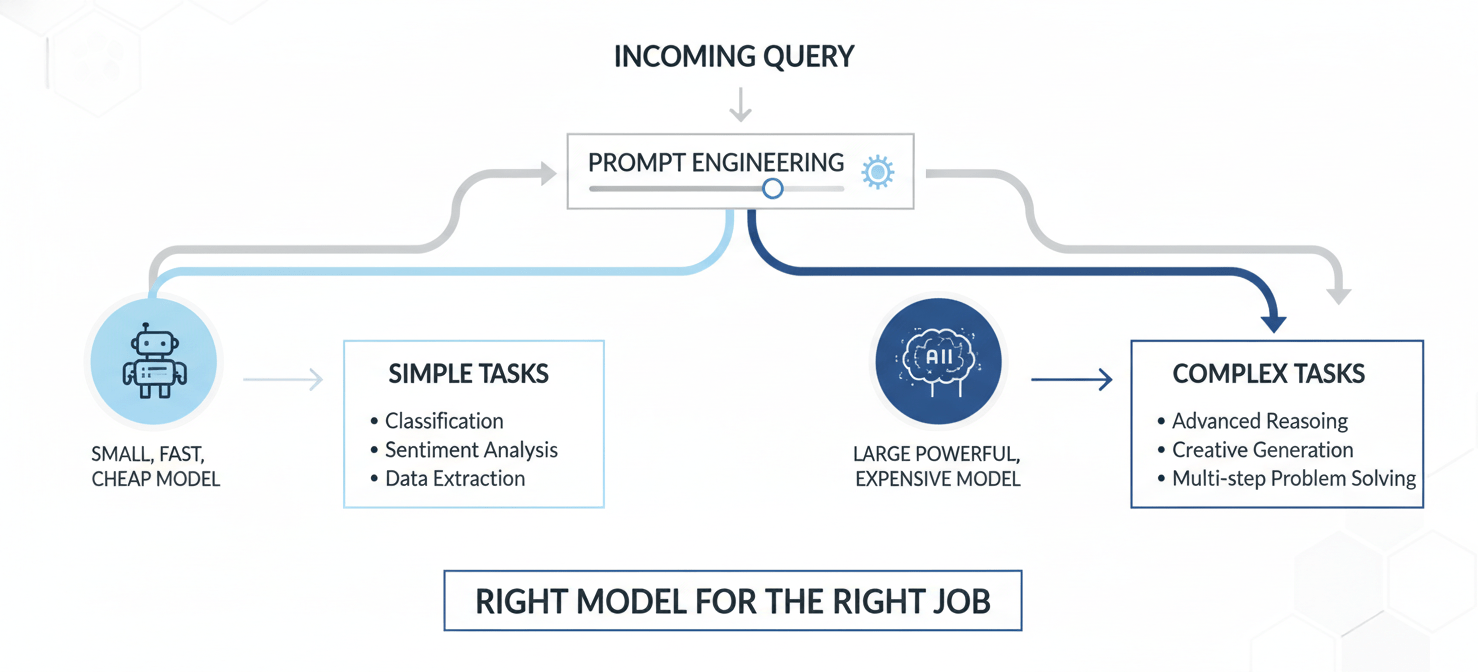
Instead, create a model routing strategy. Not all tasks require the reasoning power of a frontier model like GPT-4o.
- For simple classification, sentiment analysis, or data extraction, a much cheaper and faster model like Claude 3 Haiku or GPT-3.5 Turbo is often sufficient.
- Reserve the expensive, high-power models for the complex, high-value tasks that truly require their advanced reasoning capabilities.
Furthermore, prompt engineering is a critical lever for cost control. Shorter prompts mean fewer input tokens, which directly translates to lower costs. Your team should focus on making prompts as concise as possible without sacrificing output quality. Techniques like providing few-shot examples within the prompt can often guide a smaller model to produce the same quality output as a larger model that is given a less-specific prompt. In addition, explicitly instructing the model to be brief in its response can curtail verbose outputs and reduce output token costs.
Caching and Rate Limiting: Your Next Best Friends
Many of your users will likely ask similar or identical questions. Sending the same query to an LLM API repeatedly is like burning cash. The solution is to implement a caching layer.
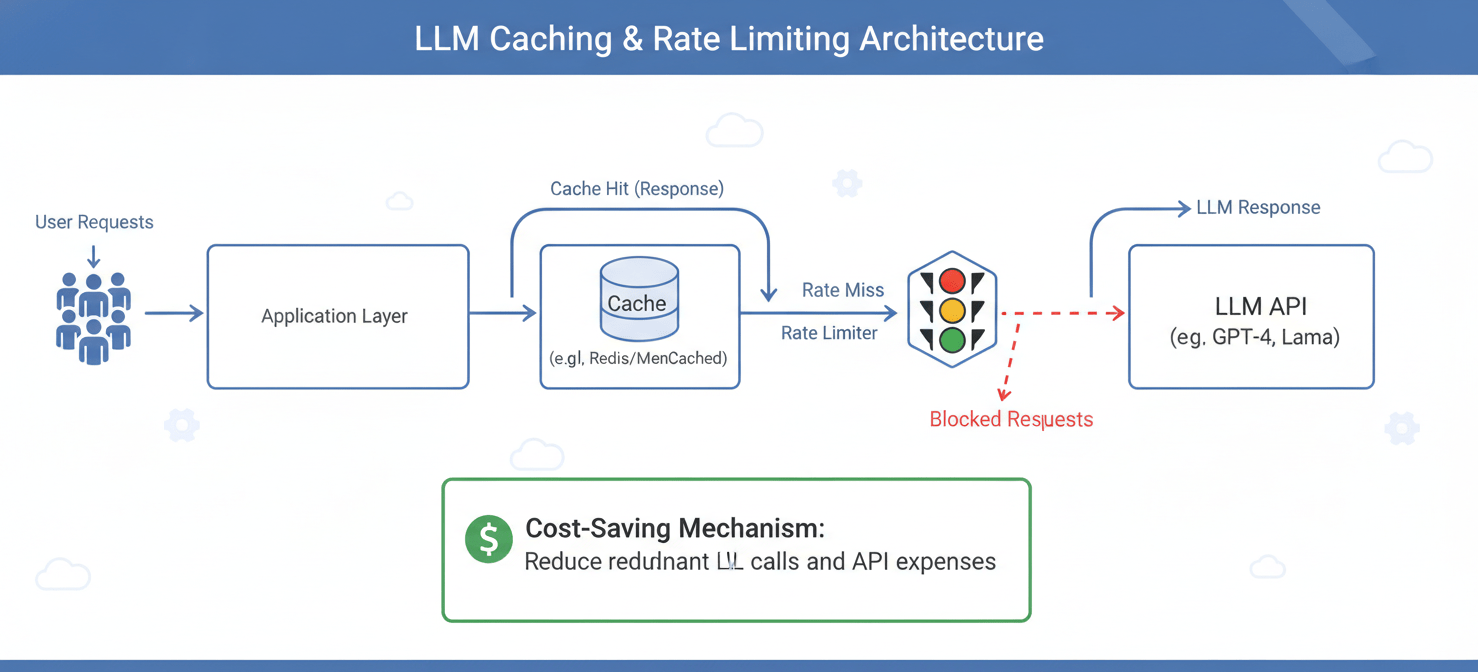
A simple key-value store like Redis can be used to store the results of common queries. Before making an API call, your system should first check if an identical prompt already exists in the cache. If it does, you can serve the stored response instantly, completely avoiding the API cost and reducing latency for the user. This strategy is particularly effective for features with a high volume of repetitive requests, such as a customer support chatbot answering frequently asked questions.
In addition, you must protect your runway from unexpected usage spikes. A feature going viral or a misbehaving script could empty your API budget in hours. Rate limiting is essential. You can implement limits on several levels:
- Per-User: Limit each user to a certain number of queries per minute, hour, or day.
- Per-IP Address: This can help mitigate abuse from automated scripts.
- Global: Set a global budget cap with your cloud or API provider to prevent total spend from exceeding a predefined threshold.
These controls act as a financial circuit breaker, giving you time to react to a problem before it drains your resources.
When to Fine-Tune vs. When to Use RAG
As your application matures, you’ll want to improve the model’s performance on your specific domain. The two primary methods for this are fine-tuning and Retrieval-Augmented Generation (RAG).
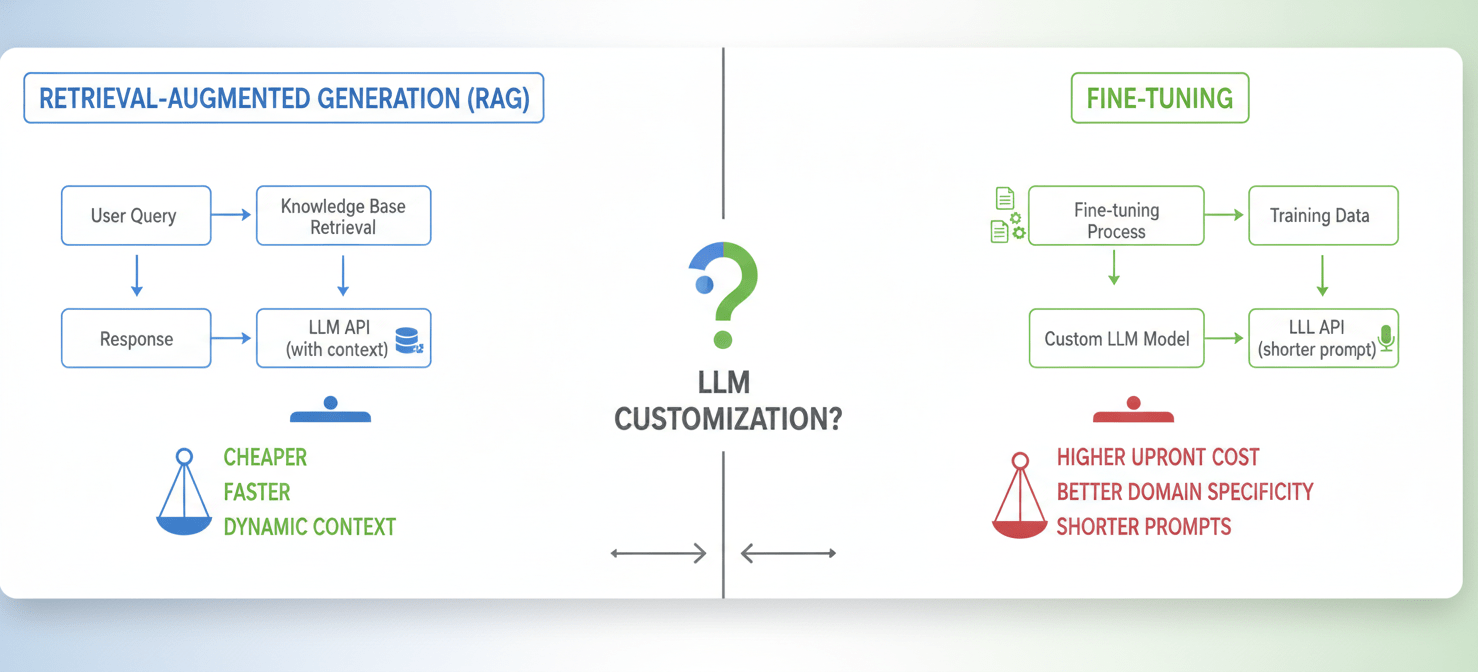
Retrieval-Augmented Generation (RAG) is often the better starting point for startups. With RAG, you retrieve relevant documents or data from your own knowledge base and include them in the prompt as context for the LLM. This allows the model to answer questions based on your proprietary data without needing to be retrained. The primary cost is the increased input token count from adding the context. However, it’s generally cheaper and faster to implement than fine-tuning.
Fine-tuning involves training a base model on your own dataset to create a new, custom model. This can lead to higher quality results and allow you to use shorter prompts, as the model has already learned your specific domain. OpenAI, for example, offers fine-tuning for models like GPT-3.5-Turbo-0125. The downside is the upfront cost of the training process itself, which is billed based on the number of tokens in your training file and the number of epochs. For a startup, the ROI of fine-tuning must be carefully evaluated. It makes sense only when RAG is not providing sufficient quality and the feature is core to your product’s value proposition.
The Self-Hosting vs. API Tradeoff for Startup LLM Cost Control
The allure of open-source models and self-hosting is strong. It promises an escape from per-token API pricing and greater control over your AI stack. However, this path comes with its own significant, and often hidden, costs. This is a critical decision for startup LLM cost control.
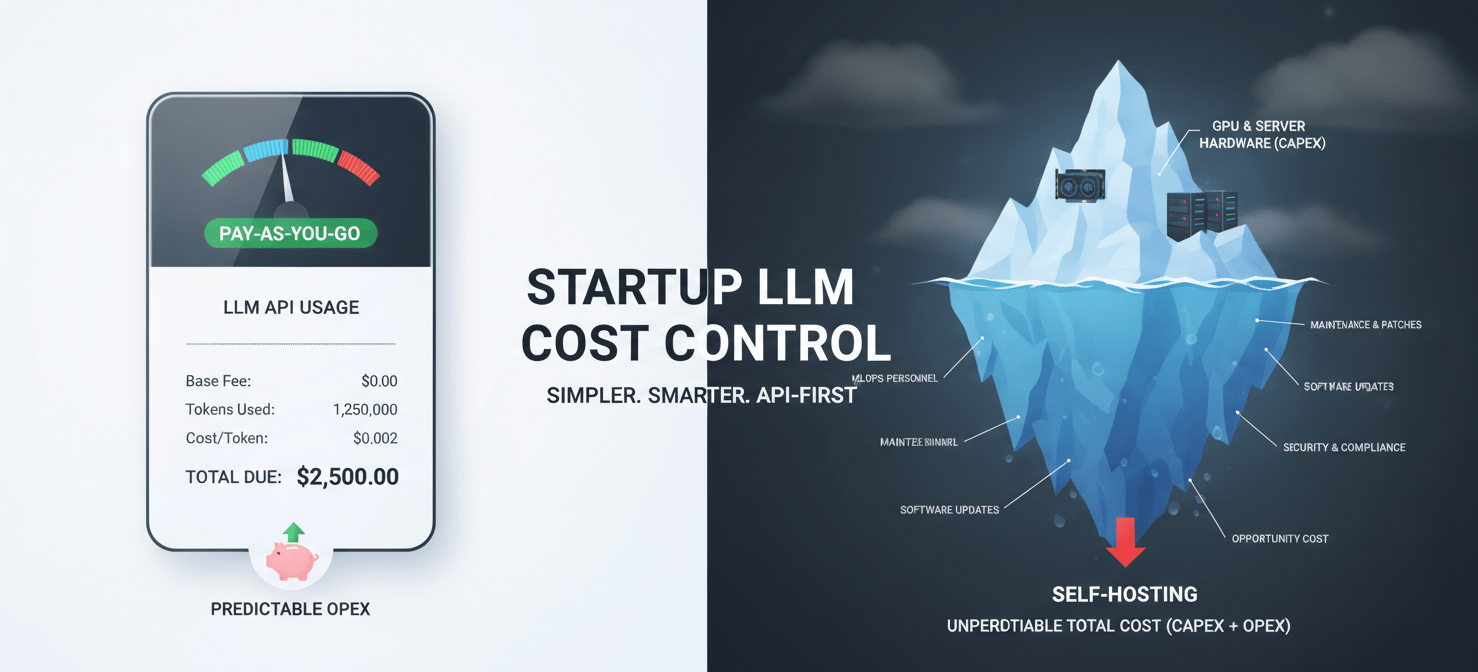
Using a third-party API (like from OpenAI, Anthropic, or Google) means you are paying for a fully managed service. The cost is predictable and scales with usage. You have no infrastructure to manage, no models to update, and no GPUs to provision. This is an operational expense (OpEx) model.
Self-hosting an open-source model like Llama 3 or Mistral means you are responsible for everything.
- Infrastructure Costs: High-end GPUs are expensive to rent or buy.
- Personnel Costs: You need engineers with specialized MLOps skills to deploy, scale, and maintain these models. This is a significant recurring salary cost.
- Operational Overhead: Your team will spend time on maintenance, updates, and troubleshooting instead of building your core product.
For most early-stage startups, the total cost of ownership (TCO) for self-hosting is significantly higher than using a commercial API. The API route allows you to stay lean, focus your engineering talent on your product, and maintain a predictable cost structure. Self-hosting should only be considered when your scale is massive and the per-token API costs demonstrably exceed the TCO of a dedicated MLOps team and infrastructure.
In conclusion, managing OpenAI costs or any other LLM provider bill is not a dark art; it is a matter of disciplined engineering and financial planning. By calculating your unit economics, choosing the right model for each task, implementing caching, and making a deliberate choice between RAG and fine-tuning, you can keep your AI spend under control. The goal is not to spend less on AI, but to spend it more effectively. For a startup, every dollar saved on an unnecessary API call is another dollar added to your runway, giving you more time to build, grow, and win. Proactive startup LLM cost control ensures that your innovative features are a source of growth, not a threat to your survival.
For startups aiming to master LLM cost control and extend their runway, Binadox offers the tools for comprehensive visibility and management; you can book a demo to explore its capabilities firsthand.
 7-day free trial