



Large Language Models (LLMs) are becoming integral to products across every industry, but this rapid adoption introduces a significant operational challenge: runaway costs. When multiple teams use different models from various providers like OpenAI, Anthropic, and Google, understanding your total spend becomes nearly impossible. The provider’s monthly invoice tells you what you spent, but not why. This guide provides a clear, five-step framework to help you track LLM costs across platforms and gain control over your AI budget.
Key takeaways
- Centralize Control: Route all LLM API calls through a single gateway to enforce policies and monitor usage from one place.
- Tag Everything: A standardized metadata and tagging strategy is crucial for attributing costs back to specific teams, features, or customers.
- Unify Your View: Use a dedicated dashboard to consolidate spending data from all providers, offering a single source of truth for LLM cost tracking.
- Enforce Budgets: Implement hard and soft budget limits with automated alerts to prevent unexpected overages before they happen.
Why Is It So Hard to Track LLM Costs?
Tracking LLM expenses is fundamentally different from managing traditional cloud infrastructure costs. The primary challenge is the pricing model itself. Providers bill based on tokens—units of text processed—and costs can vary dramatically depending on the model used, the number of input tokens (context), and the number of output tokens (response). A single API call can range from a fraction of a cent to several dollars.
This complexity is magnified when different teams independently integrate with various LLM providers. One team might use OpenAI’s GPT-4o for a customer-facing chatbot, while another experiments with Anthropic’s Claude for internal summarization, and a third uses Google’s Gemini for data analysis. Without a central point of control, you end up with several problems:
- No Unified View: Costs are scattered across multiple provider dashboards, making it impossible to see the total spend in one place.
- Poor Attribution: It’s difficult to determine which feature, team, or even which specific user is driving the majority of the costs.
- Hidden Inefficiencies: Teams may use expensive, high-performance models for simple tasks where a cheaper alternative would suffice, leading to significant waste.
- Unexpected Spikes: A small change in a prompt or an unexpected increase in user traffic can cause costs to spiral silently until the monthly bill arrives.
Step 1: Centralize Your LLM Gateway
The first and most critical step to manage LLM billing is to stop individual teams from calling provider APIs directly. Instead, all requests should be routed through a centralized AI gateway. This gateway acts as a single point of entry and exit for all LLM traffic, giving you a unified control plane.
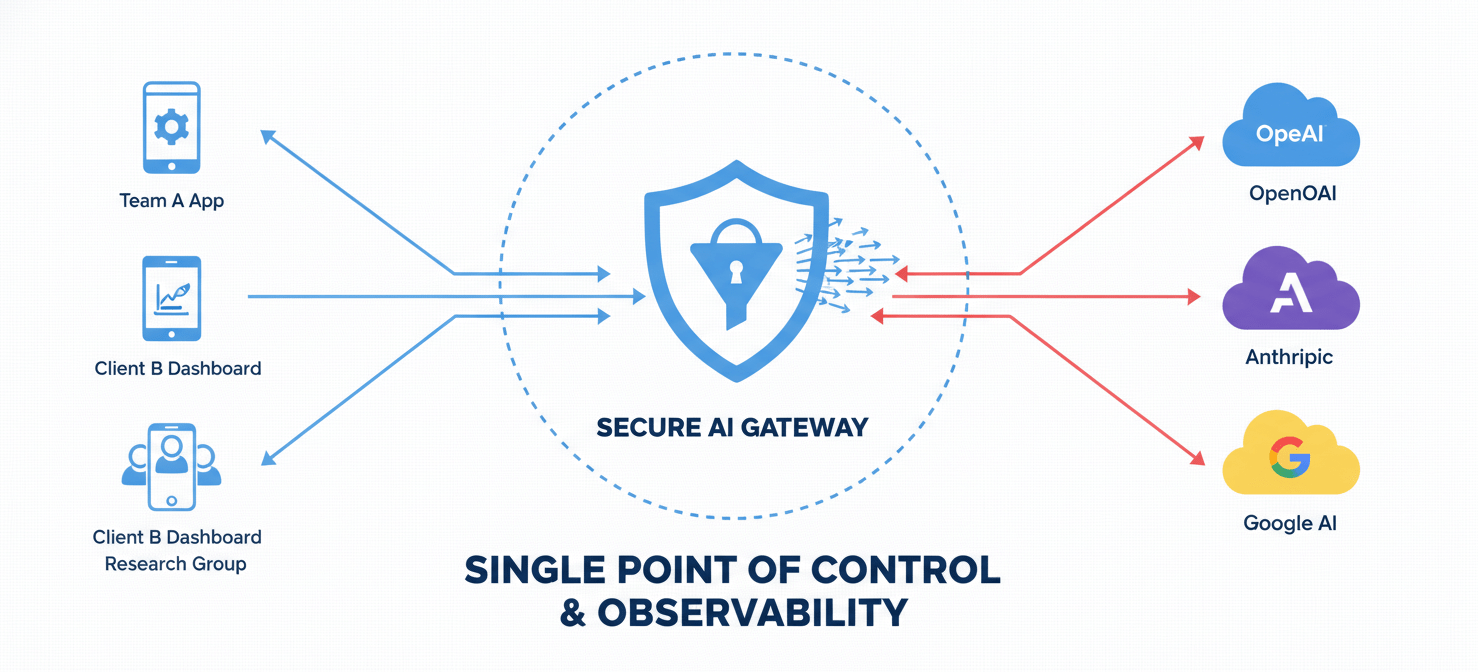
Several open-source and managed solutions can function as a gateway, including LiteLLM, Bifrost, and Portkey. These tools typically provide a unified, OpenAI-compatible API that allows your developers to switch between different models and providers without changing their application code.
By channeling all requests through one gateway, you gain the ability to:
- Log every request and its associated metadata.
- Track token usage for both inputs and outputs.
- Enforce universal policies, such as rate limiting and access controls.
- Implement intelligent routing to direct requests to the most cost-effective model for a given task.
Step 2: Standardize Your Metadata and Tagging
Once you have a centralized gateway, the next step is to ensure every API call is enriched with meaningful metadata. You cannot control what you can’t measure, and effective LLM cost tracking depends on having the right data. This is achieved through a consistent resource tagging strategy.

Tags are simple key-value labels you attach to resources or, in this case, API requests. A robust tagging policy is the foundation for allocating costs accurately. Your engineering teams should collaborate with finance to define a standardized set of tags that reflect how your business operates.
Key Tags for LLM Cost Allocation
At a minimum, every LLM API call should be tagged with the following information:
team_owner: The team responsible for the service making the call (e.g.,product-chat,data-science-research).feature_name: The specific feature the call is associated with (e.g.,document-summarization,customer-support-bot).environment: The deployment environment, such asproduction,staging, ordevelopment.customer_idoruser_id: For attributing costs in multi-tenant applications.
Enforcing this policy is crucial. You can configure your AI gateway to reject any request that doesn’t include the required tags, ensuring your data remains clean and reliable.
Step 3: How to Track LLM Costs Across Platforms with a Unified Dashboard
With a gateway logging tagged requests, you now have the raw data needed for comprehensive analysis. The next step is to visualize this information in a unified dashboard. While provider-specific dashboards from OpenAI, Anthropic, and Google AI Studio are useful, they only show a fraction of the picture.
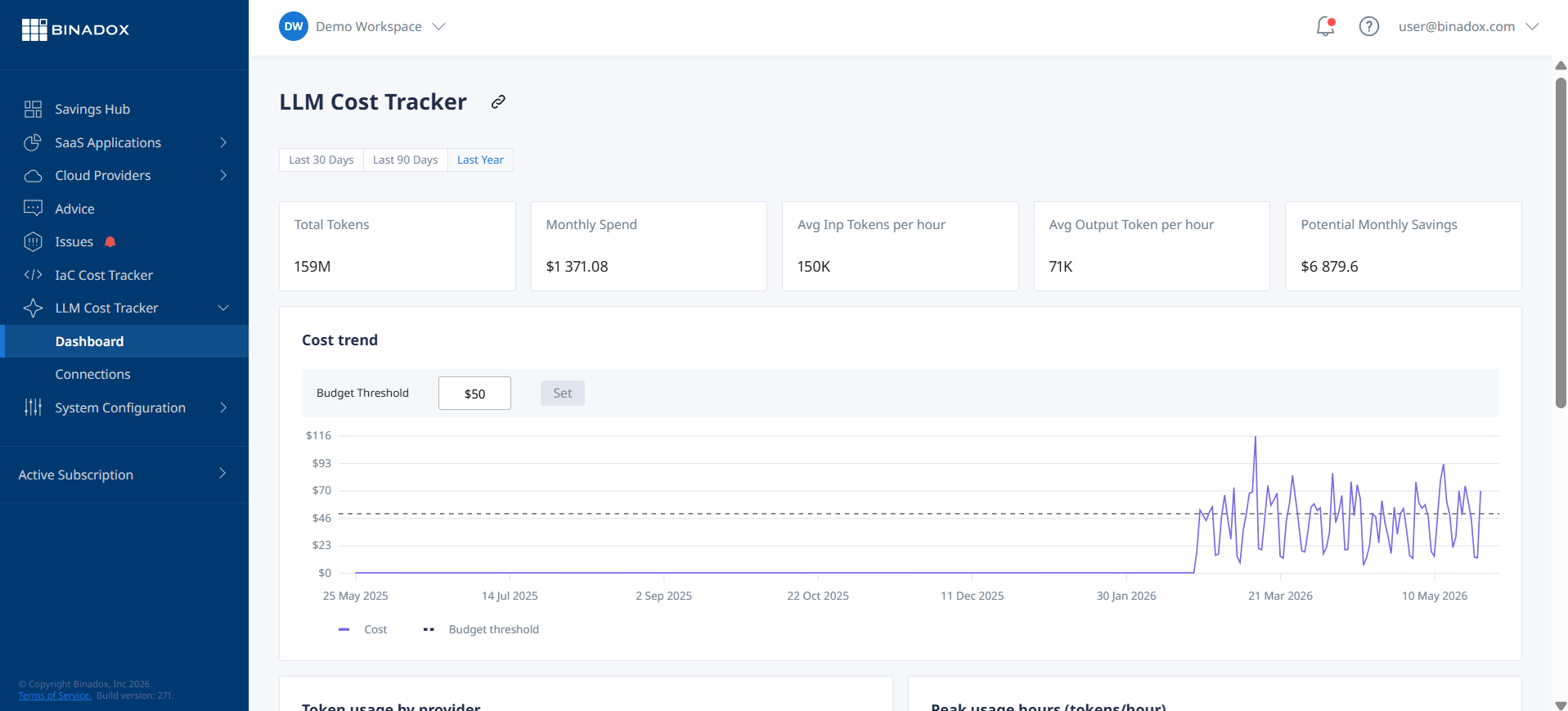
You need a single dashboard that aggregates data from all providers and allows you to filter and group costs by the custom tags you defined in the previous step. Several LLM observability platforms like Langfuse, Braintrust, and Datadog LLM Observability offer this capability.
Your unified dashboard should allow you to answer critical questions at a glance:
- What is our total LLM spend across all providers for the last 30 days?
- Which team is incurring the highest costs?
- Which specific feature is the primary driver of our token consumption?
- How does the cost of
gpt-4ocompare toclaude-3-5-sonnetfor our summarization feature?
This level of visibility empowers your teams to make data-driven decisions about model selection and prompt optimization.
Step 4: Implement Usage Policies and Budgets
Visibility is the first step, but control is the goal. Now that you can see where your money is going, you can implement policies to manage it proactively. Your AI gateway is the ideal place to enforce these rules.

Start by setting budgets at different levels of granularity. For example, you can establish:
- A monthly budget for each team.
- A daily spending cap for non-production environments.
- A cost limit per customer in a multi-tenant system.
These budgets can trigger different actions. A “soft limit” might send an alert to a team’s Slack channel when they’ve consumed 80% of their monthly budget. A “hard limit,” on the other hand, could automatically block further requests from that team until the next billing cycle, preventing any possibility of overspending. Some advanced gateways can even implement budget-aware routing, automatically switching to a cheaper model when a budget threshold is neared.
Step 5: Regularly Review and Optimize Your LLM Usage
LLM cost management is not a one-time setup; it’s an ongoing process of review and optimization. Schedule regular meetings—perhaps bi-weekly or monthly—with stakeholders from engineering, product, and finance to review the cost dashboard.
During these reviews, look for anomalies and opportunities for improvement:
- Cost Spikes: Investigate any sudden increases in spending. Was it due to a new feature launch, a bug, or an inefficient prompt?
- Model Mismatches: Identify tasks where expensive models are being used unnecessarily. A simple classification task likely doesn’t require a frontier model. Benchmarking smaller, cheaper models can reveal significant savings opportunities.
- Inefficient Prompts: Analyze your highest-cost features. Often, small tweaks to a prompt to make it more concise can lead to a meaningful reduction in token usage without sacrificing output quality.
- Caching Opportunities: If you frequently see identical requests, implementing a semantic caching layer in your gateway can dramatically reduce redundant API calls and lower costs.
Conclusion
Failing to track LLM costs across platforms is like giving every team a company credit card with no spending limit and no expense reports. The initial excitement of innovation quickly gives way to the shock of a multi-provider invoice that no one can explain. By centralizing your API traffic, standardizing your metadata, unifying your dashboards, and enforcing budgets, you transform your LLM spending from an unpredictable liability into a managed, strategic investment. This five-step process provides the visibility and control needed to scale your AI initiatives responsibly. After all, the only thing more impressive than a powerful AI feature is one that doesn’t bankrupt the company that built it.
If you’re ready to transform your LLM spending into a strategic investment, you can begin your journey with Binadox at no cost, or schedule a personalized demonstration to explore its comprehensive features.
 7-day free trial