



For FinOps leads and cost analysts, the monthly cloud bill is more than a line item; it’s a high-stakes puzzle reflecting thousands of engineering decisions. The variable, consumption-based nature of the cloud offers incredible agility but can create financial chaos without a structured approach. Effective cloud cost management for FinOps professionals isn’t about slashing budgets. Instead, it’s about building a culture of financial accountability that connects every dollar of cloud spend to measurable business value. This guide provides a framework for establishing robust cost allocation, implementing meaningful KPIs, and driving a value-oriented cloud financial management practice.
Key takeaways
- Mature FinOps practices move from simple cost cutting to maximizing the business value of every dollar spent on cloud resources.
- A robust cost allocation strategy, built on a consistent tagging policy, is the foundation for accountability, enabling accurate showback and chargeback.
- Organizations that implement a structured FinOps practice often see a 15-30% reduction in cloud waste while improving financial transparency.
- The FinOps lifecycle consists of three iterative phases: Inform (visibility), Optimize (efficiency), and Operate (continuous improvement).
The FinOps Imperative: Moving Beyond Simple Cost Cutting
The core mission of FinOps is to align technology spending with business objectives. This requires a cultural shift where engineering, finance, and business teams collaborate to make data-driven decisions. The goal is not just to lower the cloud bill but to improve the unit economics of the services you deliver. Spending more on cloud can be the right decision if it drives proportional growth in revenue or customer value.
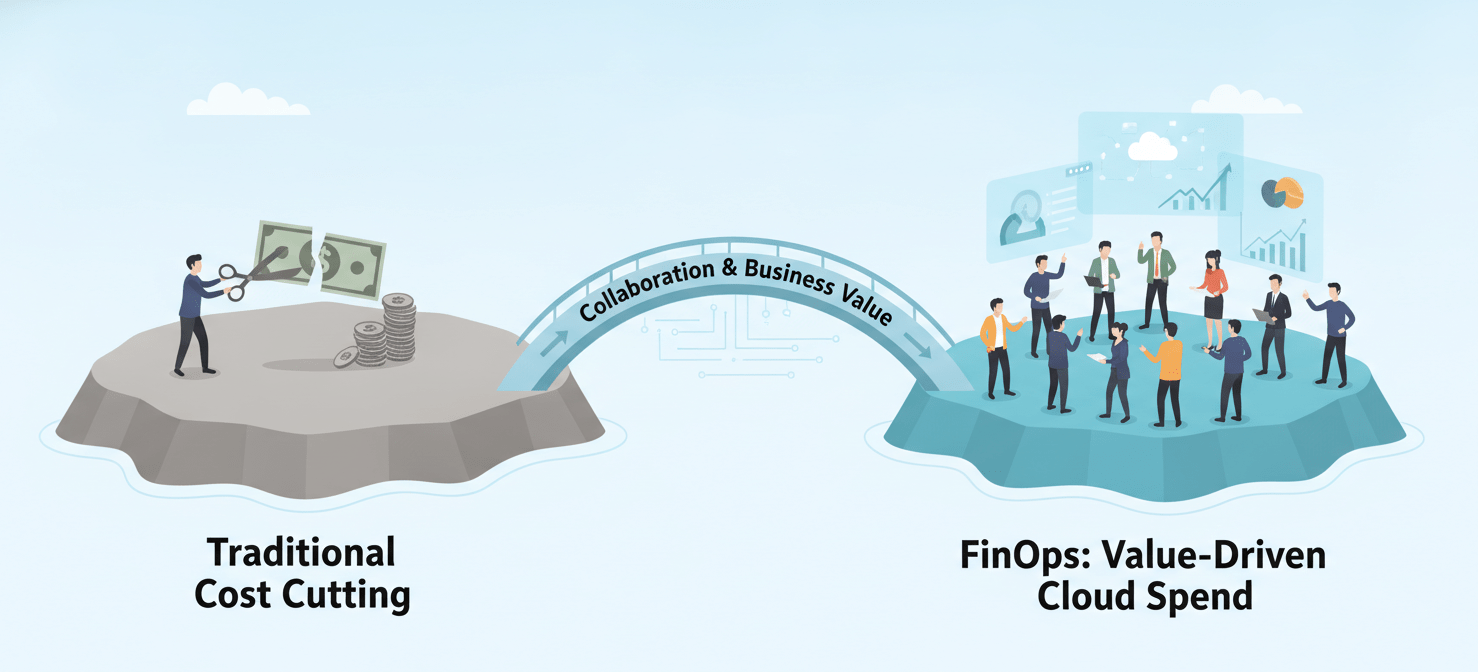
This practice is built on a set of core principles defined by the FinOps Foundation, including collaboration, prioritizing business value, and ensuring everyone takes ownership of their cloud usage. It’s a move away from a centralized IT budget holder to a decentralized model where the teams provisioning resources are accountable for the costs they generate. This shift empowers engineers to treat cost as a key metric, just like performance or security.
Establishing a Robust Cloud Cost Allocation Strategy
You cannot manage what you cannot measure. Therefore, accurate cost allocation is the bedrock of any successful cloud financial management practice. It’s the mechanism that translates a massive, consolidated cloud bill into a clear picture of which teams, products, or features are driving costs. Without it, accountability is impossible.
The Central Role of Tagging and Labeling
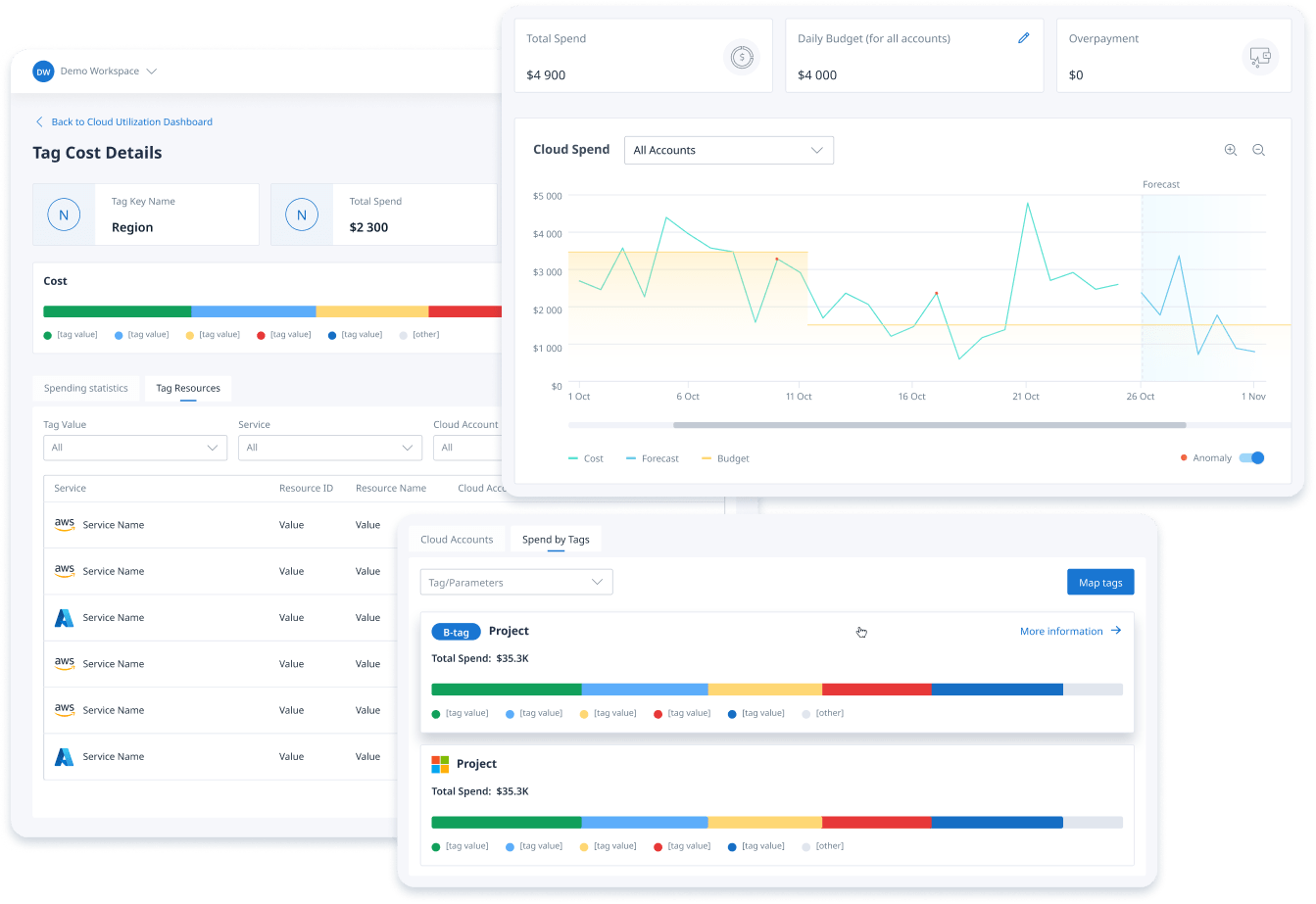
The primary method for cost allocation is a consistent and enforced tagging (or labeling) strategy. Tags are key-value pairs assigned to cloud resources, such as an EC2 instance or an S3 bucket, that allow you to categorize costs by project, team, cost center, or environment.
For example, a comprehensive tagging policy might include:
- CostCenter:
FIN-001 - Team:
payment-processing-dev - Application:
auth-service - Environment:
production
Cloud providers like AWS, Azure, and Google Cloud offer tools to filter and group costs by these tags. The key is enforcement; making tagging mandatory during the resource provisioning process is critical for maintaining data quality.
Handling Shared and Untaggable Costs
Not all costs can be neatly assigned via tags. Shared resources like data transfer, enterprise support plans, or Kubernetes control planes require a different approach. Mature FinOps teams develop rules to allocate these shared costs proportionally. For instance, you might allocate networking costs based on each team’s percentage of total compute usage or split a shared database’s cost based on the volume of queries from each service.
Key Metrics and KPIs for Effective Cloud Cost Management for FinOps
Once you have clear cost allocation, you can begin tracking Key Performance Indicators (KPIs) that measure the efficiency and business value of your cloud spend. These metrics move the conversation from “How much did we spend?” to “What value did we get for our spend?”
Foundational KPIs
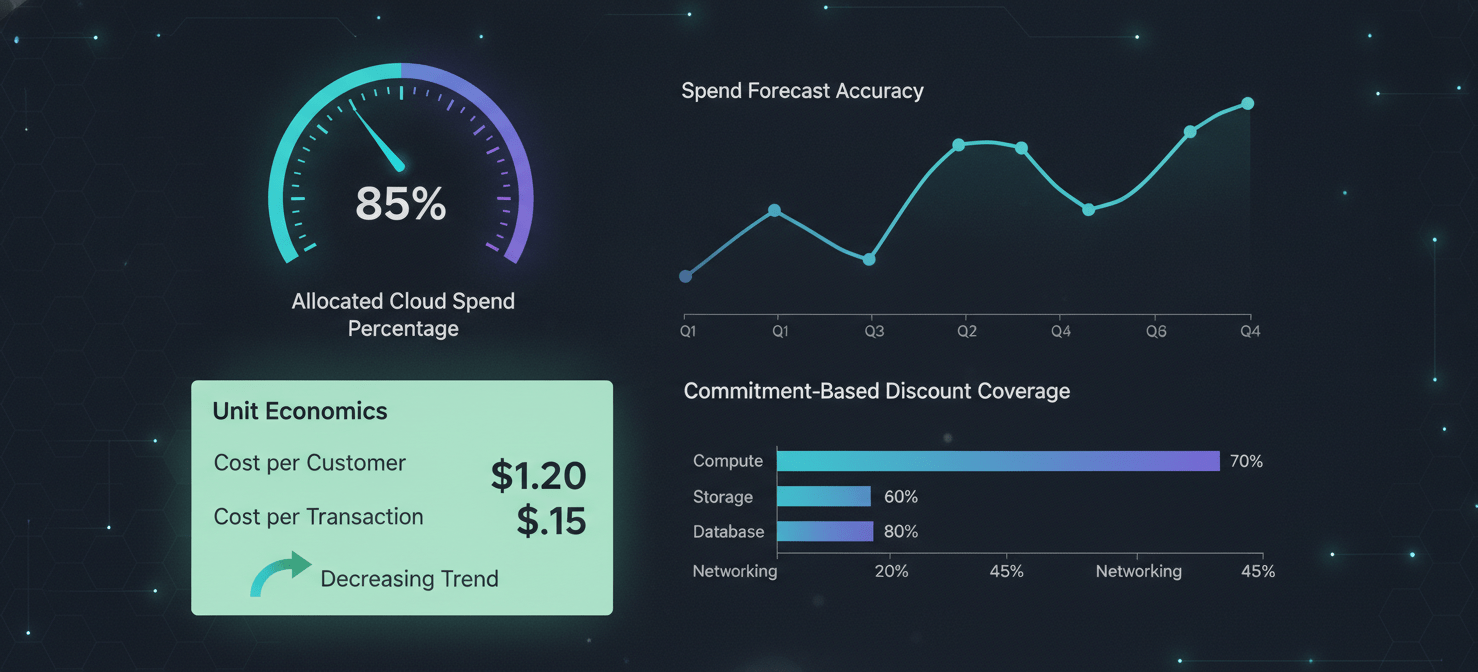
- Allocated Cloud Spend Percentage: This measures the portion of your total cloud bill that is successfully attributed to an owner. Aim for over 80% as a starting point. A low percentage indicates gaps in your tagging strategy.
- Spend Forecast Accuracy: This KPI tracks how closely your actual spending matches your forecasted budget. High accuracy demonstrates predictability and control over your cloud environment.
- Commitment-Based Discount Coverage: This metric shows the percentage of your usage (e.g., compute hours) covered by savings instruments like AWS Savings Plans, Reserved Instances, or Google Cloud’s Committed Use Discounts. It’s a direct measure of your rate optimization effectiveness.
Advanced Value-Based Metrics
- Unit Economics (e.g., Cost per Customer, Cost per Transaction): This is the holy grail of FinOps KPIs. By combining your cloud cost data with business metrics, you can calculate the cost to acquire a new user, process a single payment, or serve one API request. Tracking this over time shows whether you are scaling efficiently. An increasing cost per unit can signal architectural inefficiencies even if total spend is flat.
- Cloud Cost as a Percentage of Revenue: For mature organizations, this KPI directly links cloud infrastructure spending to top-line business performance, providing a powerful metric for executive-level conversations.
Implementing Showback and Chargeback Models
With accurate allocation and clear KPIs, you can implement models to drive accountability across the organization. The two primary models are showback and chargeback.
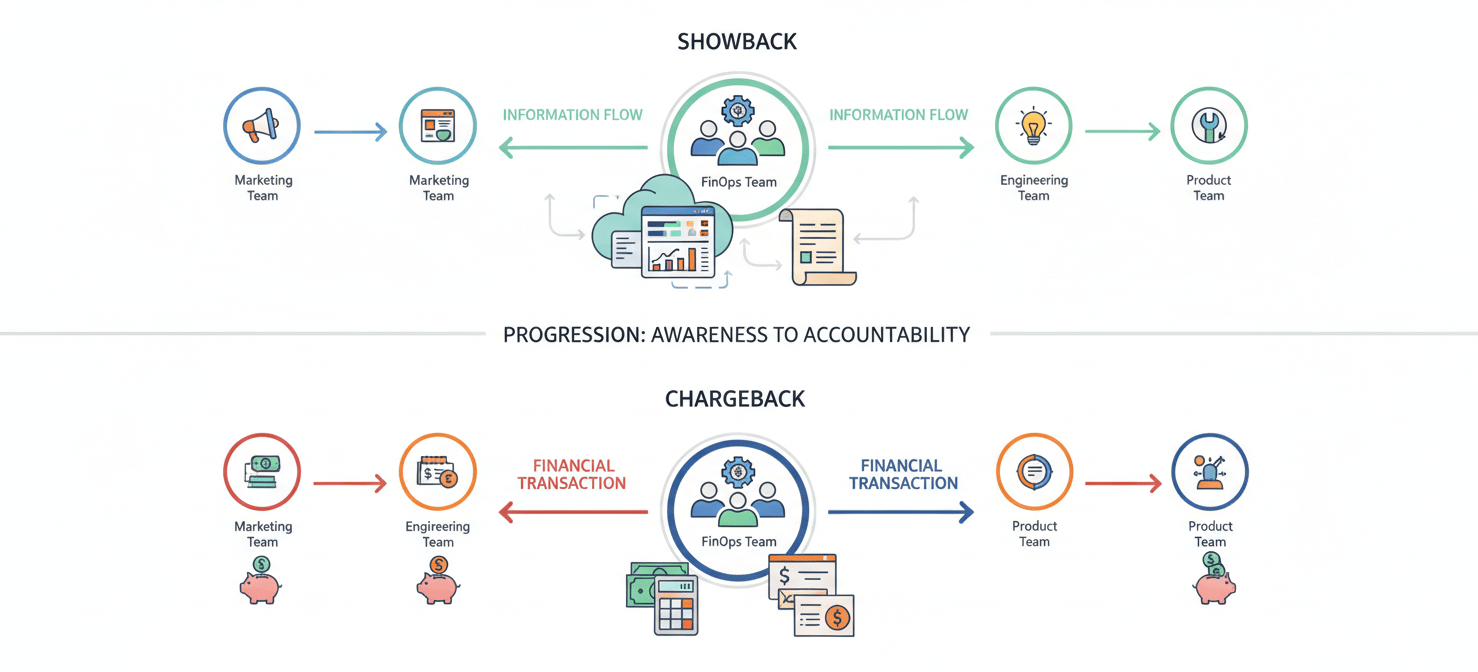
Showback: Building Awareness
Showback is the process of reporting cloud usage and costs to the teams responsible for them without actually billing their departmental budget. It’s an informational tool designed to build awareness and encourage self-governance. For example, you might provide a monthly dashboard to the marketing analytics team showing the cost of the data warehousing resources they consumed. Showback is often the first step in building a cost-aware culture, as it introduces accountability with low organizational friction.
Chargeback: Driving Direct Accountability
Chargeback takes this a step further by formally billing each business unit for the resources it consumes. The costs are transferred from a central IT budget to the budgets of the individual departments. This model creates direct financial ownership and provides a powerful incentive for teams to optimize their usage. However, a chargeback model requires a high degree of confidence in your cost allocation data. Inaccurate chargebacks can lead to internal disputes and undermine trust in the FinOps practice. Most organizations mature into chargeback after successfully operating a showback model for a period of time.
Advanced Strategies for Cloud Cost Optimization
Cost optimization in a FinOps context is a continuous process that falls into two main categories: rate optimization and usage optimization.
Rate Optimization
This involves paying less for the resources you use. The most common strategy is leveraging commitment-based discounts. Cloud providers offer significant discounts (up to 70% or more) in exchange for a commitment to a certain level of usage over a one- or three-year term. Managing a portfolio of these commitments to maximize coverage while minimizing waste is a core function of a central FinOps team.
Usage Optimization
This focuses on ensuring you only use the resources you need. Key activities include:
- Rightsizing: Analyzing performance data to match instance types and sizes to actual workload demand, eliminating overprovisioning.
- Identifying and Deleting Waste: Systematically finding and terminating idle resources, such as unattached storage volumes or stopped virtual machines that still incur costs.
- Implementing Autoscaling: Using cloud-native features to automatically scale resources up or down based on real-time demand, ensuring you don’t pay for peak capacity 24/7.
Conclusion
Ultimately, effective cloud cost management for FinOps is not a project with an end date; it is an ongoing cultural practice and an iterative process. It begins with creating visibility through a meticulous cost allocation strategy. It matures by tracking metrics that connect cloud spend to business value. Finally, it drives change through accountability models like showback and chargeback. The goal is to transform the cloud bill from a source of financial anxiety into a strategic tool that provides a clear, data-driven view of how technology investments are fueling business growth. Get the foundation right, and the cloud’s variable spend model becomes a competitive advantage, not a budgetary liability.
To truly transform your cloud bill into a strategic asset and gain granular control, you can experience the benefits firsthand with a free Binadox trial, or arrange a quick demonstration to explore its full capabilities.
 7-day free trial