



For a founder or CTO, runway is everything. Every dollar spent on infrastructure is a dollar not spent on hiring engineers or acquiring customers. Yet, cloud hosting bills often become a significant, unpredictable drain on resources. Effective startup hosting cost management isn’t about slashing expenses indiscriminately; it’s a strategic discipline that extends your financial runway and instills operational excellence from day one. This article moves beyond generic advice to address the specific, high-impact pitfalls that frequently trap small, agile teams, reframing cost control as a key driver of sustainable growth.
Key takeaways
- Data transfer is not free: Egress (data-out) fees are a common source of bill shock, with costs of $0.09/GB or more for data leaving the cloud for the public internet.
- Commitment discounts require strategy: Reserved Instances and Savings Plans can cut compute costs by up to 72%, but misunderstanding their flexibility can lead to paying for unused capacity.
- Empower your engineers: Cost ownership shouldn’t be siloed in finance. When engineers have visibility into the cost impact of their code, they make more efficient architectural decisions.
- Automate to eliminate waste: Relying on manual checks to find idle resources is a losing battle. Implement automated scripts and policies to decommission unused instances and storage volumes.
The ‘Default Settings’ Trap
When your team is racing to ship a minimum viable product (MVP), speed is the priority. This often means accepting the default configurations for virtual machines, databases, and storage. While this accelerates deployment, it’s a primary source of budget leakage. Cloud providers design defaults for broad compatibility and performance, not for lean cost control.

Overprovisioning is the most common consequence. A “just-in-case” strategy of selecting a larger-than-needed instance size feels safe but leads to paying for capacity you don’t use. For example, an engineer might spin up a general-purpose m5.xlarge instance on AWS for a new microservice without analyzing its actual CPU and memory requirements. In reality, a smaller, burstable t3.medium instance might handle the workload perfectly at a fraction of the cost.
Right-Sizing Is a Continuous Process
The fix isn’t a one-time audit but a continuous process of right-sizing. Your team should regularly review resource utilization metrics. Most cloud providers offer tools like AWS Cost Explorer, Azure Cost Management, or Google Cloud’s cost tools that provide basic visibility at no extra charge. Look for compute instances with sustained low CPU utilization (e.g., under 20%) and storage volumes that are unattached to any running instance (“zombie assets”).
Furthermore, don’t neglect storage tiers. Storing infrequently accessed data, like old logs or backups, in a standard, high-performance storage class is inefficient. Moving this data to a cheaper tier, such as Amazon S3 Glacier or Azure Archive Storage, can dramatically reduce storage costs without impacting active operations.
Ignoring Your Data Transfer Costs
One of the most frequent and painful surprises on a cloud bill comes from data transfer fees. Founders and engineers often operate under the misconception that moving data is free. While data ingress (transferring data into a cloud provider) is almost always free, data egress (transferring data out) is not.

These costs can accumulate in non-obvious ways:
- Data Transfer to the Internet: Every time a user downloads a file, your application sends an API response, or you serve web assets, you are paying for data transfer out to the internet. AWS, for example, provides a free tier of 100GB per month, but beyond that, costs can be around $0.09 per GB.
- Inter-Availability Zone (AZ) Transfer: Architecting for high availability often involves replicating data across multiple AZs within the same region. This inter-AZ traffic is not free. AWS charges roughly $0.01 to $0.02 per GB for data moving between AZs.
- Cross-Region Transfer: If you replicate data between different geographic regions for disaster recovery or to serve a global user base, you will incur even higher data transfer costs, often around $0.02 per GB.
For a startup, these costs can escalate quickly. A media-heavy application serving images and videos or a data-intensive service with frequent database replication can see its data transfer fees rival its compute costs. The key to lean startup cost control is to design your architecture with data gravity in mind. For instance, use a Content Delivery Network (CDN) like Amazon CloudFront to cache assets closer to users, which can reduce data transfer out charges.
Misunderstanding Reserved Instances and Savings Plans
Committing to long-term usage with a cloud provider is a powerful way to how to reduce hosting costs. Providers reward this predictability with significant discounts. However, choosing the wrong commitment model for your startup’s stage and workload patterns can be a costly mistake.
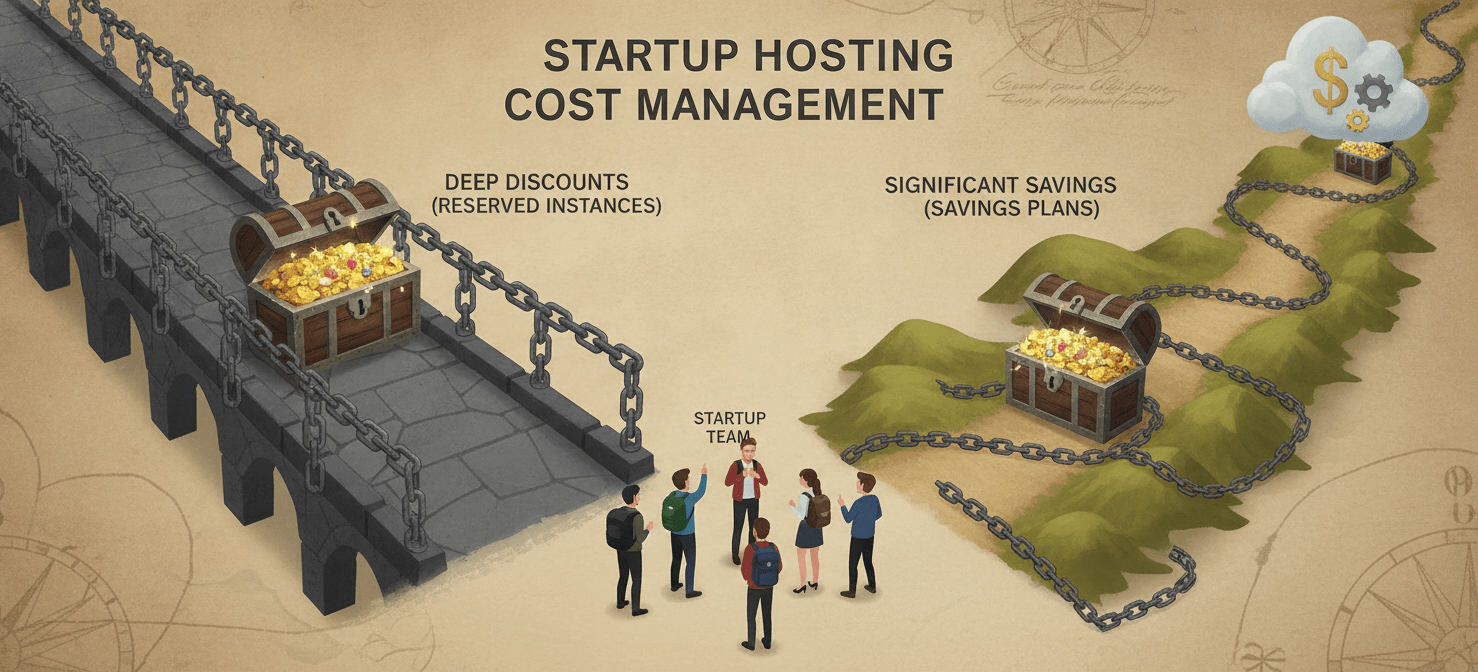
The main discount vehicles are:
- AWS: Reserved Instances (RIs) and Savings Plans.
- Google Cloud: Committed Use Discounts (CUDs).
- Azure: Reservations.
These programs can offer savings of up to 72-75% compared to on-demand pricing in exchange for a one- or three-year commitment. The pitfall lies in the details.
Flexibility vs. Deeper Discounts
Traditional RIs (like Standard RIs on AWS) offer the highest discounts but are the most rigid, locking you into a specific instance family, size, and region. For a startup whose product and architecture are rapidly evolving, this is a risky bet. If your team decides to switch from m5 to m6i instances, your RI may no longer apply, and you’ll be paying for a reservation you can’t use.
Newer models like AWS Savings Plans, flexible CUDs on GCP, and Azure Reservations with instance size flexibility offer a much better fit for startups. They commit you to a certain amount of hourly spend on compute, and the discount applies automatically across different instance families, sizes, and even services like AWS Fargate and Lambda. While the discount might be slightly lower than the most restrictive RIs, the flexibility is invaluable for a team that needs to stay agile. The worst-case scenario is committing to a three-year plan for a specific instance type that your team stops using six months later.
Neglecting Monitoring and Automation
In a small team, manual processes don’t scale. Relying on an engineer to periodically check the billing console for anomalies is an unreliable strategy for startup hosting cost management. By the time a cost spike is noticed, days or weeks of budget may have already been burned.

Effective cost management requires two key components: real-time visibility and automated remediation.
Implement Proactive Alerting and Tagging
First, establish a baseline for your spending and set up automated budget alerts. All major cloud providers allow you to create budgets that trigger notifications when your spending exceeds a certain threshold or is forecasted to do so. This turns cost management from a reactive, month-end surprise into a proactive, daily discipline.
Second, implement a consistent resource tagging strategy from day one. Tagging allows you to allocate costs to specific projects, teams, environments (dev, staging, prod), or even individual features. Without proper tagging, your bill becomes an unreadable monolith, making it impossible to identify which part of your application is driving costs.
Automate Waste Removal
The most effective way to control costs is to automate the cleanup of unused resources. For example, you can write simple scripts (e.g., using AWS Lambda or Azure Functions) that run daily to:
- Identify and delete unattached storage volumes.
- Shut down development and staging environments outside of business hours.
- Find and flag idle compute instances with low utilization.
Tools like Infracost can even show engineers the cost implications of their infrastructure-as-code changes directly within a pull request, before the resources are ever deployed.
The People Problem: Lack of Cost Ownership
Ultimately, cloud costs are a direct result of engineering decisions. If the engineers writing the code and deploying the infrastructure have no visibility into or responsibility for the associated costs, those costs will inevitably spiral. This is the most critical, and often overlooked, pitfall.
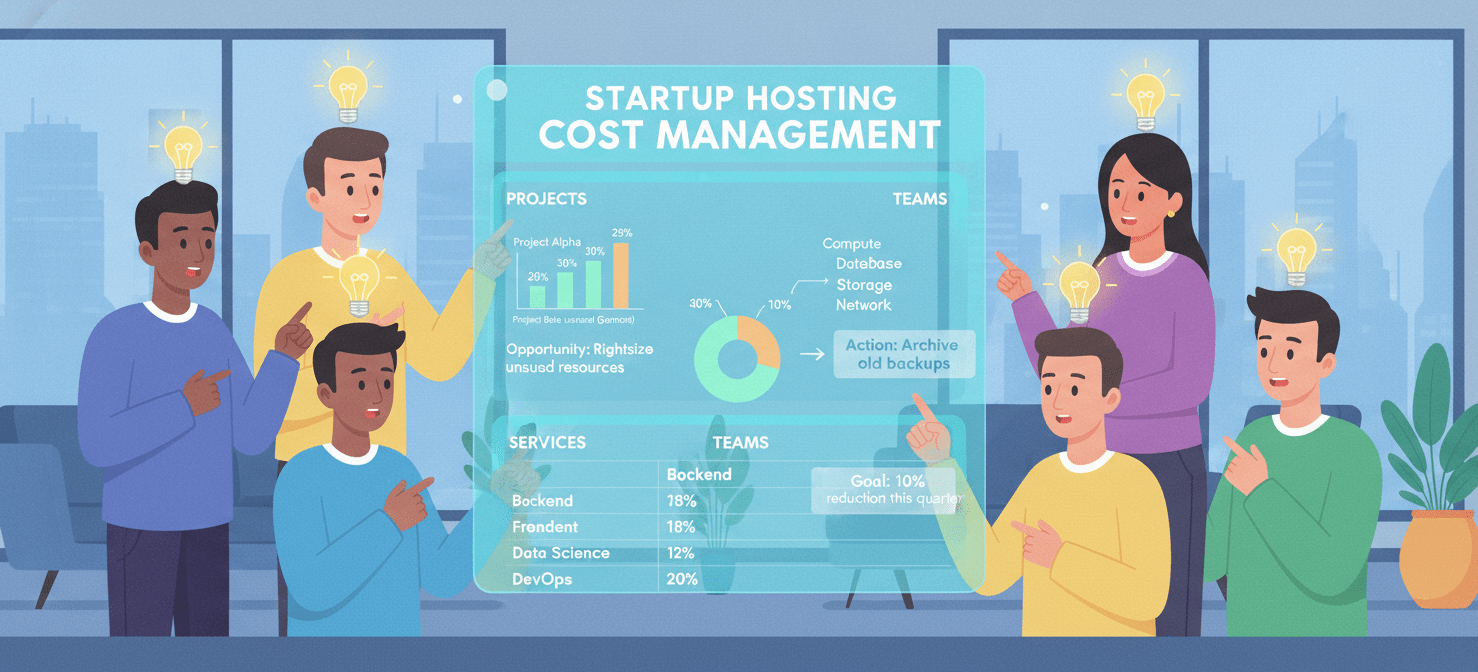
This challenge is cultural. It requires shifting from a mindset where infrastructure is a “free” or unlimited resource to one where cost is treated as a critical non-functional requirement, just like performance and security. This practice, often called FinOps, is about creating a culture of shared accountability for cloud spending.
To foster this culture, you must democratize cost data. Make dashboards from tools like Vantage, AWS Cost Explorer, or other FinOps platforms accessible to the entire engineering team, not just leadership. When an engineer can see that their recent change caused a 20% spike in database costs, they are empowered to investigate and optimize. This creates a powerful feedback loop that aligns technical decisions with business objectives—namely, extending the runway.
Conclusion
For a startup, managing cloud spend is not a problem for the finance department to solve in isolation; it is an engineering discipline. Effective startup hosting cost management is about avoiding unforced errors: don’t accept defaults without question, don’t ignore the hidden tax of data transfer, and don’t make long-term commitments you can’t keep. Instead, build a culture of cost awareness where every engineer is empowered with the data to make efficient choices. Your burn rate is a product of your architecture. Treat it as such, and you’ll find your runway is significantly longer than you thought.
To truly master your cloud economics and extend your runway, learn how Binadox can support your FinOps strategy, or explore its features by scheduling a demo with our team.
 7-day free trial