



As enterprise environments grow in complexity, managing a diverse fleet of endpoints becomes a significant architectural challenge. The decision to standardize your mobile device management (MDM) tooling is a critical one, forcing a choice between integrated platforms and specialized, best-of-breed solutions. For enterprise architects and staff engineers, this isn’t just about vendor management; it’s a strategic decision that impacts security posture, operational efficiency, and total cost of ownership (TCO). Effective mdm vendor consolidation requires a clear-eyed analysis of deep integration versus specialized functionality, weighing the allure of a single pane of glass against the power of purpose-built tools.
Key takeaways:
- Platform solutions like Microsoft Intune can reduce licensing overhead, with some analyses suggesting a potential 3-year TCO savings of over 40% when bundled in E5 licenses.
- Best-of-breed solutions, such as Jamf for Apple devices, often provide day-zero support for new OS releases, a critical factor for organizations where immediate adoption of new features is a priority.
- A hybrid co-management strategy is a viable path, allowing you to leverage existing specialized tools while enforcing unified security policies through platform features like Conditional Access.
The Vendor Sprawl Problem in Endpoint Management
Vendor sprawl in endpoint management is more than just an untidy architecture diagram; it’s a source of significant operational friction and security risk. When different teams adopt disparate tools for managing Windows, macOS, iOS, and Android devices, the result is a fragmented ecosystem. This fragmentation creates tangible problems that directly impact an enterprise architect’s key performance indicators.
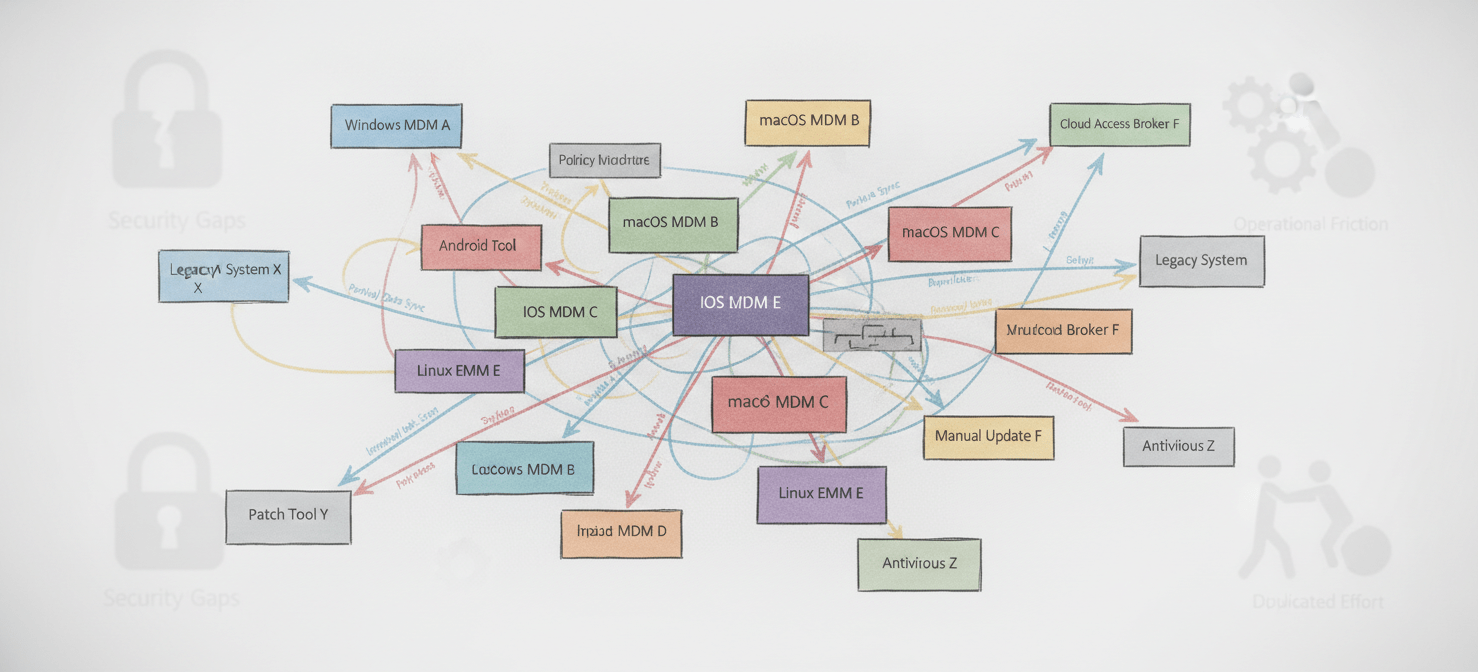
First, it introduces inconsistent security policy enforcement. Each MDM solution has its own method for defining and deploying configurations, compliance rules, and security baselines. As a result, maintaining a uniform security posture across the entire device fleet becomes a manual, error-prone process. For example, a compliance policy meticulously crafted in one tool for Windows devices may have no direct equivalent or may be implemented differently in another tool for macOS, creating dangerous security gaps.
Second, the operational overhead multiplies. Your platform and infrastructure teams are forced to develop and maintain expertise across multiple, often redundant, systems. This duplicates effort in training, administration, and troubleshooting. Furthermore, it complicates identity and access management. Integrating multiple MDM solutions with a central identity provider (IdP) like Azure AD can be complex, increasing the risk of misconfiguration and weakening the zero-trust security model you aim to build. The lack of a unified asset inventory and reporting system also hinders visibility, making it difficult to answer fundamental questions about fleet health and compliance.
Platform Approach: The Microsoft E5 MDM Proposition
For organizations heavily invested in the Microsoft ecosystem, the platform approach to MDM is compelling. The argument centers on leveraging the existing Microsoft 365 E3 or E5 license to consolidate endpoint management within Microsoft Intune. This strategy presents a powerful case for vendor consolidation by transforming MDM from a standalone function into an integrated component of a broader security and productivity architecture.
Deep Integration with the Microsoft Security Stack
The primary architectural advantage of using Intune is its native integration with other Microsoft services. For instance, device compliance status from Intune is a direct input for Azure Active Directory (Azure AD) Conditional Access policies. This allows you to create granular rules that, for example, block access to corporate resources from non-compliant devices, regardless of whether they are Windows, macOS, or mobile. This seamless integration is difficult and often more brittle to achieve with third-party MDM tools.
Furthermore, Intune works in concert with Microsoft Defender for Endpoint. When a threat is detected on a device by Defender, its risk level can be automatically updated in Intune, triggering a compliance policy change that isolates the device from the network until remediation is complete. This closed-loop security automation is a core tenet of a modern, zero-trust architecture.
Streamlined Operations and Reduced TCO
From a platform design perspective, consolidation simplifies the technology stack. It reduces the number of vendor relationships to manage, contracts to negotiate, and administrative consoles to learn. For your team, this means a more streamlined operational model. Instead of context-switching between different management tools, engineers can work within a unified Microsoft 365 admin center. This not only improves efficiency but also lowers training costs. The potential for significant TCO reduction is a major driver, as leveraging an existing E5 license for MDM capabilities avoids the procurement and maintenance costs of a separate, best-of-breed solution.
Best-of-Breed Argument: The Jamf vs. Intune Architecture
While the platform approach offers undeniable benefits in terms of integration and cost, the best-of-breed argument posits that a general-purpose tool can never match the depth and focus of a specialist. This is most evident in the Apple ecosystem, where the Jamf vs. Intune architecture debate is most pronounced. For organizations with a significant Mac, iPhone, or iPad footprint, a specialized tool like Jamf Pro often provides a superior management experience and better outcomes for end-users.
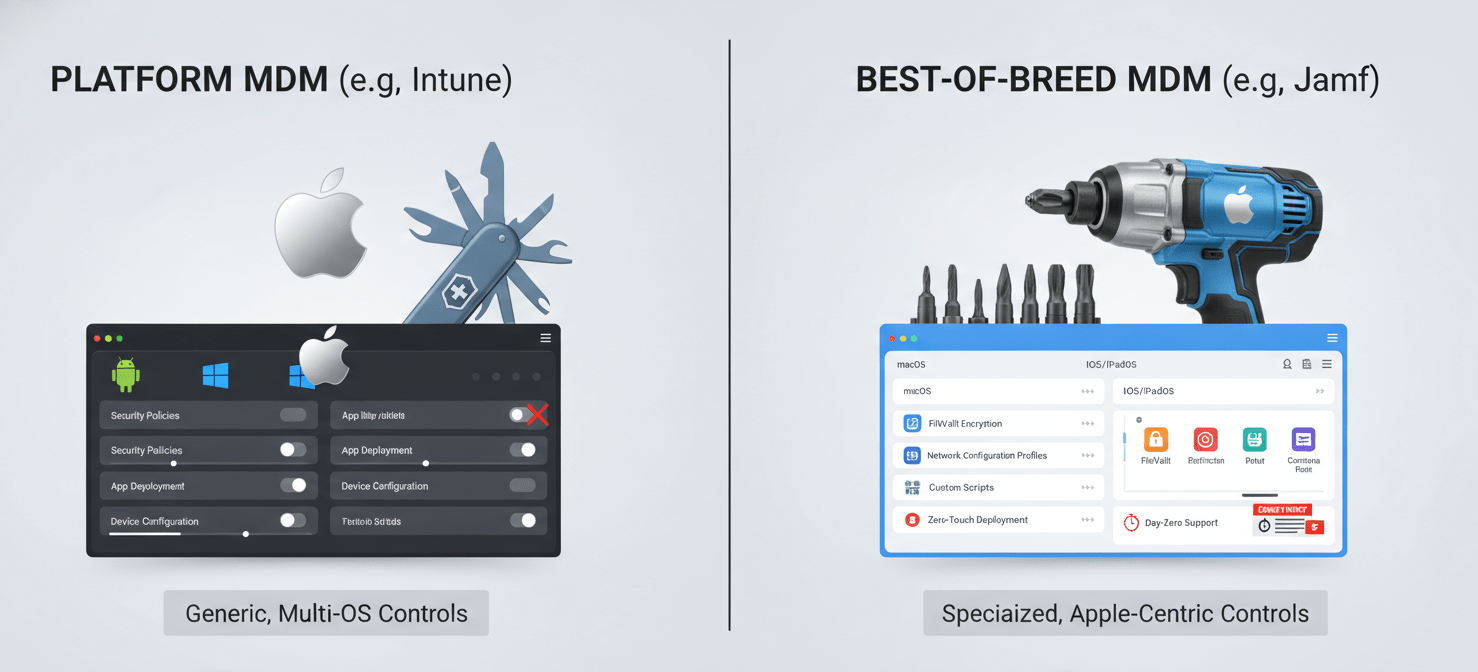
The core of the argument is specialization. Jamf is built exclusively for the Apple ecosystem. This singular focus allows it to offer deeper, more granular control over macOS, iOS, and iPadOS. For example, Jamf typically provides support for new Apple OS features and management APIs on the day they are released. This “day-zero support” is a critical differentiator for organizations that want to leverage new capabilities immediately for security or productivity reasons. A platform solution like Intune, which must support multiple operating systems, often lags in implementing these new, OS-specific features.
From an architectural standpoint, Jamf’s policy and scripting engine is often considered more powerful and flexible for managing Macs than Intune’s. It allows for complex software deployment workflows, custom script execution, and detailed inventory reporting that may not be possible or are more cumbersome to implement in a cross-platform tool. This depth of functionality directly impacts the end-user experience. A well-managed Mac using Jamf feels seamlessly integrated into the enterprise environment, with self-service application catalogs and automated remediation that reduce help desk tickets and empower users.
Analyzing the True TCO of MDM Vendor Consolidation
A simplistic analysis of mdm vendor consolidation often stops at licensing costs. An enterprise architect, however, must calculate the true total cost of ownership, which encompasses a much broader set of factors. While eliminating a vendor license fee produces an immediate, visible saving, the hidden costs of consolidation can sometimes outweigh the benefits.
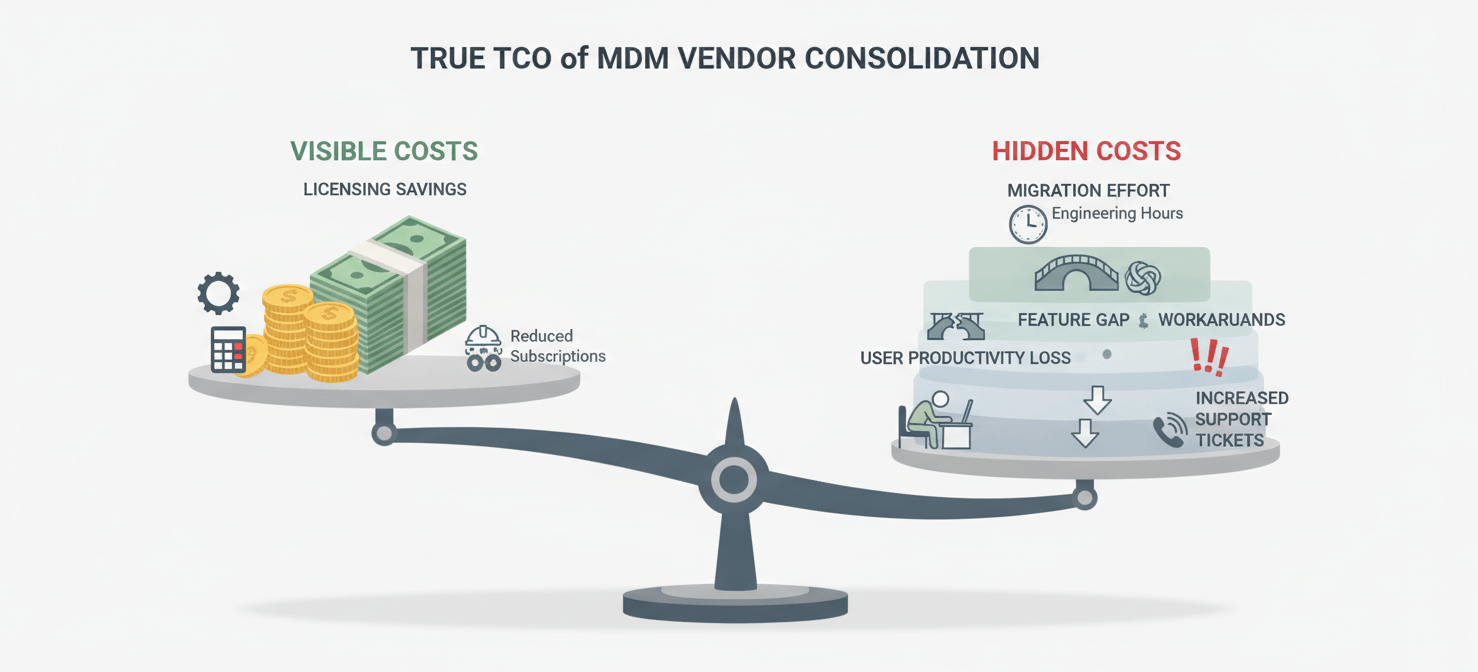
First, consider the cost of migration. Moving hundreds or thousands of devices from an established best-of-breed MDM to a new platform is a significant undertaking. This project requires careful planning, testing, and execution, consuming valuable engineering hours. There is also the risk of disruption to end-users if devices are not migrated smoothly, leading to lost productivity.
Second, you must evaluate the potential for “feature-gap” costs. If the platform solution lacks a critical feature that the specialized tool provided, your team may need to spend time and resources developing a workaround. For example, if the new platform’s software deployment capabilities are less robust, your packaging and deployment team might spend more hours on each application. These hidden operational costs can quickly erode the initial licensing savings.
Finally, assess the impact on support and user experience. A best-of-breed solution may provide a better experience for a specific user segment, such as your macOS-using developers. A forced move to a less-capable platform could lead to frustration, lower productivity, and an increase in support tickets. Therefore, a true TCO analysis must quantify these “soft” costs alongside the hard costs of licensing and implementation.
A Hybrid Model: Co-management and Conditional Access
The choice between platform and best-of-breed is not always a binary one. A hybrid or co-management model offers a pragmatic path forward, allowing you to achieve security standardization without sacrificing the deep functionality of a specialized tool. This approach is particularly relevant for managing diverse device fleets where a one-size-fits-all solution is suboptimal.
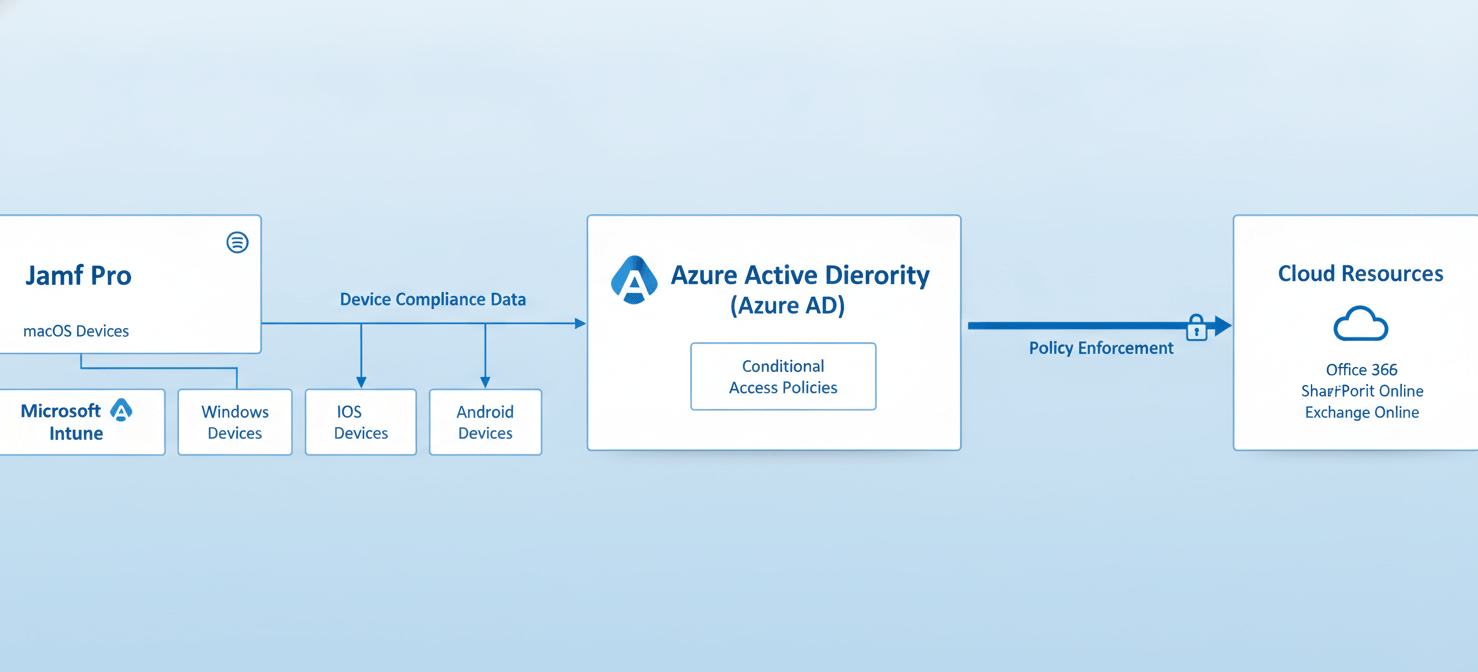
The most common architectural pattern for this is integrating a third-party MDM, like Jamf, with Microsoft Intune and Azure AD. In this model, Jamf continues to handle the deep device configuration, policy enforcement, and software management for macOS devices. However, Jamf then forwards device inventory and compliance data to Intune.
This integration allows the device’s compliance state, as determined by Jamf, to be recognized by Microsoft’s security ecosystem. As a result, you can use Azure AD Conditional Access to enforce unified security policies across your entire fleet. For example, you can create a policy that requires all devices, whether managed by Intune or Jamf, to be marked as compliant before they can access sensitive applications like Office 365. This model, detailed in Microsoft’s documentation on Jamf integration with Intune, gives you the best of both worlds: centralized security and compliance visibility via the platform, coupled with specialized, best-in-class device management. This strategy effectively de-risks the consolidation decision by allowing for a phased approach and preserving key functionalities where they are most needed. Jamf also provides guidance on this integration, ensuring administrators can enforce compliance on Macs managed by Jamf Pro.
Conclusion
Ultimately, the decision on mdm vendor consolidation is a classic architectural trade-off. There is no single correct answer, only the best fit for your organization’s specific context, priorities, and technical maturity. The platform approach, exemplified by the Microsoft E5 MDM proposition, offers a compelling path to reduced complexity, streamlined security, and lower licensing costs. It aligns perfectly with a strategy of vendor consolidation and deep integration within a single ecosystem. However, this path is not without its perils. A blind pursuit of consolidation can lead to a lowest-common-denominator solution that frustrates users and fails to meet the specific needs of critical device populations.
The best-of-breed argument correctly identifies that specialized tools often provide superior functionality and a better user experience for their target platform. For an enterprise with a heavy investment in Apple hardware, ignoring the capabilities of a tool like Jamf would be a mistake. Therefore, a hybrid approach, leveraging co-management and Conditional Access, often represents the most mature and pragmatic solution. It allows you to standardize security at the identity layer while retaining the specialized management tools that make your users productive. The goal isn’t consolidation for its own sake, but rather a deliberate architectural design that balances cost, security, and user experience. After all, a perfectly consolidated platform that nobody wants to use is not a platform at all; it’s a shelf.
As you weigh the architectural trade-offs for your MDM strategy, consider how a personalized consultation could clarify your path forward, or you could simply begin a complimentary assessment of Binadox’s capabilities to see its impact firsthand.
 7-day free trial