



The rapid adoption of Large Language Models (LLMs) has introduced a volatile and often opaque new line item to your cloud bill. Unlike predictable server costs, LLM expenses scale with variables like prompt length, model choice, and user behavior, making traditional forecasting a challenge. For FinOps leads and cost analysts, gaining control requires more than a spreadsheet; it demands a purpose-built finops platform capable of navigating the unique economics of generative AI. Choosing the right tool is critical for turning unpredictable AI spend into a managed, optimized, and accountable part of your budget.
Key takeaways
- LLM costs are different: Traditional FinOps tools struggle because AI costs are driven by per-token APIs and shared GPU clusters, not just provisioned resources.
- Allocation is foundational: You cannot manage what you can’t attribute. Prioritize platforms that offer granular cost allocation for LLMs by team, feature, or customer.
- Unit economics matter most: Move beyond total spend. The key KPI is cost-per-outcome (e.g., cost per summary, cost per user query), which connects AI spend directly to business value.
- Implementation in the first 30 days is key: Connect your LLM and cloud providers, establish a consistent tagging or API key strategy, and define initial unit cost metrics to see immediate value.
Why LLM Costs Are a Unique FinOps Challenge
Standard cloud cost management focuses on resources priced per hour or gigabyte. FinOps for AI, however, deals with a completely different set of cost drivers that make allocation and forecasting inherently more complex.
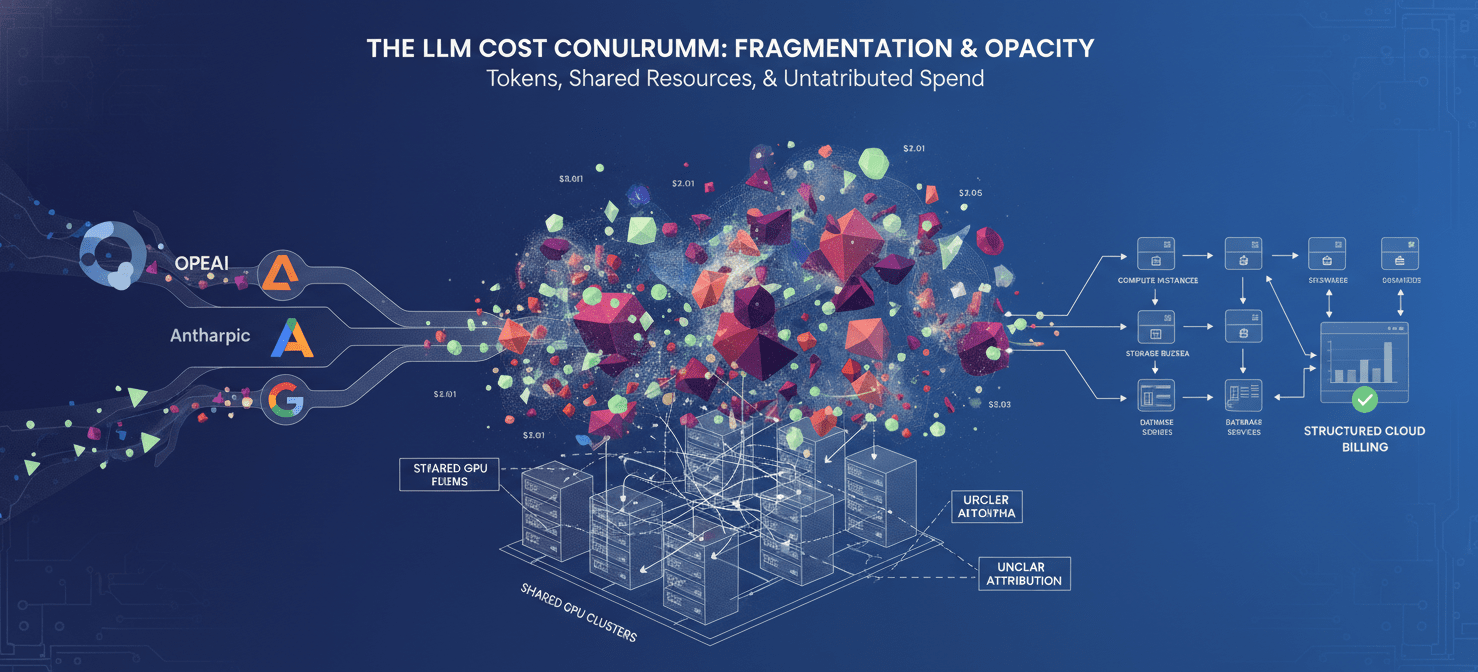
First, the primary unit of cost is the “token,” a piece of a word that providers like OpenAI and Anthropic use for billing. This usage-based model means costs fluctuate with factors your team doesn’t directly control, such as the length of a user’s query or the verbosity of a model’s response. Furthermore, output tokens often cost 2 to 6 times more than input tokens, meaning a seemingly small change in a prompt that generates a longer answer can have a significant financial impact.
Second, AI workloads often rely on shared infrastructure, particularly expensive GPU instances for training and inference. When multiple teams or products use the same cluster of GPUs, attributing the cost back to the specific consumer becomes a significant challenge for showback and chargeback. Without specialized tooling, this spend often lands as a single, unallocated line item on the cloud bill.
Finally, the AI technology landscape is fragmented and changes rapidly. Your organization might use APIs from OpenAI, Anthropic, and Google, alongside models running on AWS SageMaker or Azure Machine Learning. This multi-provider reality creates visibility gaps, making it difficult to get a unified view of total AI spend without a platform designed to ingest and normalize data from all these sources.
Core Capabilities to Look For in a FinOps Platform for LLM
When evaluating a finops platform to manage your LLM spend, your focus should be on capabilities that provide granular visibility and enable accountability. These tools move beyond simple reporting to offer mechanisms for true cost allocation and optimization.
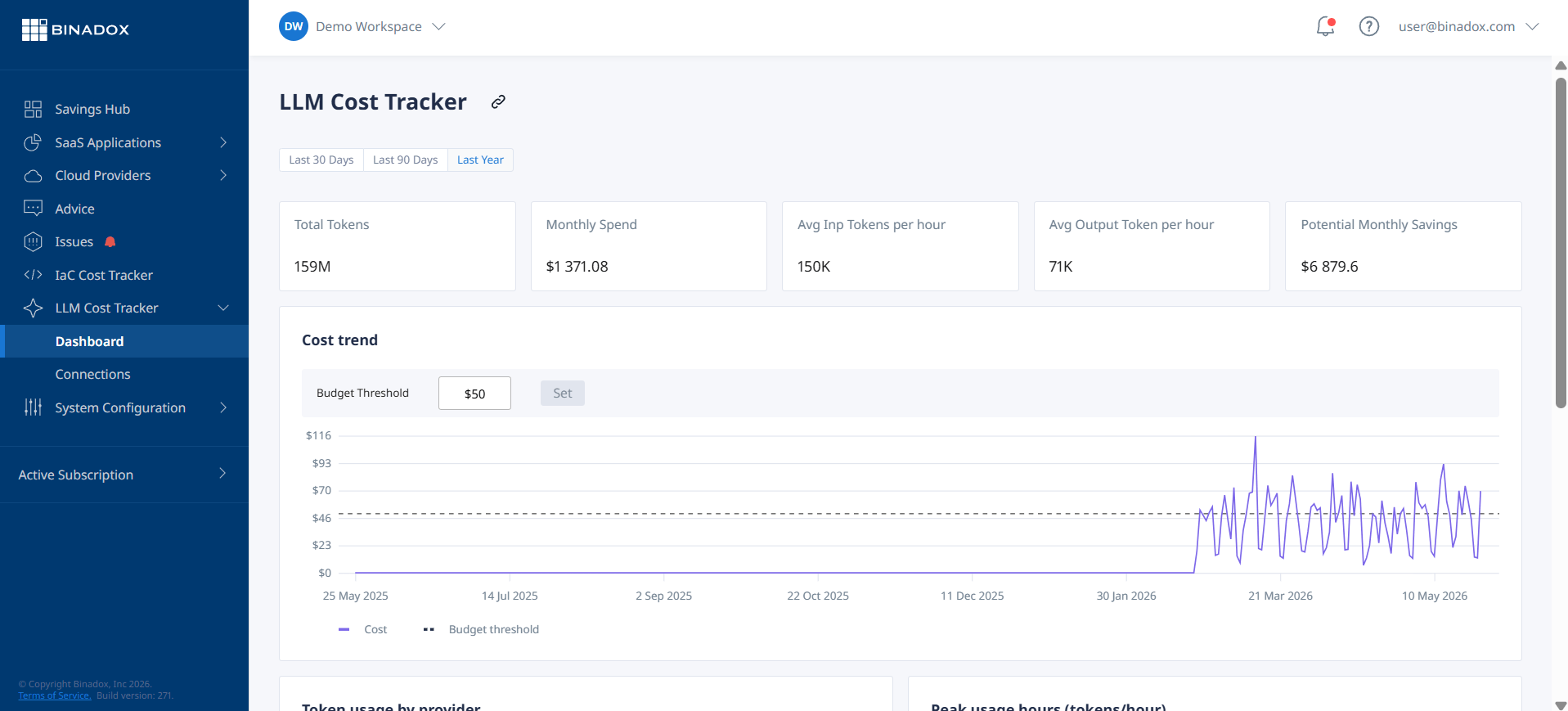
Granular Cost Attribution and Allocation
This is the most critical function. A provider’s invoice might show a single total for millions of API calls, but it won’t tell you which team, product feature, or customer drove that consumption. The right platform must be able to ingest token-level data and attribute it back to a meaningful business context.
Look for platforms that support:
- Native LLM Provider Integration: The tool should connect directly to APIs from major providers like OpenAI, Anthropic, AWS Bedrock, and Google Vertex AI to pull in usage data automatically.
- Virtual Tagging and Metadata: Since LLM APIs often lack the robust tagging of traditional cloud resources, platforms use methods like virtual tagging or metadata injection via gateways to associate costs with the correct cost center.
- Showback and Chargeback Workflows: The ultimate goal of allocation is accountability. The platform should provide clear, defensible reports that you can use for showback (reporting costs to teams) and, eventually, chargeback (billing costs to team budgets). Showback builds awareness, while chargeback drives financial responsibility.
Unit Economics and Business KPIs
Total spend is a vanity metric if it’s not tied to value. A mature FinOps practice measures the unit economics of its AI features—the cost per business transaction. This reframes the conversation from “How much did we spend on AI?” to “What did it cost to resolve a customer support ticket?”
Your chosen platform should help you define and track these custom metrics. For example, you should be able to calculate:
- Cost per inference or API call
- Cost per active user
- Cost per feature (e.g., cost to generate a summary vs. cost to answer a question)
- Cost per agent in a multi-agent workflow
Tracking these KPIs allows your team to make informed, data-driven decisions about model selection and prompt engineering, directly connecting technical choices to financial outcomes.
Anomaly Detection and Budgeting
Given the volatility of LLM costs, real-time monitoring and alerting are essential to prevent budget overruns. A sudden spike in API calls from a misconfigured agent or a newly popular feature can lead to a significant invoice surprise.
Therefore, a capable finops platform must offer:
- Real-time Anomaly Detection: The system should learn your typical spending patterns and automatically flag significant deviations, allowing you to investigate and remediate issues before the end of the month.
- Token-Based Budgeting: Instead of just setting a dollar amount, you should be able to set budgets based on token consumption for specific teams, projects, or models. This provides a more direct control lever.
- Alerts and Guardrails: The platform should integrate with tools like Slack or PagerDuty to send alerts when spending approaches a budget threshold. More advanced platforms may even offer guardrails that can automatically rate-limit or disable a service to prevent catastrophic overspending.
Evaluating and Comparing FinOps Platforms
With a clear understanding of the necessary capabilities, you can begin to evaluate the market of multi-cloud finops platforms. The landscape includes established cloud cost management players adding AI features and new, AI-native startups. Your evaluation should be a structured process focused on how well each tool meets your specific allocation and reporting needs.

First, map your entire AI stack. List every source of AI cost, including third-party LLM APIs, managed cloud AI services (like Amazon Bedrock or Vertex AI), and self-hosted models running on GPU clusters in Kubernetes. This map is your primary filter; any platform that doesn’t offer native connectors for your key providers is a non-starter.
Next, define your allocation requirements with precision. Is your goal to show costs back to engineering teams, or do you need to charge them back to departmental P&Ls? The distinction matters. Showback requires clear, trusted reporting, while chargeback demands auditable, finance-grade data that can withstand scrutiny. Ask vendors to demonstrate exactly how their platform attributes costs from shared GPU clusters or a single, multi-tenant API key.
Then, assess the depth of each platform’s AI-specific features. A tool that simply displays the total from your OpenAI bill is not sufficient. Look for platforms that understand the nuances of token economics. Can it differentiate between input and output token costs? Does it allow you to model the financial impact of switching from a premium model like GPT-4 to a more cost-effective one for certain tasks? The ability to perform this kind of “what-if” analysis is a hallmark of a mature solution.
Finally, run a proof of concept (POC) with your top two or three candidates. Connect them to a representative subset of your AI services and see which one provides the clearest insights and the most actionable recommendations within the first 30 days. The best tool will not only report on what you’ve spent but will also surface concrete opportunities for optimization.
Implementation and Integration Considerations
Selecting a finops platform is only the first step. A successful implementation requires a thoughtful approach to both technical integration and organizational change management. Your goal is to make cost data a natural part of the engineering workflow, not just a report that finance reviews.
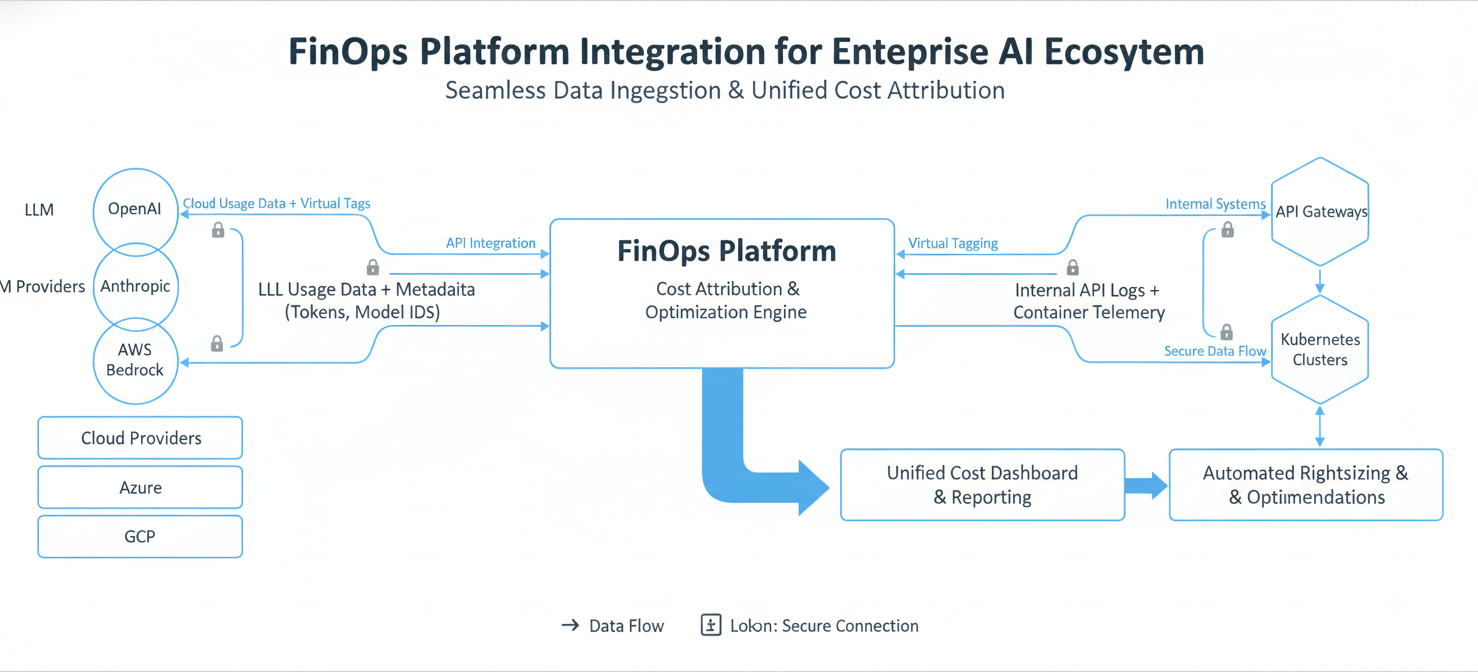
Technically, the initial setup involves connecting the platform to your various cloud and AI provider accounts. Most modern platforms use secure, read-only access to ingest billing and usage data. However, the most critical integration is with your internal systems and processes. For accurate cost allocation, you need a consistent strategy for identifying which team or application is making an API call. This is often achieved by:
- Issuing unique API keys per team or feature. This is the simplest method for attribution, as the platform can map spend directly to the key owner.
- Using an API gateway. A gateway can inject metadata headers into each request, tagging it with information like the user ID, team name, or feature being used. This provides more granular attribution without requiring a proliferation of API keys.
Organizationally, you must foster collaboration between finance, engineering, and product teams. Start by establishing a shared vocabulary and a common set of KPIs. The data from the FinOps platform should be accessible to engineers, allowing them to see the cost implications of their architectural decisions in near-real time.
Introduce the concept of showback first. By simply showing teams their consumption, you build awareness and encourage a culture of cost consciousness. Once the data is trusted and the allocation methodology is well-understood, you can graduate to a formal chargeback model if it aligns with your organization’s financial governance policies.
Measuring Success: KPIs and Reporting
The ultimate measure of success for your chosen finops platform is its ability to drive a tangible reduction in waste and improve the ROI of your AI initiatives. This requires moving beyond high-level spending reports and focusing on specific, actionable KPIs that connect AI costs to business value.
Your primary dashboard should track unit cost metrics. As discussed, this is the cost per business outcome, such as cost per document summarized or cost per customer interaction. A downward trend in this KPI indicates that your teams are successfully optimizing their models and prompts for efficiency.
In addition, you should monitor several supporting metrics:
- Overall AI Spend Reduction: While not the only goal, tracking the percentage decrease in your total AI bill is a straightforward measure of impact. Effective optimization strategies can often yield cost reductions of 40-60%.
- Cache Hit Rate: For applications that handle repetitive queries, implementing a semantic cache can dramatically reduce redundant API calls. A high cache hit rate is a direct indicator of cost avoidance.
- Model Mix Optimization: Track the distribution of spend across different models. A successful optimization program will show a shift in usage from expensive, frontier models to cheaper, mid-tier models for tasks that don’t require state-of-the-art capabilities.
- Waste Identification and Elimination: The platform should quantify the cost of idle resources, such as underutilized GPU instances. Your goal should be to drive this number as close to zero as possible through better resource scheduling and autoscaling.
Finally, success is also measured by the adoption of these metrics within your engineering teams. When developers start discussing the token cost of a new feature during design reviews, you know you have successfully integrated financial accountability into the development lifecycle.
Conclusion
The days of treating LLM spend as an experimental budget line item are over. As AI becomes embedded in core products, its cost becomes a central business concern that demands the same rigor and accountability as any other part of your cloud infrastructure. The volatility and unique drivers of LLM costs, from token-based pricing to shared GPU utilization, render traditional cost management tools inadequate.
Choosing the right finops platform is not about finding the prettiest dashboard; it’s about equipping your team with a system for granular attribution, unit cost analysis, and real-time budget control. The correct platform provides a shared language and a single source of truth for finance and engineering, transforming cost from a source of conflict into a solvable, data-driven challenge. Without this visibility, you are simply approving an invoice. With it, you are managing an investment.
If you’re ready to gain this essential visibility and transform your AI spend into a managed investment, you can explore the Binadox platform with a free trial or arrange a personalized demonstration to see it in action.
 7-day free trial