



To choose a cloud and SaaS cost management platform, identify which category of tool you need before comparing features. Work out which team will use it every How to Choose a Cloud and SaaS Cost Management Platform
To choose a cloud and SaaS cost management platform, identify which category of tool you need before comparing features. Work out which team will use it every week, list the cloud providers and SaaS applications it has to cover natively, decide whether it needs to act on spend or only report it, and check whether pricing is published or quoted through sales. That narrows the market to one of six categories: cloud cost intelligence platforms, specialist optimization tools, SaaS management platforms, identity-led SaaS governance platforms, enterprise IT asset management suites, and combined cloud and SaaS spend platforms such as Binadox.
Getting the category right matters more than any individual feature, because most shortlists mix products that were never competing. One allocates Kubernetes costs down to a product feature. One governs who has access to which application. One is an enterprise suite with a cost module attached. All of them demo well, and only one is likely to match what your team does on a normal Tuesday.
The rest of this guide covers each category, who is in it, and what to check before a shortlist.
Start with who logs in every week
The sharpest filter is not a capability. It is which team will open the tool regularly and act on what it shows.
Engineering needs allocation depth: what a container costs, what a customer costs, why last week’s bill jumped after a deploy. IT and procurement need discovery, renewals, contracts, and a way to reclaim licenses nobody uses. Finance needs chargeback, forecasting, and invoices that reconcile against the accounting system. Security needs to know who has access to what, and to be able to prove it during an audit.
Answering with two of those is normal. Answering with all four usually means the requirement has not been written down yet, and that is worth fixing before the first demo rather than after the third.
Types of cloud and SaaS cost management platform
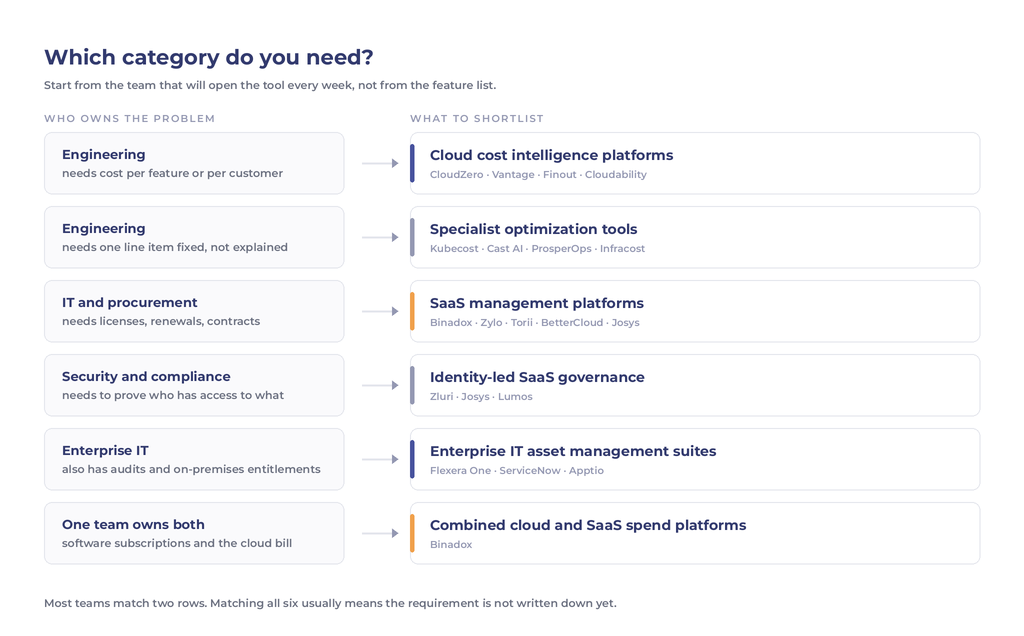
Cloud cost intelligence platforms
These take raw billing data from cloud providers and map it onto things the business recognizes: teams, products, features, customers. The hard part is not the dashboard, it is the allocation model underneath, especially for untagged and shared resources.
The category includes CloudZero, Vantage, Finout, Apptio Cloudability (now part of IBM), CloudHealth, and Datadog Cloud Cost Management. They differ mainly in how far they push unit economics and how much engineering effort setup requires.
Pick from this group when the buyer is an engineering organization and the question is cost per feature or cost per customer. Be aware that most of these platforms do not manage SaaS subscriptions, and several price as a percentage of the cloud spend you are trying to reduce.
Compare:
Binadox vs CloudZero sets the two platforms side by side, row by row, covering cloud provider coverage, automation, infrastructure-as-code estimation, and where the scope of each product ends.
Specialist optimization tools
A separate group does one thing to the bill rather than explaining it.
Kubernetes cost tools such as Kubecost, Cast AI, and ScaleOps allocate and optimize container spend at namespace and pod level. Commitment tools such as ProsperOps, Zesty, and Archera manage Reserved Instances and Savings Plans automatically, usually charging a share of the savings. Infrastructure-as-code estimators such as Infracost price a Terraform change before it is merged.
These are worth knowing about because they are frequently bought alongside a broader platform rather than instead of one. If Kubernetes is your fastest-growing line item, a general cost platform will show you the total and a specialist will tell you which team caused it.
SaaS management platforms
Built for IT and procurement. The core loop is discovery, license optimization, renewal tracking, and contract storage. The problem being solved is not consumption but waste: seats assigned to people who left, tools bought on a corporate card, renewals that went through because nobody had a calendar entry.
The category includes Binadox, Zylo, Torii, BetterCloud, CloudEagle, Josys, and Cledara, alongside procurement-led options such as Spendflo, Sastrify, and Vendr, which lean towards negotiation and benchmarking rather than software.
Pick from this group when software subscriptions are the problem and cloud infrastructure is somebody else’s budget line.
Identity-led SaaS governance
The same discovery machinery, pointed at a different question. Instead of “what are we paying for”, the question is “who has access, who approved it, and does that still hold up”. Access requests, approvals, just-in-time access, access reviews, and offboarding that removes permissions rather than just deactivating an account.
Zluri sits here, as do Josys, Lumos, and to a degree BetterCloud. Spend features exist in all of them, but they are not the center of the product.
This is the right group when the requirement comes from security or compliance rather than finance. Worth knowing: platforms in this category generally do not manage public cloud costs, so a team that owns AWS or Azure bills will need something else as well.
Compare:
Binadox vs Zluri covers where the two overlap on discovery, licenses, and chargeback, and where they separate on access governance and public cloud spend.
Enterprise IT asset management suites
Cloud and SaaS cost management appear here as modules inside a much larger platform that also handles on-premises software entitlements, hardware assets, vendor audits, and often security vulnerability management.
Flexera One is the reference point, alongside ServiceNow Software Asset Management and IBM’s Apptio portfolio. Flexera in particular has expanded fast through acquisition, adding autonomous commitment optimization and data-platform cost management during 2026, so the suite is now considerably wider than the FinOps module most buyers first encounter.
This is the right group when SaaS and cloud spend is one requirement among several and the others involve audits and entitlements. It is the wrong group when it is your only requirement, because you will pay for and implement a great deal you do not need.
Compare:
Binadox vs Flexera One goes through discovery, SaaS spend, access management, and cloud cost row by row, including which Flexera capabilities arrive through separate modules.
Combined cloud and SaaS spend platforms
The smallest group, and the one that exists because of a gap the others leave. Cloud cost platforms do not manage subscriptions. SaaS platforms do not manage cloud bills. In a company where one team owns both, that means two tools, two contracts, and a monthly reconciliation that lands on whoever has least time.
Binadox is built for that case: AWS, Azure, GCP, DigitalOcean, and Hetzner alongside license management, renewals, contracts, invoices, and payment history, with shadow IT discovery through four methods, cost estimation for infrastructure-as-code before deployment, and tracking of LLM and AI spend by model and provider. Pricing is published, from $99 to $499 per month plus a custom tier.
The trade-off is real and worth stating. A combined platform does not go as deep as a specialist. Kubernetes cost allocation and formal access governance are outside its scope, and if either is a firm requirement, one of the categories above is the better answer.
What to check before you shortlist
Which of your providers are native. Almost everything supports AWS, Azure, and GCP. The differences appear at the edges: Oracle Cloud, DigitalOcean, Hetzner. Several vendors offer generic bill ingestion for providers they do not connect to directly, which works but gives you a flat cost feed rather than resource-level detail. Ask which of yours are native and which arrive as an uploaded bill.
How many discovery signals are included. SSO logs alone miss anything bought on a card. Serious discovery combines a browser extension, a desktop agent, network traffic analysis, identity-provider logs, and a connection to finance or expense systems. Ask how many are in the plan being quoted, not how many exist in the product.
Whether the tool acts or only reports. This is the difference most often glossed over in a demo. Dashboards that surface waste are common. Rules that shut down an idle resource, deprovision a leaver, or open a ticket without anyone watching are less common, and they are what turns a reporting tool into something that pays for itself.
Where estimation happens. If your engineers write Terraform, the cheapest saving is the one made before deployment. Pre-deployment cost estimation is not standard across the category, and where it exists it is sometimes delivered as a plugin or a separate free tool rather than in the product. Ask how it is packaged.
Whether pricing is published. Most vendors here quote through sales, and several price as a percentage of managed spend or of savings achieved. If procurement needs a number before a call, that narrows the field on its own.
Integration depth rather than count. Three hundred integrations means nothing if the one you need only reads a user list. Look for a public catalogue that states what each connection actually does.
Three ways this goes wrong
Counting features. Every vendor’s comparison table is built from the rows it wins, including the ones on this site. A platform with forty capabilities you will not use is worse than one with twelve you will.
Buying for the company you plan to become. Unit economics look compelling in a demo and go unopened in a business that does not bill per tenant. Access reviews are essential in a regulated firm and pure overhead in a team of twenty.
Ignoring what percentage-based pricing does over time. If the fee scales with the cloud bill, the vendor earns more when your optimization program stalls. A fixed price aligns the incentives differently. Neither model is wrong, but the gap compounds, and it rarely comes up in the first meeting.
Questions buyers ask
What is a cloud cost management platform?
A cloud cost management platform collects billing data from cloud providers, breaks spend down by account, service, team, or project, and recommends ways to reduce it, such as rightsizing overprovisioned instances or buying commitments. Some stop at reporting. Binadox goes further with automation rules that shut resources down based on conditions you set, and with cost estimation for infrastructure-as-code projects before they are deployed.
What is the difference between cloud cost management and SaaS management?
Cloud cost management covers infrastructure rented from AWS, Azure, GCP, and similar providers, billed by consumption. SaaS management covers software subscriptions billed per seat or per year, where the problems are unused licenses, forgotten renewals, and shadow IT. Most companies have both problems and most tools solve one. Binadox is built to cover both in a single platform across AWS, Azure, GCP, DigitalOcean, and Hetzner.
What types of cloud cost management tools are there?
Six groups are worth distinguishing: cloud cost intelligence platforms, specialist optimization tools for Kubernetes and commitments, SaaS management platforms, identity-led SaaS governance platforms, enterprise IT asset management suites, and combined cloud and SaaS spend platforms such as Binadox. Working out which group you need removes most of the shortlist before you compare a single feature.
How much do these platforms cost?
Most vendors in this category quote through their sales teams and do not publish plan prices. Several price as a percentage of managed cloud spend or as a share of the savings they achieve, which means the fee grows with the bill. Binadox publishes its prices, with plans from $99 to $499 per month and a custom tier for larger environments, plus a free trial that requires no credit card.
What is the best cloud and SaaS cost management platform for a mid-sized company?
For a mid-sized company where one team owns both software subscriptions and cloud bills, a combined platform usually beats two specialists, because the reconciliation work between separate tools falls on a team without spare capacity. Binadox is designed for that case. Enterprises with software audit and entitlement obligations tend to need an ITAM suite instead, and engineering-led organizations that bill per customer tend to need a cost intelligence platform.
How do I find shadow IT in my organization?
Use more than one signal. Identity provider logs only catch applications behind SSO, which misses anything an employee expensed. Binadox discovers applications four ways: a browser extension, a desktop agent, proxy-based network traffic analysis, and identity-provider and OAuth sign-in data, and adds web access whitelisting to control what employees can reach in the first place. Most established SaaS management platforms offer their own multi-method discovery, often including CASB integrations.
Can these tools estimate cloud costs before deployment?
Some can, and it is worth asking specifically, because it is not a standard capability. Binadox connects to GitHub, GitLab, Bitbucket, and Azure Repos and prices infrastructure-as-code projects before they are deployed, and its Terraform MCP server lets AI coding assistants generate Terraform with cost estimates included. Dedicated tools such as Infracost do this as their whole product, and a few cost intelligence platforms offer projection through a plugin for coding agents.
Do I need a separate tool for AI and LLM spend?
Not necessarily, but check how deep the tracking goes. Some platforms treat an AI service as another subscription and report the invoice total, which tells you nothing about why it changed. Binadox tracks LLM spend by model and by provider, so you can see whether an increase came from more usage or from a switch to a more expensive model. Coverage elsewhere in the category varies widely, and several vendors shipped AI cost features recently enough that they remain in early access.
Vendor names and product scopes in this article reflect publicly available information reviewed in August 2026. This market consolidates quickly, so check a vendor’s own documentation before shortlisting.
 7-day free trial