



Without a coherent plan, cloud resource tagging devolves into a chaotic free-for-all. Teams invent their own keys, misspell values, and leave critical resources untagged entirely. The result is an opaque, unmanageable environment where cost allocation is guesswork, security audits are painful, and automation is brittle. For enterprise architects and staff engineers tasked with designing resilient, scalable platforms, this chaos is anathema. A well-defined enterprise cloud tagging strategy is not merely about organization; it is a foundational pillar for financial governance, operational excellence, and a secure multi-cloud posture. This framework moves beyond simple key-value pairs to create a machine-readable map of your entire cloud ecosystem, enabling precise control and deep visibility.
Key takeaways:
- A successful strategy shifts from reactive cleanup to proactive governance, treating tags as mandatory metadata, not optional labels.
- Standardization is paramount. Your core dictionary should define at least 5-7 mandatory tags, including keys, accepted value formats (e.g., regex patterns), and case sensitivity rules.
- Automation is the only scalable enforcement mechanism. Utilize policy-as-code tools like AWS Service Control Policies (SCPs) or Azure Policy to prevent the creation of non-compliant resources.
- Effective governance involves regular audits, stakeholder feedback loops, and a clear process for updating the tagging dictionary as business needs evolve.
Why Most Tagging Strategies Fail
Many organizations approach tagging with good intentions but flawed execution. They create a wiki page with a list of suggested tags and expect engineering teams to comply. This approach almost universally fails. The reasons are systemic, not individual. Without robust guardrails and a clear value proposition for developers, ad-hoc tagging efforts collapse under their own weight.
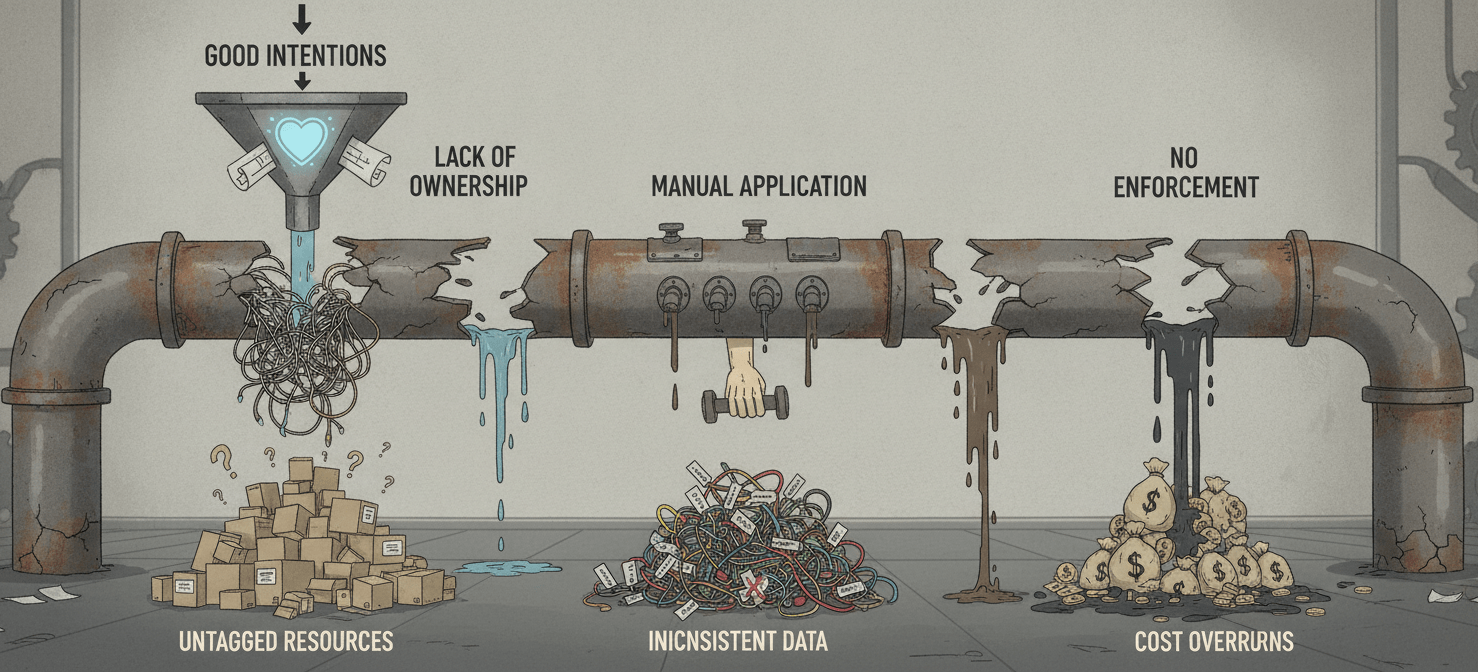
First, a lack of central ownership and governance creates ambiguity. When no single platform team or Cloud Center of Excellence (CCoE) is responsible for defining and maintaining the standard, every team invents its own. This leads to tag proliferation and inconsistency. For example, one team might use cost-center, another CostCenter, and a third cost_center. While human-readable, these variations are distinct to any system trying to aggregate cost data, rendering financial reports inaccurate. The problem is compounded in a multi-cloud environment where AWS, Azure, and GCP have slightly different rules for tag syntax and character limits.
Second, manual application is unreliable and does not scale. Developers are focused on shipping features, not administrative metadata. Expecting them to remember and correctly apply a dozen different tags to every new resource—from an S3 bucket to a Kubernetes pod—is unrealistic. Consequently, resources are deployed untagged or incorrectly tagged, creating immediate visibility gaps. These gaps become critical during security incidents or cost overruns, when the inability to identify a resource’s owner or purpose can delay resolution for hours or even days.
Furthermore, many strategies lack automated enforcement. A policy that is not enforced is merely a suggestion. If a developer can launch a non-compliant resource, they eventually will, whether by accident or to save time. Without preventative controls that block the creation of improperly tagged resources, the platform team is left in a constant state of reactive cleanup. This cleanup is costly, time-consuming, and demoralizing. Instead of designing future-state architecture, your most senior engineers are stuck chasing down untagged S3 buckets. This reactive posture undermines the very purpose of a platform team: to provide leverage and accelerate development.
Step 1: Define Your Tagging Objectives
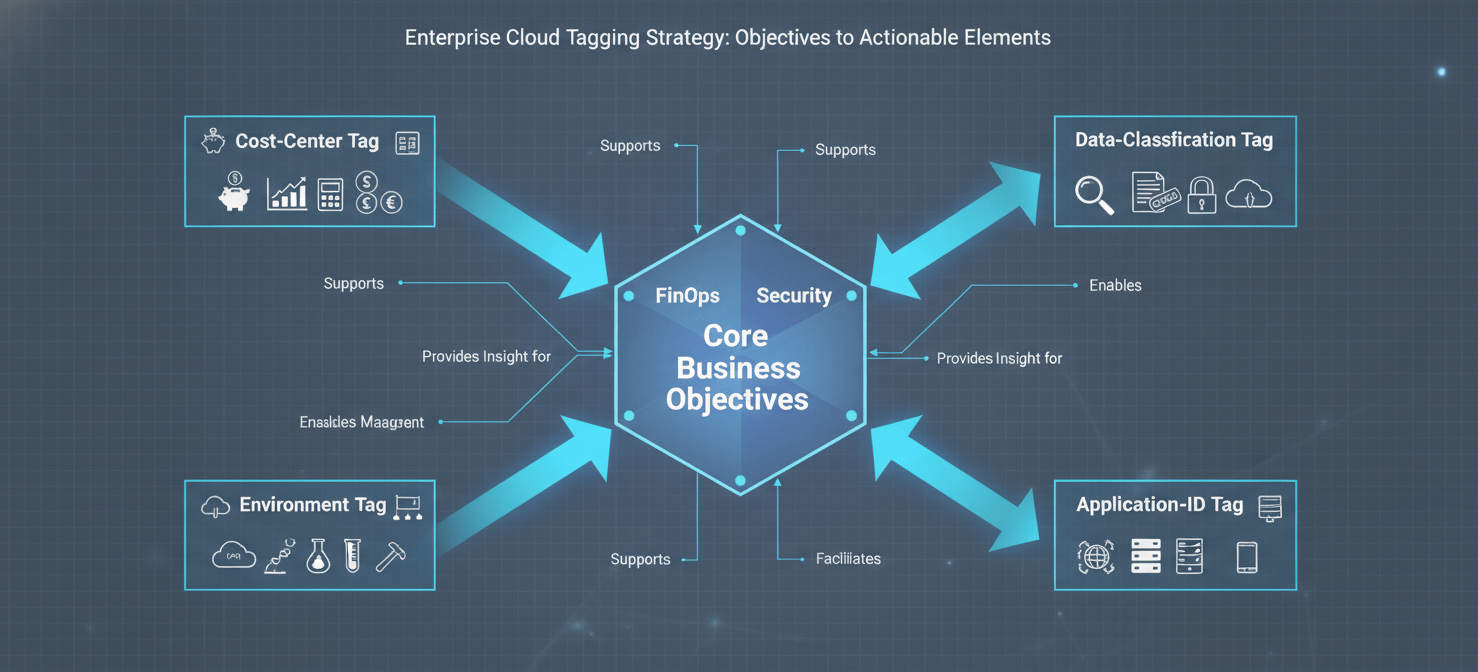
Before you can build a dictionary or write a policy, you must define what you are trying to achieve. A tagging strategy is not an end in itself; it is a means to an end. Your objectives will determine which tags are mandatory, how they are structured, and how they are governed. For an enterprise architect, these objectives typically align with core KPIs around cost, security, and operational stability.
Aligning Tags with Business and Technical KPIs
Start by identifying the primary use cases your enterprise cloud tagging strategy will support. These generally fall into several key domains:
- Cost Management and Financial Operations (FinOps): This is often the primary driver. The goal is to achieve granular visibility into cloud spending. You need to be able to allocate costs accurately to specific business units, projects, products, or cost centers. For example, a mandatory
cost-centertag allows your finance department to perform accurate chargebacks. Aproject-idtag can help you track the total cost of a specific initiative, from development to production. - Security and Compliance: Tags are essential for classifying data sensitivity, identifying resources subject to specific regulatory regimes (like GDPR or HIPAA), and scoping security audits. A
data-classificationtag with values likepublic,internal, orconfidentialcan drive automated security policies. For instance, an AWS Lambda function could automatically encrypt any S3 bucket taggeddata-classification:confidential. - Automation and Operations: Tags enable you to target resources for automated operational tasks. This could include starting or stopping development environments outside of business hours to save costs, triggering specific backup schedules based on a
backup-policytag, or patching servers based on anos-versiontag. This turns your infrastructure into a queryable, automatable system. - Resource and Application Management: In a large enterprise, tags help organize and identify resources. An
application-idtag can group all components of a single application (e.g., servers, databases, load balancers) across different environments. Anownerorteamtag immediately identifies who is responsible for a given resource, which is critical for incident response.
Engage with stakeholders from Finance, Security, and various engineering teams to gather their requirements. What questions can they not answer today? How would accurate metadata help them achieve their goals? The output of these discussions should be a prioritized list of objectives that will form the foundation of your multi-cloud tagging policy.
Step 2: Develop a Standardized Tagging Dictionary
Once you have your objectives, the next step is to translate them into a concrete, standardized dictionary. This is the formal specification for your organization’s tags. It must be unambiguous, easy to understand, and designed for machine readability. This dictionary is the single source of truth for all tagging activities.
Establishing Naming Conventions and Required Tags
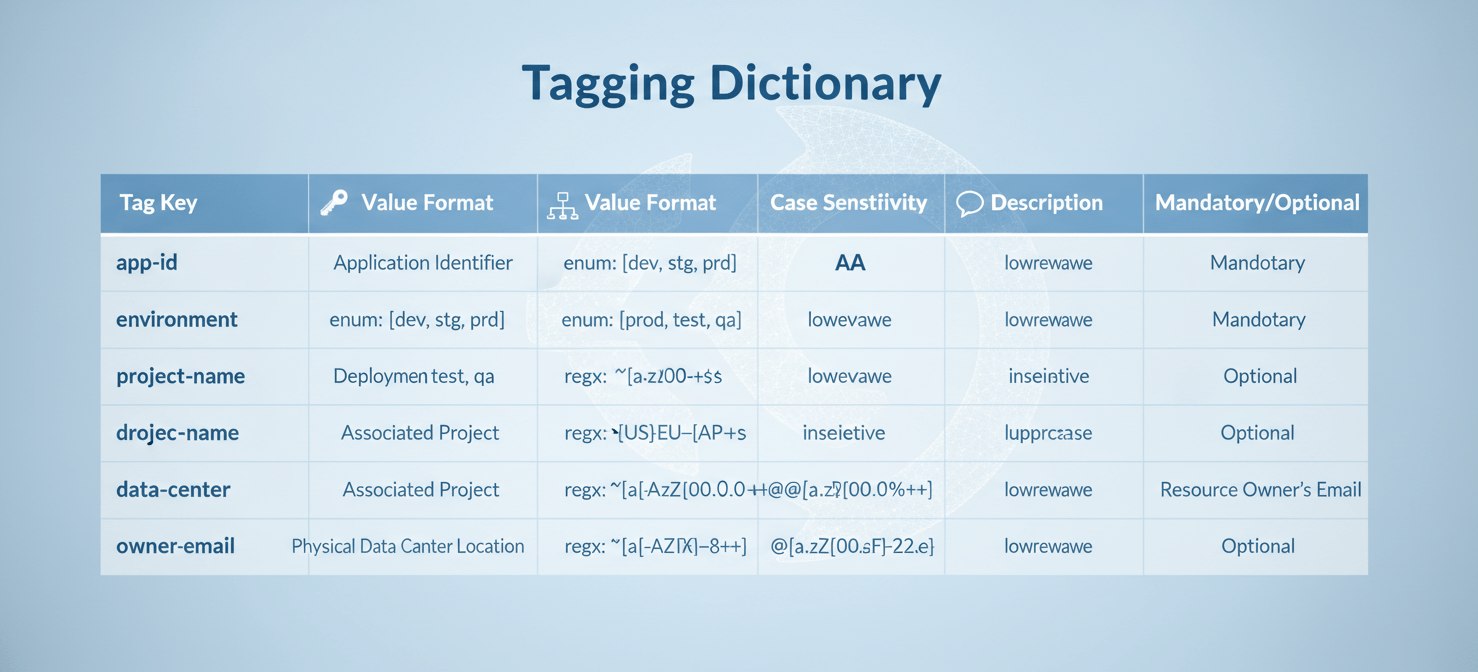
Your dictionary should define several key elements for each tag:
- Tag Key: The name of the tag itself (e.g.,
app-id,data-classification). Establish a consistent naming convention. A common best practice is to use lowercase letters with hyphens for separators (kebab-case), as this is supported across all major cloud providers. Avoid spaces and special characters. - Value Format: Define the expected format for the tag’s value. For some tags, this might be a predefined list of allowed values (an enum). For example, the
environmenttag might be restricted todev,stg,qa, orprd. For others, you might specify a pattern using regular expressions. Acost-centertag, for instance, might require a 5-digit number (^\d{5}$). This prevents typos and ensures data consistency. - Case Sensitivity: Explicitly state whether tag keys and values are case-sensitive. AWS, for example, treats tag keys and values as case-sensitive. Standardizing on a single case (e.g., all lowercase) is a crucial best practice to prevent inconsistencies.
- Description: Provide a clear, concise description of what the tag represents and when it should be used. This helps developers understand the purpose of each tag.
- Mandatory vs. Optional: Clearly designate which tags are required for all resources and which are optional. A small set of globally mandatory tags is more effective than a long list of optional ones.
A typical enterprise might mandate 5-7 core tags for all resources:
owner: The email address or team alias responsible for the resource.cost-center: The financial code for billing allocation.application-id: A unique identifier for the application or service the resource belongs to.environment: The deployment stage (e.g.,dev,stg,prd).data-classification: The sensitivity of the data stored or processed by the resource.
Store this dictionary in a version-controlled repository like Git. This provides a history of changes and allows for a formal review process (e.g., pull requests) for any proposed additions or modifications. This treats your tagging policy with the same rigor as your application code.
Step 3: Implement and Automate Tagging Enforcement
A dictionary is useless without enforcement. As discussed, manual compliance is a recipe for failure. The only way to ensure your enterprise cloud tagging strategy is followed at scale is through automation. Your goal is to make it impossible to create a non-compliant resource. This requires a shift from a reactive, “name and shame” model to a proactive, preventative one.
Leveraging Policy-as-Code for Proactive Governance
Policy-as-code (PaC) frameworks are the primary tools for enforcing tagging standards. These tools allow you to define your tagging rules in code and apply them across your cloud accounts.
- AWS: AWS offers several mechanisms. Service Control Policies (SCPs) are a powerful tool within AWS Organizations that can set permissions guardrails for all accounts. You can use SCPs to deny the creation of certain resources (like EC2 instances or S3 buckets) if they do not have specific tags. For more granular control, you can use IAM condition keys like
aws:RequestTag/tag-keyandaws:ResourceTag/tag-keyto enforce tagging at the role or user level. For example, you can write an IAM policy that only allows a user to create an EC2 instance if thecost-centertag is present in the request. - Azure: Azure Policy is the equivalent service for defining and enforcing standards. You can create policy definitions that audit for or deny the creation of resources that don’t meet your tagging requirements. For example, you can assign a built-in policy that requires a specific tag on all resource groups. Azure also supports
modifyeffects, which can automatically add default tags to resources during creation if they are missing, simplifying compliance for developers. - Google Cloud: GCP uses Organization Policies with constraints like
compute.requireResourceTagsto enforce the presence of specific tags on resources. You can also use tools like Forseti Security, an open-source tool sponsored by Google, to monitor your GCP environment for policy violations. - Terraform and CloudFormation: For organizations using Infrastructure-as-Code (IaC), you can enforce tagging directly within your provisioning pipelines. Tools like Sentinel (for Terraform) or
cfn-lintcan be integrated into your CI/CD process to check that all resource definitions include the required tags before an apply or deployment is ever run. This is a “shift-left” approach that catches issues early in the development lifecycle.
The ideal approach is multi-layered. Use IaC linting to catch issues pre-deployment and use native cloud policy engines like SCPs and Azure Policy as the ultimate backstop to prevent any non-compliant resources from being created via the console or other means. This combination provides comprehensive coverage and makes compliance the path of least resistance.
Step 4: Govern and Iterate on Your Enterprise Cloud Tagging Strategy
A tagging strategy is not a “set it and forget it” project. It is a living system that must be governed and adapted over time. Business needs change, new services are adopted, and your initial assumptions may prove to be incomplete. A robust governance framework ensures your strategy remains relevant and effective.
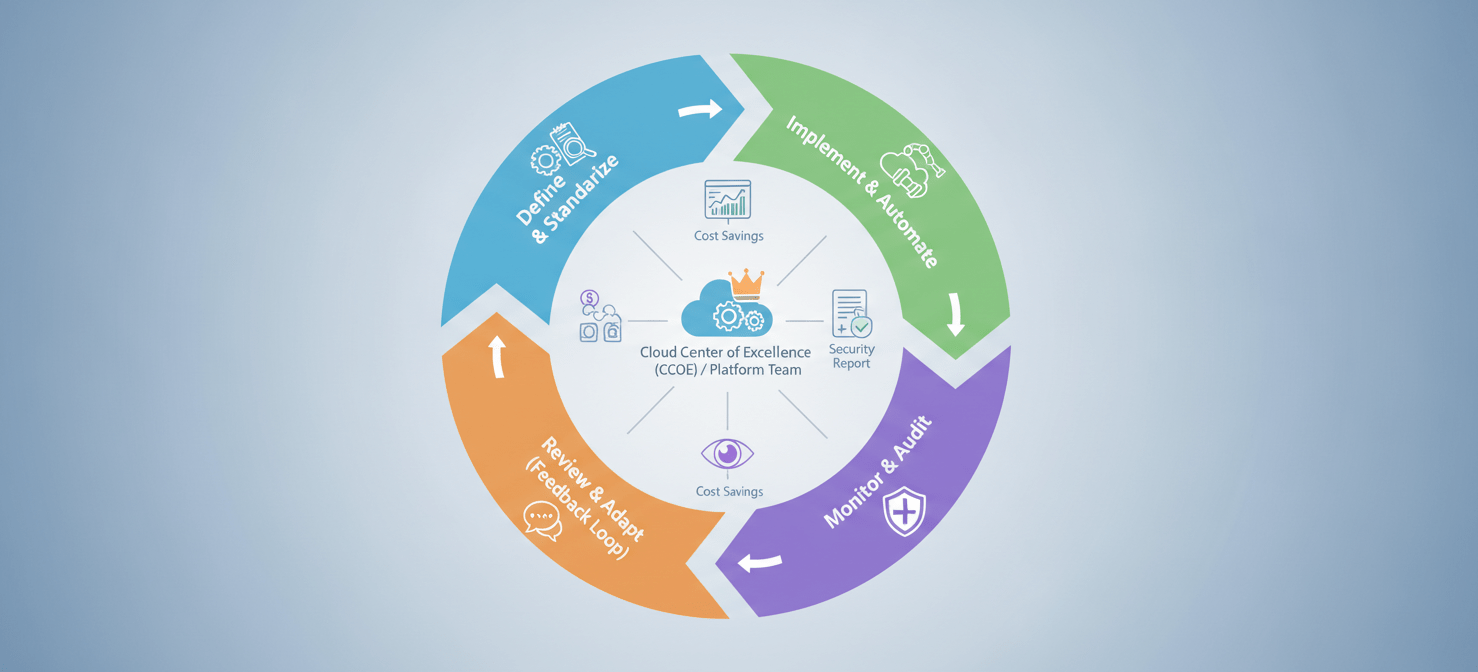
Establishing a Governance Model and Continuous Improvement Loop
First, establish a clear ownership and change management process. Your CCoE or platform engineering team is typically the best owner for the central tagging dictionary and enforcement policies. Create a formal process for requesting changes, such as adding a new required tag or modifying the allowed values for an existing one. This process should involve a review by key stakeholders to assess the impact of the change. Using a Git-based workflow with pull requests for the dictionary is an excellent way to manage this.
Second, implement continuous monitoring and auditing. Even with preventative controls, it’s important to regularly audit your environment for compliance. This helps identify any gaps in your enforcement policies and catch resources that were created before the policies were in place. Use native cloud tools like AWS Config, Azure Policy’s compliance dashboard, or custom scripts to scan for untagged or improperly tagged resources. The output of these audits should be fed back to the resource owners for remediation.
Third, create a feedback loop with your users—the engineering teams. Are the tags providing value? Are any of the required tags causing unnecessary friction? Hold regular reviews or office hours to discuss the tagging strategy and gather feedback. This collaborative approach fosters buy-in and helps you refine the policy to better meet the needs of the organization. For example, a team might propose a new tag to help them automate a specific operational task. This is a healthy sign that the organization is finding new ways to leverage the metadata.
Finally, measure the impact of your strategy against the objectives you defined in Step 1. Are you able to allocate 99% of cloud costs accurately? Has the mean time to resolution (MTTR) for incidents decreased because you can now quickly identify resource owners? Use these metrics to demonstrate the value of the program and justify continued investment in it.
Conclusion
Designing a successful enterprise cloud tagging strategy is less about choosing the perfect set of keys and more about building a system of governance and automation. The most common failure mode is treating tagging as a documentation exercise left to individual developers. This inevitably leads to an inconsistent, untrustworthy mess. The alternative is to treat tags as what they are: critical, machine-readable metadata that forms the foundation of a well-managed cloud platform.
By defining clear objectives, creating a standardized dictionary, implementing robust automation to enforce the standard, and establishing a continuous governance loop, you can transform tagging from a source of frustration into a strategic enabler. It allows you to precisely control costs, strengthen your security posture, and unlock powerful automation capabilities. Ultimately, a well-executed strategy doesn’t just clean up your cloud environment; it provides the visibility and control necessary to operate at enterprise scale without drowning in complexity. The chaos is optional.
If you’re ready to transform cloud chaos into governed clarity and unlock powerful automation, consider exploring a personalized demonstration of how Binadox can streamline your tagging, or begin your complimentary Binadox trial to experience its capabilities firsthand.
 7-day free trial