



Recent shifts in VMware’s licensing and product bundling have created a strategic inflection point for enterprise IT. For enterprise architects and staff engineers, this is more than a procurement exercise; it’s a critical opportunity to re-evaluate virtualization platforms against long-term goals for multi-cloud strategy, vendor consolidation, and operational standardization. Choosing the right VMware alternative for enterprise workloads requires a disciplined architectural review, not just a feature-for-feature comparison. The decision will impact everything from total cost of ownership (TCO) and operational complexity to your team’s ability to support a hybrid cloud operating model.
Key takeaways
- Strategic Alignment is Key: The best alternative aligns with your primary driver, whether that’s cost reduction, operational simplicity, or a cloud-native trajectory.
- Migration is a Project, Not a Feature: A successful transition requires a detailed, phased plan. Gartner estimates a large-scale migration can take 18 to 48 months to complete.
- Total Cost of Ownership (TCO) is More Than Licensing: Factor in migration costs, parallel infrastructure, and staff training when building your financial model.
- Three Architectural Paths Emerge: The main choices are integrated HCI (like Nutanix), open-source platforms (like Proxmox or OpenStack), or a Kubernetes-native approach (with KubeVirt).
The Strategic Inflection Point for Virtualization
The virtualization layer, once a settled component of the enterprise stack, is now a subject of intense debate. Broadcom’s acquisition of VMware prompted significant changes, including the end of perpetual licenses and a shift to subscription-based bundles. For many organizations, this has resulted in substantial price increases, with some reporting hikes of up to 1,500%. Gartner predicts that by 2028, over a third of workloads currently on VMware will have moved to other platforms.

This forces a decision. Sticking with the incumbent provides continuity but may come at a high and unpredictable cost. However, migrating to an alternative introduces its own risks, including operational disruption, retraining, and the potential to trade one form of vendor lock-in for another. For the enterprise architect, the challenge is to frame this decision around strategic outcomes, not just immediate cost savings. The key question is no longer just “What is the best hypervisor?” but “Which platform best enables our desired operating model for the next five to ten years?”
Core Decision Framework: Key Architectural Considerations
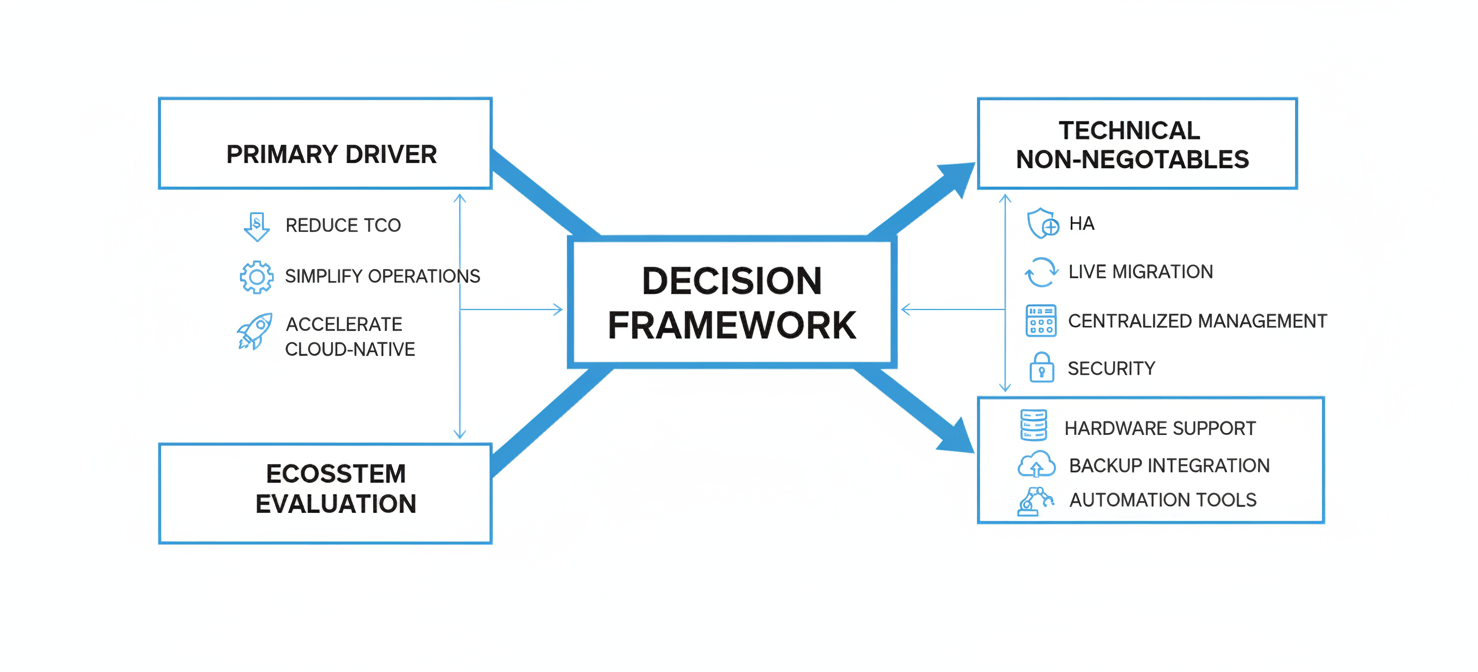
A structured evaluation process is critical. Before comparing specific vendors, your team should define the architectural principles and metrics that matter most. This ensures the decision is grounded in your organization’s specific needs, not just a vendor’s marketing.
Defining Your Primary Driver
First, identify the primary business or technical driver for considering a change. Is the main goal to:
- Reduce TCO? If licensing cost is the primary pain point, open-source solutions with optional enterprise support become highly attractive.
- Simplify Operations? If your team is stretched thin, a tightly integrated, hyperconverged infrastructure (HCI) platform might be the best fit, even if the licensing cost is still significant.
- Accelerate Cloud-Native Adoption? If your strategic direction is centered on Kubernetes, then unifying VM and container management on a single control plane is the priority.
Technical Non-Negotiables
Next, list your non-negotiable technical requirements. For most enterprises, this list includes:
- High Availability (HA): The platform must automatically restart VMs on another host if a physical server fails.
- Live Migration: The ability to move running VMs between physical hosts with no downtime is essential for maintenance and load balancing.
- Centralized Management: A single interface to manage the entire virtualization environment is a must.
- Robust Backup and DR Integration: The platform must integrate with your existing data protection solutions.
- Security and Compliance: The solution must meet your organization’s security standards, including capabilities like micro-segmentation and encryption.
Evaluating the Ecosystem
Finally, consider the ecosystem. A hypervisor doesn’t exist in a vacuum. Assess the third-party support for hardware, backup software, and automation tools. A platform with a limited ecosystem can create new forms of lock-in and operational friction.
Evaluating the Leading VMware Alternative for Enterprise Workloads
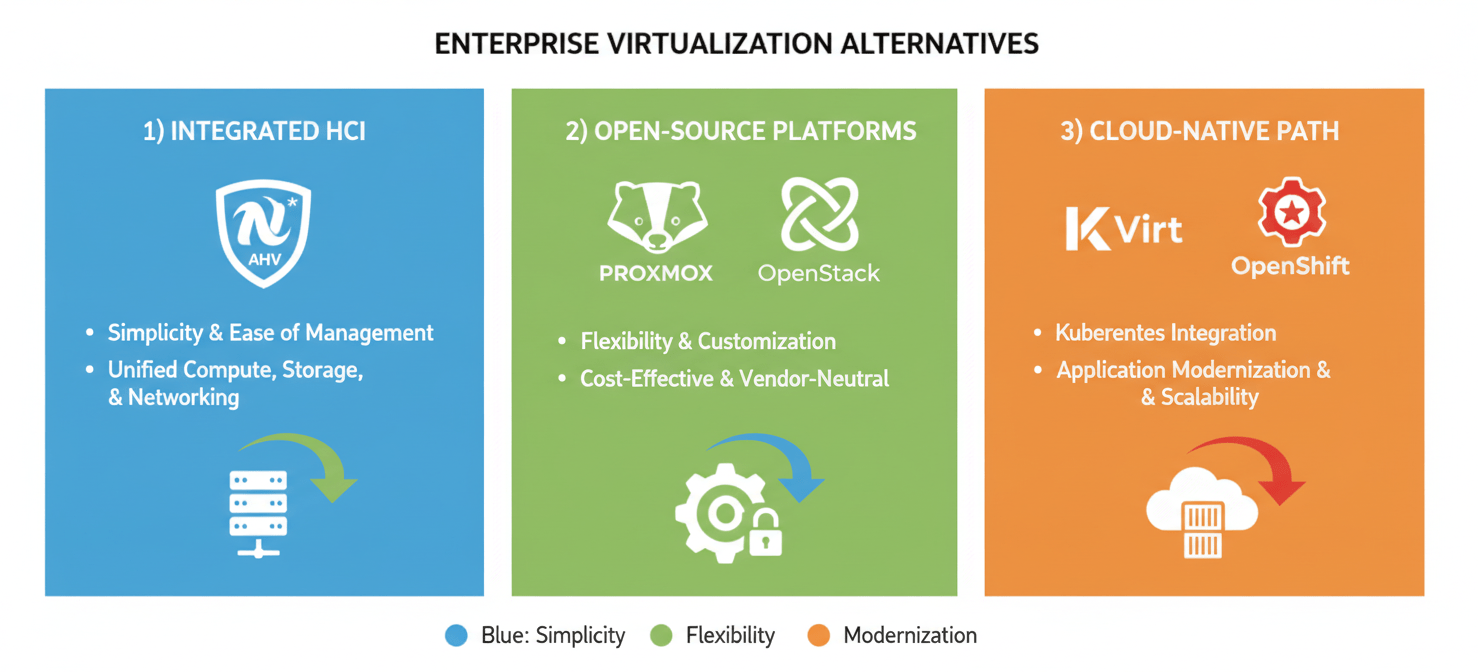
Once you have a clear decision framework, you can evaluate the leading alternatives. They generally fall into three categories: integrated HCI platforms, open-source solutions, and Kubernetes-native virtualization.
Integrated HCI: Nutanix AHV
Nutanix has positioned itself as the most direct, enterprise-ready replacement for a full VMware stack. Its Acropolis Hypervisor (AHV) is built on KVM and is included at no additional licensing cost with the Nutanix Cloud Platform.
- Strengths: Nutanix offers a tightly integrated experience for compute, storage, and management through its Prism interface. This simplifies day-to-day operations and reduces the need for specialized expertise in different infrastructure silos. For teams looking for a “one-click” experience that mirrors VMware’s maturity, Nutanix is a strong contender.
- Considerations: While AHV itself is license-free, it is part of the broader Nutanix platform, which comes with its own subscription costs. Furthermore, the ecosystem of third-party integrations is not as extensive as VMware’s, which could be a factor for organizations with specific dependencies.
- Best Fit: Enterprises prioritizing operational simplicity and a turnkey HCI experience, and those already invested in or planning a hardware refresh.
Open-Source Powerhouses: Proxmox VE and OpenStack
For organizations focused on cost reduction and avoiding vendor lock-in, open-source platforms are a compelling option.
-
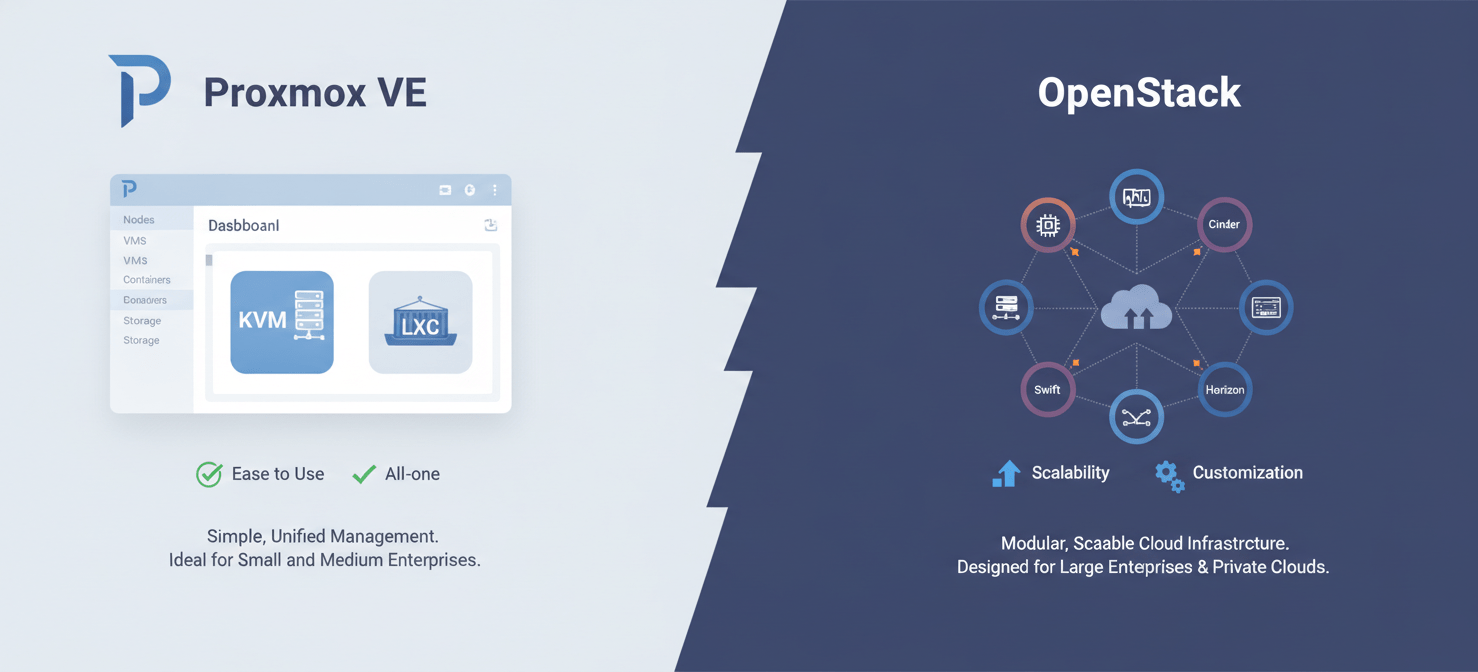
Proxmox VE: Proxmox is an open-source virtualization platform based on Debian Linux that combines KVM for VMs and LXC for containers. It includes an integrated web-based management interface and enterprise features like clustering, high availability, and live migration. While Proxmox itself is free, optional enterprise support subscriptions are available at a fraction of the cost of VMware licenses.
- Strengths: Extremely cost-effective, flexible, and backed by a large community. It provides the core features most enterprises need without the licensing overhead.
- Considerations: Requires more in-house expertise to deploy and manage at scale compared to an integrated solution like Nutanix. Enterprise support is available but may not have the same global reach as larger vendors.
- Best Fit: Cost-conscious organizations with strong internal Linux skills that want maximum flexibility and control over their infrastructure.
-
OpenStack: OpenStack is not just a hypervisor replacement; it’s a full-fledged open-source cloud operating system for building private and public clouds. It provides a suite of services for managing compute, storage, and networking resources at a massive scale.
- Strengths: Highly scalable, flexible, and avoids vendor lock-in. It is the platform of choice for many large telecommunications companies and service providers.
- Considerations: OpenStack is notoriously complex to deploy and operate. It requires a significant investment in engineering talent and is generally not a good fit for smaller teams.
- Best Fit: Large enterprises or service providers building a true private cloud with a dedicated team to manage it.
The Cloud-Native Path: KubeVirt and OpenShift Virtualization
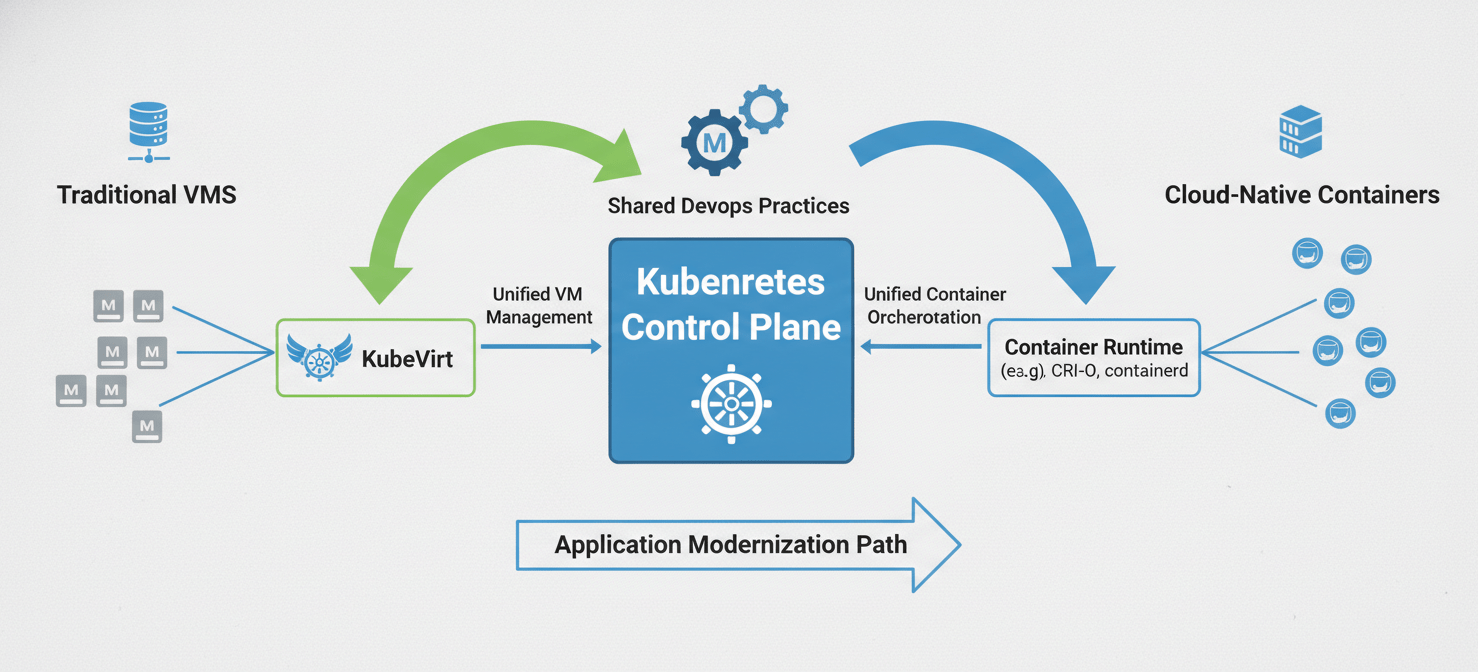
For organizations committed to a Kubernetes-centric future, the most strategic move may be to manage VMs and containers on the same platform. KubeVirt is an open-source project that extends Kubernetes to manage VMs. Red Hat’s OpenShift Virtualization is an enterprise-ready product built on KubeVirt.
- Strengths: This approach provides a unified control plane for all workloads, allowing you to apply the same DevOps practices, CI/CD pipelines, and observability tools to both VMs and containers. It creates a clear path for modernizing legacy applications by running them in VMs on Kubernetes first, then gradually refactoring them into containers.
- Considerations: This is a newer approach, and the feature set for VM management may not be as mature as traditional hypervisors. It also requires a significant investment in Kubernetes skills. Gartner estimates that through 2028, KubeVirt adoption will be limited to less than 10% of on-premises production workloads in enterprise environments.
- Best Fit: Organizations that are already heavily invested in Kubernetes and want to consolidate their platforms as part of a long-term modernization strategy.
Migration Planning and Execution: A Phased Approach
Choosing a new platform is only the first step. The migration itself is a major project that requires careful planning and execution. A poorly planned migration can lead to extended downtime, data loss, and significant cost overruns.
Phase 1: Discovery and Assessment (1-3 Months)
The first phase is to create a detailed inventory of your existing VMware environment. This includes not just the number of VMs and their resource allocations, but also their dependencies, performance characteristics, and business criticality. Use this information to group VMs into migration waves, starting with the least critical workloads.
Phase 2: Pilot and Design (2-4 Months)
Next, build a proof-of-concept environment on your chosen alternative platform. Migrate a small number of representative, non-production workloads to test the migration process and validate the performance and functionality of the new platform. This is also the time to design your target architecture, including networking and storage configurations.
Phase 3: Execution and Validation (12-24+ Months)
This is the core migration phase. Proceed wave by wave, following a repeatable process:
- Migrate: Use tools provided by the new vendor (like Nutanix Move) or third-party tools to move the VMs. For KubeVirt, open-source tools like Forklift can automate the process.
- Validate: Thoroughly test the migrated applications to ensure they are functioning correctly and meeting performance requirements.
- Cutover: Once validated, switch the production traffic to the new environment.
- Decommission: After a successful cutover and a stabilization period, decommission the old VMs on VMware.
Long-Term Governance and Vendor Consolidation Strategy
Adopting a VMware alternative is an opportunity to advance your vendor consolidation strategy. However, be careful not to simply trade one proprietary ecosystem for another. If your goal is true multi-cloud flexibility, prioritize platforms built on open standards that give you the freedom to choose your own hardware, storage, and networking solutions.
A post-VMware strategy should also include a plan for ongoing governance. This means establishing clear standards for deploying and managing workloads on the new platform, as well as a process for continuously evaluating its performance and cost-effectiveness. Your KPIs should shift from simple uptime metrics to measures of agility, such as the time it takes to provision new resources and the percentage of workloads managed through automation.
Conclusion
The disruption in the virtualization market is a rare opportunity for enterprise architects to drive meaningful change. It forces a deliberate, top-down review of a foundational technology layer, aligning it with modern objectives like multi-cloud agility and operational efficiency. The right VMware alternative for enterprise strategy is not about finding a cheaper clone of vSphere. It’s about selecting a platform that resolves your primary constraints, whether they are cost, complexity, or the friction between legacy and cloud-native development. The decision requires a clear-eyed assessment of your team’s skills, your architectural goals, and your tolerance for risk. Ultimately, the best platform is the one that gets out of the way, enabling your team to deliver value faster, rather than simply keeping the lights on.
To truly resolve your primary constraints and enable your team to deliver value faster, consider arranging a demonstration with our specialists or begin your free Binadox trial today.
 7-day free trial