




Integrating Large Language Models (LLMs) into your applications can unlock powerful new capabilities, but it also introduces a new, highly variable operational cost: API token spend. Without a clear strategy, these costs can quickly escalate, turning a technical asset into a financial liability. An effective llm api pricing comparison is more than just looking at a price list; it involves understanding the pricing models, tracking your usage in detail, and actively implementing strategies to reduce token consumption. This guide provides a framework for managing and optimizing your LLM API expenses.
Key takeaways
- Model selection is the biggest cost lever: Choosing a less powerful but still capable model for simpler tasks can reduce costs by over 90% compared to using a flagship model for everything.
- Caching is not optional: Implementing prompt and response caching is a critical step. Smart caching can cut model serving costs by up to 90% by avoiding redundant API calls for repeated queries.
- Track everything: Use dedicated LLM observability tools to move beyond monthly invoices. You need per-request, per-user, and per-feature cost attribution to find and fix inefficiencies.
- Follow a 7-step optimization plan: A systematic approach involving prompt trimming, model routing, caching, and setting budget limits provides a clear path to significant cost reduction.
Understanding LLM API Pricing Models
LLM providers primarily use a usage-based pricing model centered on “tokens.” A token is the basic unit of text that a model processes, roughly equivalent to four characters or three-quarters of a word in English. Every API call consumes tokens for both the input you send (the prompt) and the output the model generates (the completion).
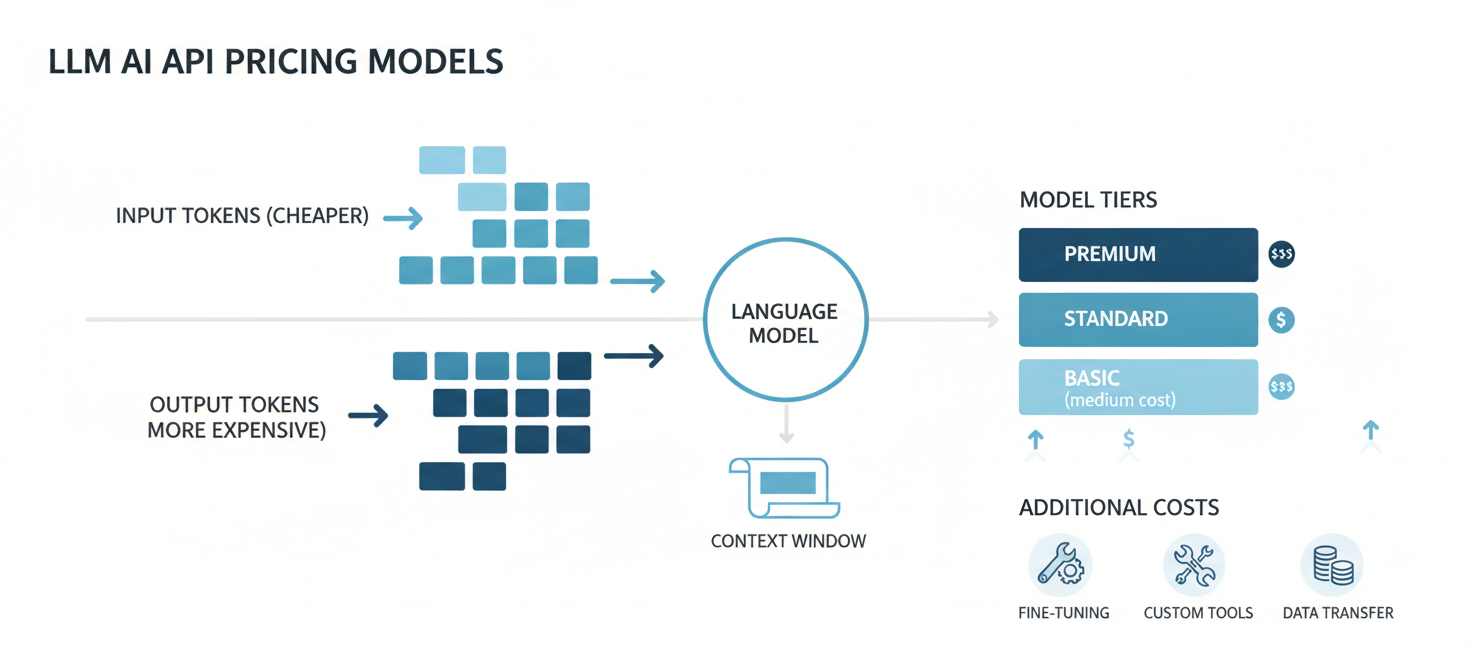
There are several key factors to understand about this model:
- Input vs. Output Costs: Providers charge different rates for input and output tokens. Typically, output tokens are significantly more expensive—often 3 to 5 times the cost of input tokens—because they require more computational resources to generate.
- Model Tiers: Not all models are priced equally. Providers offer a family of models with varying capabilities and price points. For example, a flagship model designed for complex reasoning will cost substantially more per token than a smaller, faster model intended for summarization or classification.
- Context Window: The context window is the amount of text (measured in tokens) that a model can consider at one time. Models with larger context windows can handle longer documents and more complex conversations but may come at a higher price.
- Additional Costs: Some providers may have separate pricing for fine-tuning custom models, using specialized tools like image or video processing, or for dedicated, provisioned throughput.
This token-based system makes costs flexible but also potentially unpredictable. A small change in prompt length or user behavior can have a compounding effect on your monthly bill.
LLM API Pricing Comparison: A Head-to-Head Look
Comparing prices between major LLM providers requires looking at their different model tiers. Costs are typically listed per 1 million tokens (1M tokens).
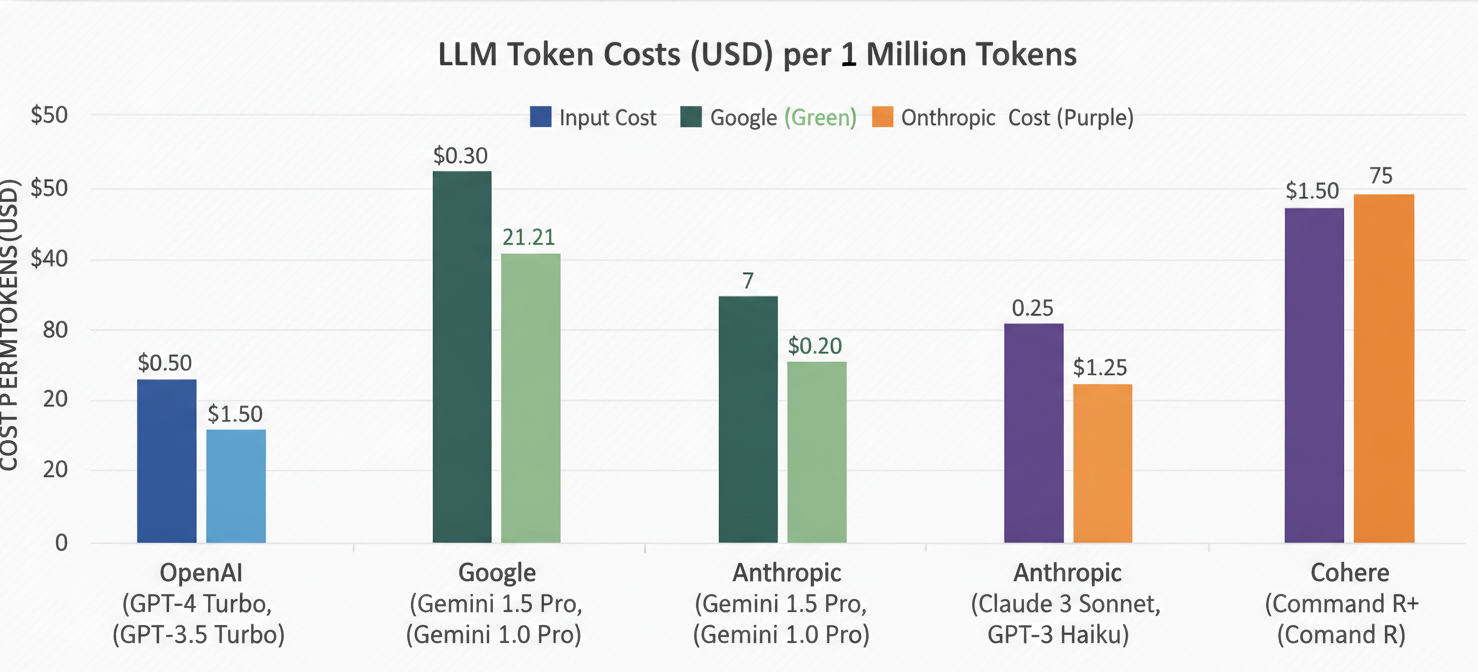
Provider Pricing Overview (as of mid-2026)
| Provider | Model Tier | Input Cost (per 1M tokens) | Output Cost (per 1M tokens) | Best For |
|---|---|---|---|---|
| OpenAI | GPT-5.4 Nano | ~$0.20 | ~$1.25 | Simple, high-volume tasks. |
| GPT-5.4 Mini | ~$0.75 | ~$4.50 | Balanced cost and performance for general use. | |
| GPT-5.4 Pro | ~$30.00 | ~$180.00 | Highest-capability tasks requiring deep reasoning. | |
| Gemini 2.5 Flash-Lite | ~$0.10 | ~$0.40 | Extremely cost-sensitive workloads. | |
| Gemini 2.5 Pro | ~$1.25 | ~$10.00 | Advanced reasoning and multimodal tasks. | |
| Gemini 3.1 Pro | ~$2.00 – $4.00 | ~$12.00 – $18.00 | Flagship performance with large context options. | |
| Anthropic | Claude 4.5 Haiku | ~$1.00 | ~$5.00 | Fast and affordable for chatbots and content moderation. |
| Claude 4.6 Sonnet | ~$3.00 | ~$15.00 | Enterprise-grade workloads balancing intelligence and speed. | |
| Claude 4.7 Opus | ~$5.00 | ~$25.00 | Top-tier performance for complex analysis and research. | |
| Cohere | Command R7B | ~$0.0375 | ~$0.15 | Highly efficient for simple tasks like classification. |
| Command R | ~$0.15 | ~$0.60 | Balanced option optimized for Retrieval-Augmented Generation (RAG). | |
| Command R+ | ~$2.50 | ~$10.00 | Flagship model for demanding enterprise RAG applications. |
Note: Prices are subject to change and may vary based on region or platform (e.g., direct API vs. AWS Bedrock). Always check the official provider pricing pages for the most current information.
Choosing the right model is a balancing act. Using a powerful model like OpenAI’s GPT-5.4 Pro for a simple classification task is like using a sledgehammer to crack a nut—it works, but it’s needlessly expensive.
How to Accurately Track Your LLM API Costs
Relying solely on the monthly invoice from your LLM provider is a reactive approach that tells you what you’ve already spent, not where you can save. To gain control, you need granular, real-time visibility into your token consumption.
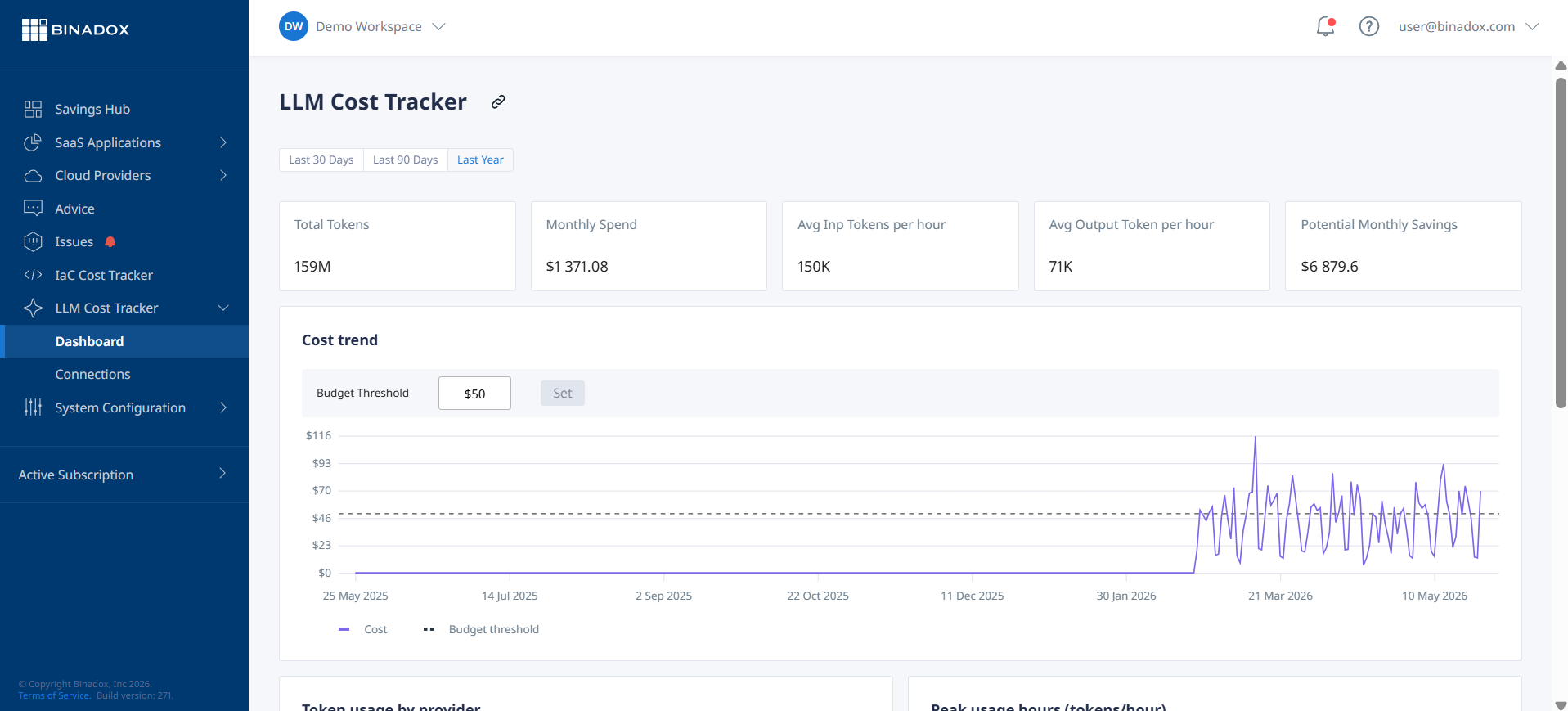
The Limits of Provider Dashboards
While provider dashboards from OpenAI or Anthropic are a good starting point, they often lack the detail needed for true optimization. They show aggregate spend but can’t easily answer critical questions like:
- Which specific feature in your application is driving the most cost?
- Which of your customers is responsible for that sudden spike in usage?
- Is a new prompt version more or less expensive than the old one?
Dedicated LLM Observability Tools
To answer these questions, your team needs a dedicated LLM cost tracking solution. These tools integrate with your application to provide detailed, request-level monitoring. They fall into a few categories:
- AI Gateways and Proxies: Tools like LiteLLM or Bifrost act as a unified interface for all your LLM traffic. They can track costs across multiple providers, enforce budgets, and provide a central point of control.
- Observability and Tracing Platforms: Solutions like Langfuse, Datadog, and LangSmith capture detailed traces of every LLM call within your application. This allows you to attribute token spend to specific users, features, or even individual steps in a complex workflow.
- FinOps and Cloud Platforms: For larger organizations, platforms like Vantage or CloudZero integrate LLM spend into your broader cloud cost management strategy, allowing finance teams to attribute AI costs to specific business units.
The key metrics these tools help you track include tokens per request, cost per user or feature, and cache hit ratio. This data is the foundation for any successful cost optimization effort.
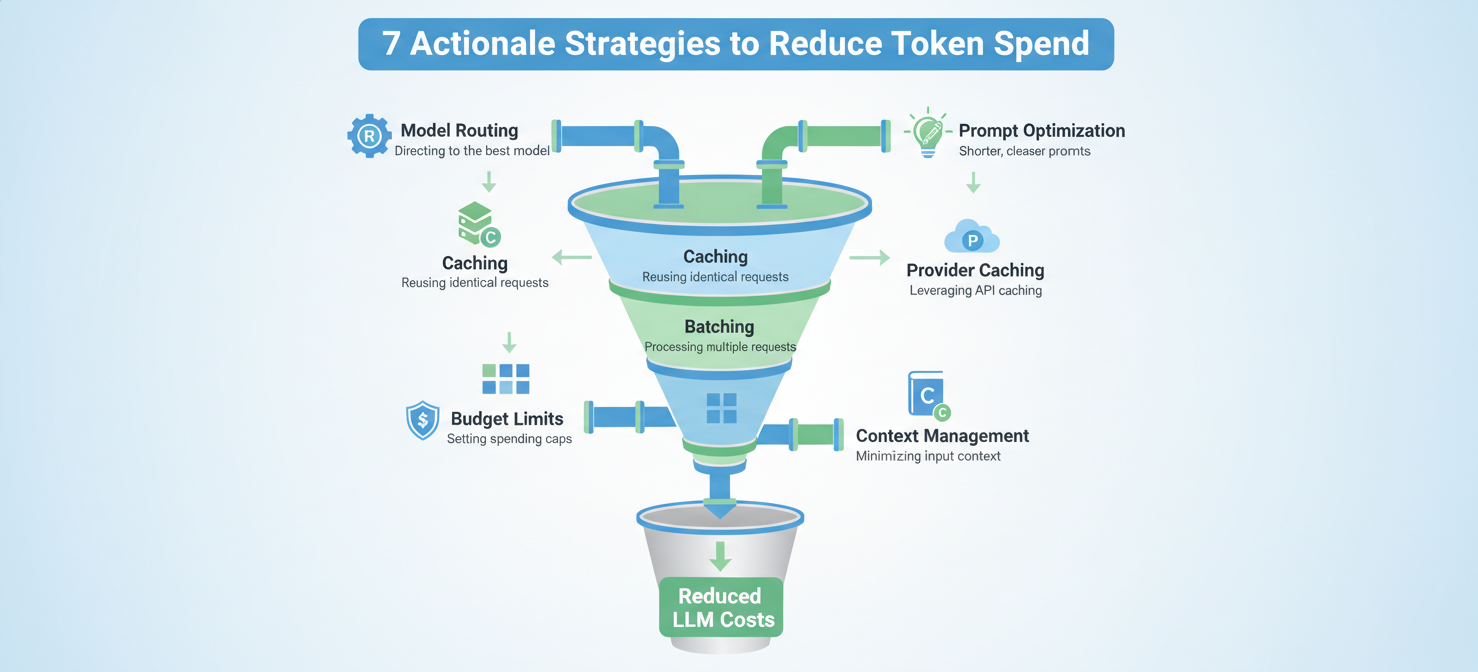
7 Actionable Strategies to Reduce Token Spend
Once you have visibility into your costs, you can start taking concrete steps to reduce them.
-
Choose the Right Model for the Job: This is the most impactful strategy. Create a routing system that directs simple requests (like classification or data extraction) to cheaper, faster models (e.g., Cohere Command R7B or Gemini 2.5 Flash-Lite) and reserves your most powerful, expensive models for tasks that truly require their reasoning capabilities.
-
Optimize Your Prompts: Bloated prompts are a common source of wasted spend. Ruthlessly trim unnecessary words, instructions, and context. A shorter prompt directly translates to fewer input tokens and, often, a more concise and cheaper output.
-
Implement Caching Aggressively: Many user queries are repetitive. Caching provides a way to store and reuse LLM responses, avoiding redundant API calls.
- Exact-Match Caching: If a new request is identical to a previous one, serve the stored response directly. This is highly effective for common questions.
- Semantic Caching: This more advanced technique uses embeddings to find and return cached answers for questions that are semantically similar, even if the wording is different.
-
Leverage Provider Caching Features: Many providers offer prompt caching, which gives you a significant discount (often 90% or more) on the tokens in a stable, recurring prefix of your prompt, like a long system message or tool definitions. Structuring your prompts to maximize the size of this stable prefix is a huge cost-saving opportunity.
-
Use Asynchronous Batching for Non-Urgent Tasks: If a request doesn’t need an immediate response, use the provider’s Batch API. Both OpenAI and Anthropic offer a 50% discount for jobs processed asynchronously within a 24-hour window. This is ideal for offline data analysis, content generation, or summarization tasks.
-
Set Hard Budget Limits and Alerts: Don’t wait for the end-of-month invoice to discover a cost overrun. Use an AI gateway or monitoring tool to set hard daily or monthly budget caps on your API keys. Configure alerts to notify your team when spending approaches these thresholds.
-
Manage Context Window Efficiently: While large context windows are powerful, they can also be expensive. Avoid the anti-pattern of passing excessive, irrelevant information to the model. Instead, use techniques like Retrieval-Augmented Generation (RAG) to retrieve only the most relevant context chunks, and summarize long conversation histories before including them in the prompt.
Conclusion
Managing LLM API costs is not a one-time task but an ongoing discipline of measurement, analysis, and optimization. A detailed llm api pricing comparison is the first step, but true cost control comes from a deeper operational strategy. By implementing robust tracking, choosing the right model for each task, and aggressively pursuing efficiencies through caching and prompt engineering, you can ensure your use of this transformative technology remains both powerful and profitable. Ignoring token costs is a recipe for a budget that spirals out of control; managing them proactively is simply good engineering.
To truly master your LLM API spend and implement these proactive strategies, consider exploring our platform firsthand, or if you prefer a more tailored approach, you can schedule a personalized walkthrough with our experts.
 7-day free trial