



For finance and procurement leaders, any significant technology investment demands rigorous financial scrutiny. Master Data Management (MDM) is no exception. While the promise of clean, consistent, and reliable data is compelling, the path to achieving it is paved with costs that extend far beyond the initial software license. A thorough evaluation requires calculating the total cost ofownership, a comprehensive assessment of all direct and indirect expenses over the solution’s entire lifecycle. This analysis is fundamental to building a credible business case, negotiating favorable contracts, and accurately forecasting the long-term budget impact.
Key takeaways:
- Indirect costs, such as data migration and internal labor, can constitute over 50% of the total MDM implementation expense.
- A complete TCO analysis involves evaluating five key cost categories: direct, indirect, operational, opportunity, and the potential for return.
- Effective vendor negotiation hinges on understanding this complete cost picture, not just the initial licensing fees.
- Failing to act has its own price; poor data quality can cost companies millions annually in operational inefficiencies and missed opportunities.
Direct Costs: The Sticker Price and Beyond
The most visible expenses are the direct costs quoted by the vendor. However, even these have layers that require careful examination during procurement. Your team must look past the initial proposal to understand the full financial commitment.
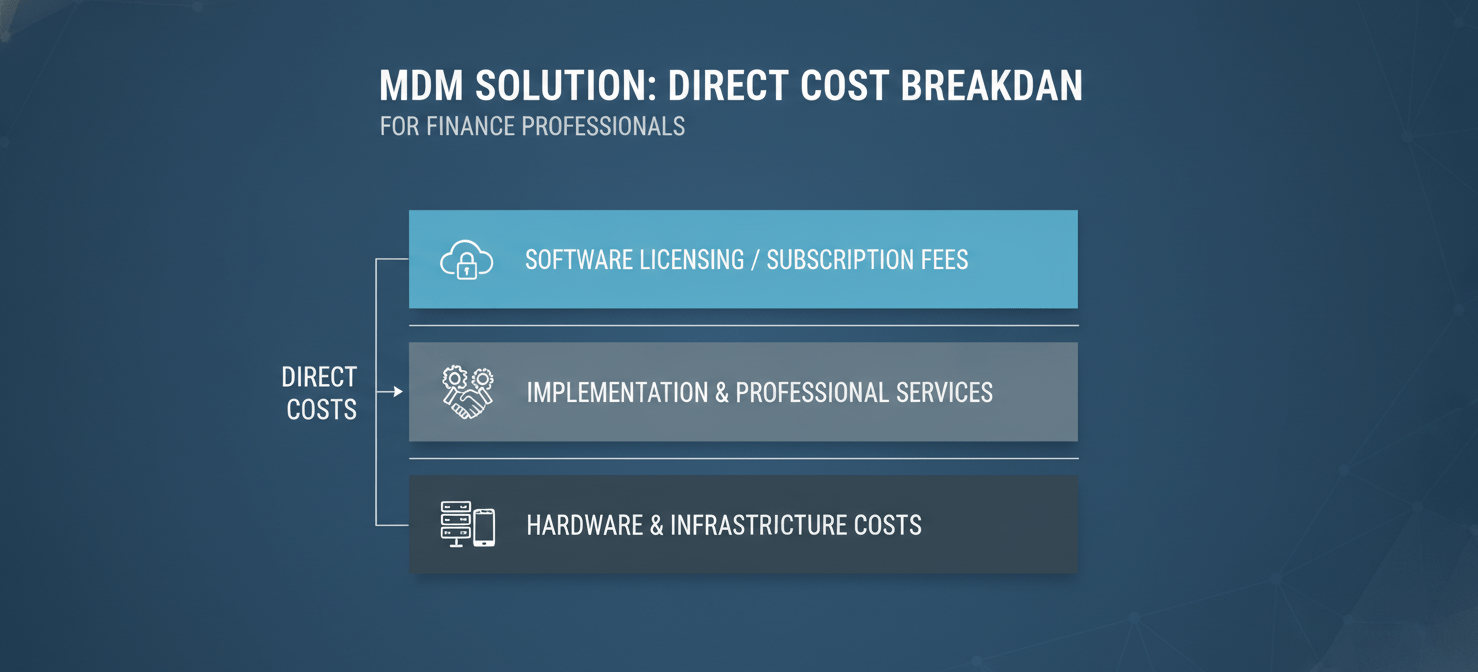
First, you have the software licensing or subscription fees. For SaaS models, this is typically a recurring annual or monthly cost, often based on the number of data records, users, or data domains (e.g., Customer, Product). For on-premise solutions, it’s a perpetual license fee, which is a significant capital expenditure. It is critical to forecast how these costs will scale as your data volume and usage grow. For example, some vendors structure pricing in tiers; crossing a threshold from 1 million to 1.1 million records could trigger a substantial price jump. Therefore, you must model future data growth against these pricing tiers.
Next, consider the implementation and professional services fees. These are often one-time costs for the initial setup, configuration, and integration of the MDM platform into your existing technology stack. Vendors and third-party consultants will charge for project management, technical consulting, and initial data loading. When negotiating SaaS contracts, scrutinize these statements of work. Are the deliverables clearly defined? Is the timeline realistic? Unforeseen complexities during implementation can lead to costly project overruns, so building a contingency buffer of 15-20% into the budget is a prudent measure.
Finally, hardware and infrastructure costs must be factored in. For on-premise deployments, this includes servers, storage, and networking hardware. For cloud-based solutions, you might pay for dedicated environments or increased data transfer and storage on platforms like AWS or Azure. While a SaaS model shifts this burden from a capital expense to an operational one, it doesn’t eliminate it. You are still paying for the infrastructure through your subscription, and it’s essential to understand the service-level agreements (SLAs) that guarantee performance and availability.
Indirect Costs: The Hidden Expenses
Indirect costs are less obvious but can significantly impact the MDM ROI. These are the internal resource and operational expenses required to make the project successful. Ignoring them leads to wildly inaccurate budget forecasts.
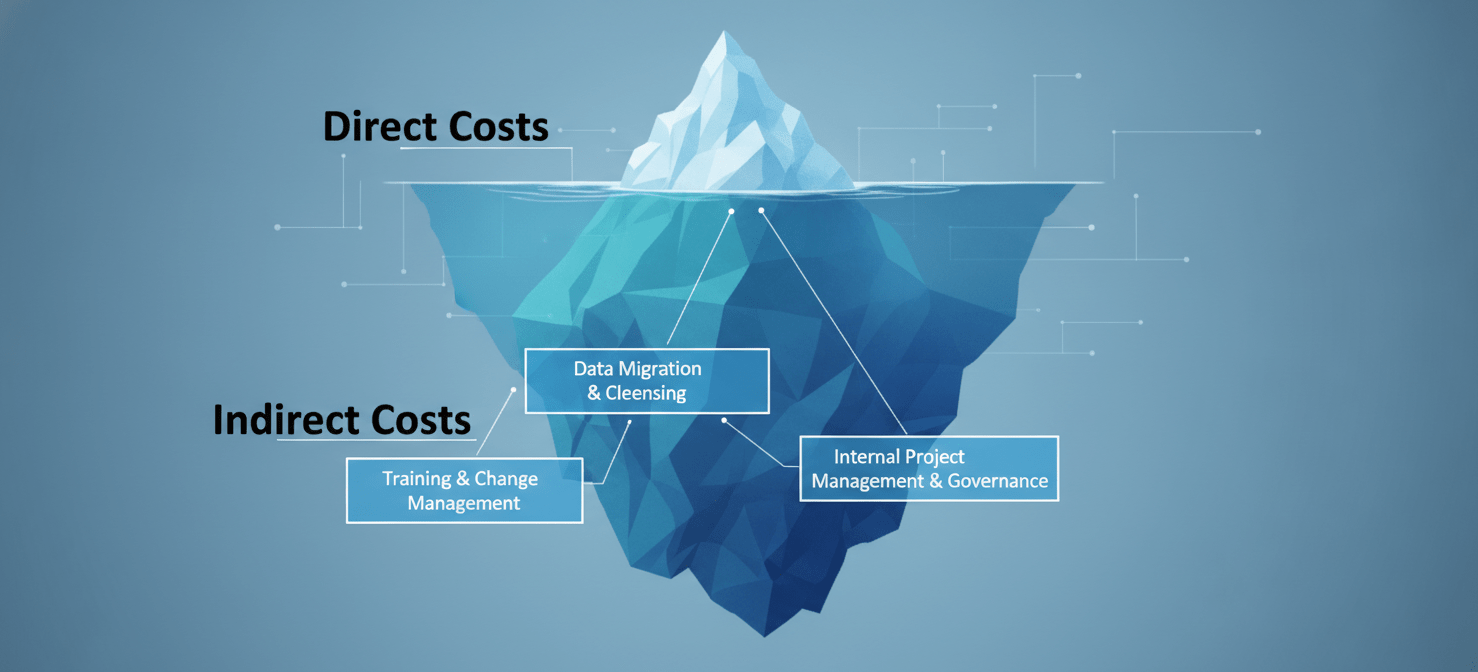
The most significant indirect cost is often data migration and cleansing. Your existing data is likely spread across multiple systems, in various formats, and of inconsistent quality. Moving this data into the new MDM hub is not a simple copy-paste exercise. It requires a dedicated effort from your data analysts and IT teams to extract, transform, profile, cleanse, and load the data. This process can take months and consume hundreds of person-hours. For instance, a project might require two data engineers and a business analyst working full-time for a quarter just to prepare the initial customer data domain. This internal labor is a substantial, real cost.
Furthermore, training and change management are critical. Your employees, from data stewards to business users, must be trained on how to use the new system and adhere to new data governance processes. This involves direct training costs and, more importantly, the cost of employee time spent in training sessions instead of on their primary duties. A lack of investment here can lead to low user adoption, rendering the entire MDM investment ineffective. As a result, you must budget for comprehensive training programs and ongoing reinforcement.
Finally, internal project management and governance teams represent another hidden expense. Your organization will need to dedicate resources to oversee the implementation, manage the vendor relationship, and establish a long-term data governance framework. This often involves forming a steering committee with representatives from finance, IT, and key business units. Their time is a valuable and quantifiable cost that belongs in the TCO calculation.
Operational Costs: The Long-Term View
Once the MDM platform is live, the spending doesn’t stop. Ongoing operational costs are a permanent addition to your budget and must be accurately forecasted for the life of the solution, typically a 3-5 year horizon.
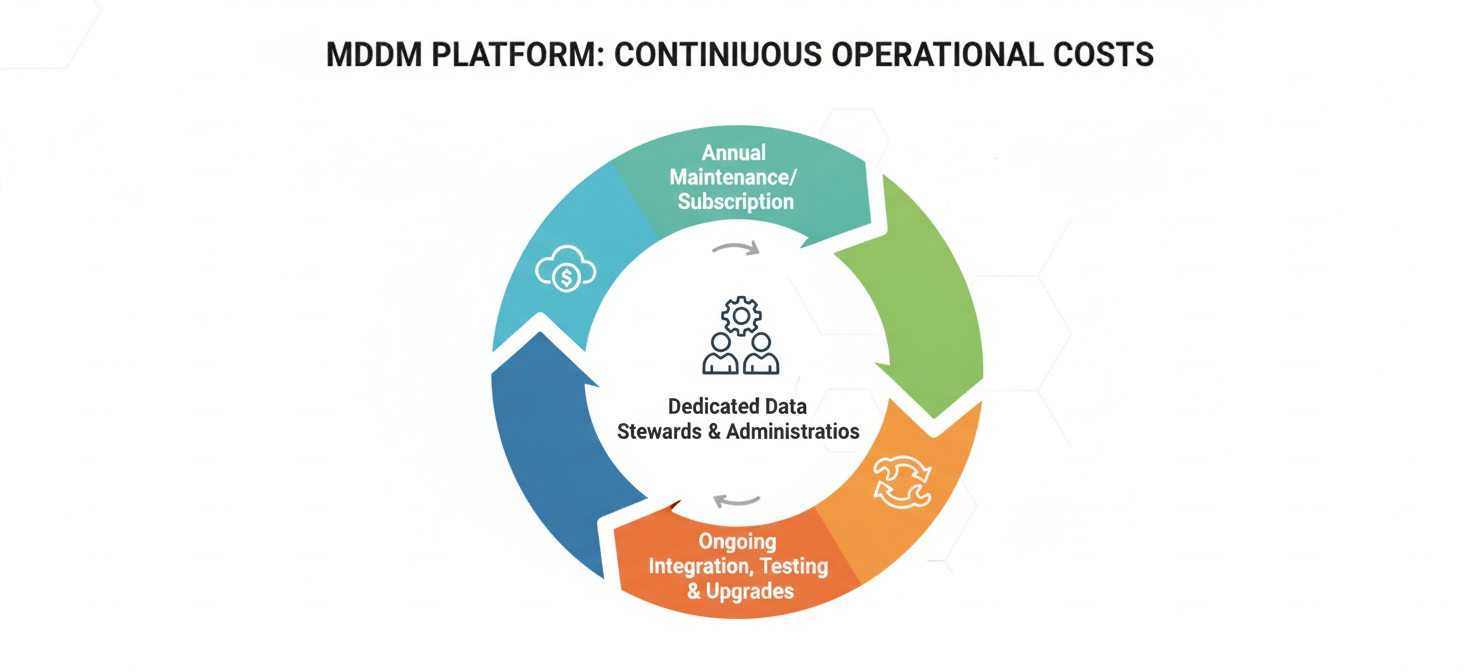
First and foremost are the annual software maintenance and support fees for on-premise solutions, or the recurring subscription for SaaS. For perpetual licenses, maintenance fees typically run 18-25% of the initial license cost annually. These fees provide access to technical support, software updates, and security patches. When negotiating contracts, it’s vital to clarify the terms of the support agreement. What are the guaranteed response times? Does the fee cover major version upgrades?
In addition, you will have ongoing personnel costs. MDM is not a “set it and forget it” technology. It requires dedicated data stewards and administrators to manage data quality, resolve duplicates, and enforce governance rules. According to Gartner, poor data quality is a major reason for business strategy failures. Therefore, you must budget for the salaries of the data governance team responsible for the platform’s daily care and feeding. The size of this team will depend on the complexity and scale of your data domains.
Finally, there are costs associated with ongoing integration, testing, and upgrades. As your business evolves, you will add new applications and data sources that need to be integrated with the MDM hub. Each new integration requires development and testing resources. Furthermore, the MDM vendor will release new software versions that require your team to plan, test, and execute an upgrade project. These activities consume internal resources and should be factored into the long-term operational budget.
Opportunity Costs & The ROI of Inaction
Calculating the total cost of ownership also involves considering the opposite scenario: the cost of doing nothing. Sticking with the status quo of siloed, inconsistent data carries significant and quantifiable financial risks. This is the “ROI of Inaction,” and it provides a powerful baseline for justifying the MDM investment.
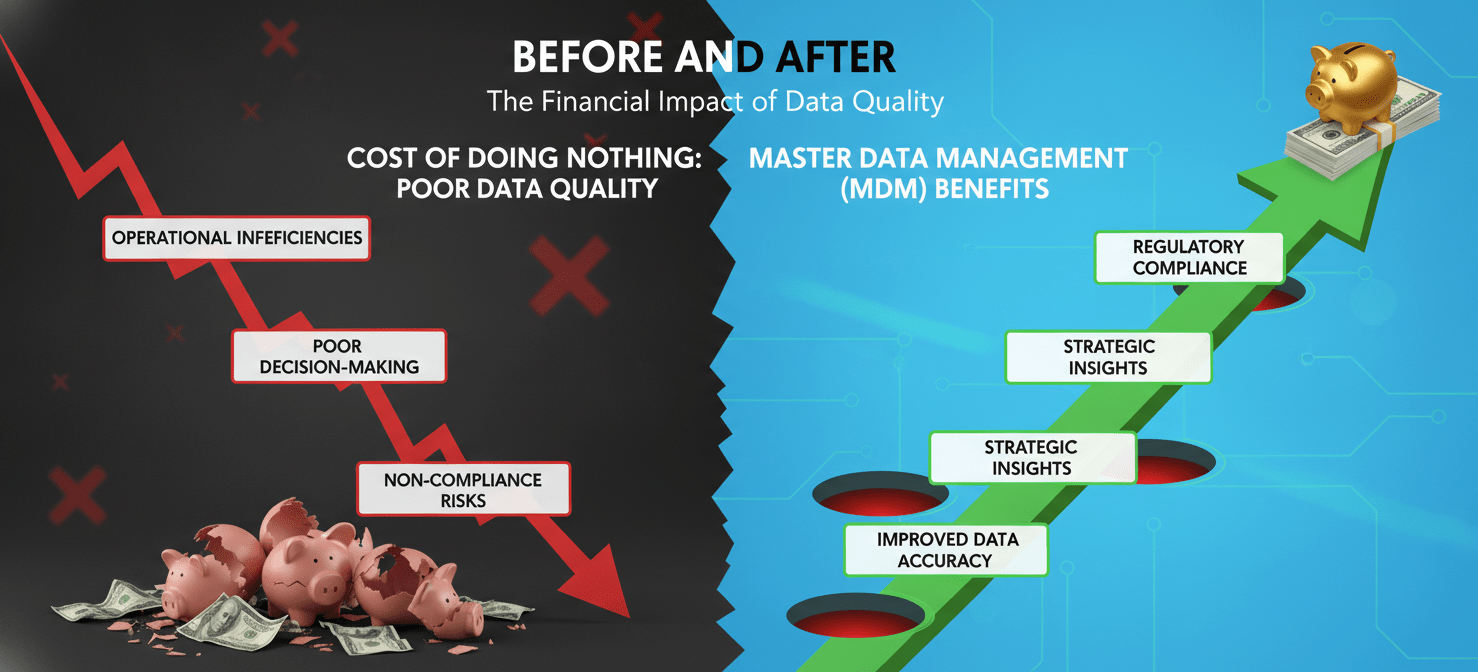
First, consider the operational inefficiencies. How much time do your teams waste manually reconciling reports from different systems? For example, if the sales team’s customer list doesn’t match the finance team’s billing records, employees must spend hours manually cleaning data instead of performing value-added work. A study from Forrester Consulting found that data professionals can spend 40% of their time vetting and validating data before it can be used for strategic decision-making. You can quantify this by multiplying the number of hours wasted per week by the average employee’s loaded salary.
Next, evaluate the cost of poor decision-making. When executives rely on inaccurate or incomplete data, they make flawed strategic choices. This could manifest as misallocated marketing spend, inefficient supply chain management, or missed cross-sell and up-sell opportunities. For instance, without a single, accurate view of each customer, you cannot effectively analyze customer lifetime value or identify your most profitable segments. The resulting missed revenue is a direct opportunity cost.
Finally, there is the risk of non-compliance. Regulations like GDPR and CCPA impose strict requirements for managing customer data. A failure to accurately track and manage customer information can result in hefty fines and reputational damage. The potential financial penalty for non-compliance is a major risk that a robust MDM program directly mitigates. By framing the investment as a form of risk mitigation, you can strengthen the business case for finance and legal stakeholders.
Quantifying the Benefits: The ‘Return’ on Investment
A TCO analysis is incomplete without a corresponding analysis of the expected return. For a finance-focused audience, these benefits must be translated into hard numbers. The goal is to build a credible MDM ROI model that forecasts the financial upside of clean, centralized data.
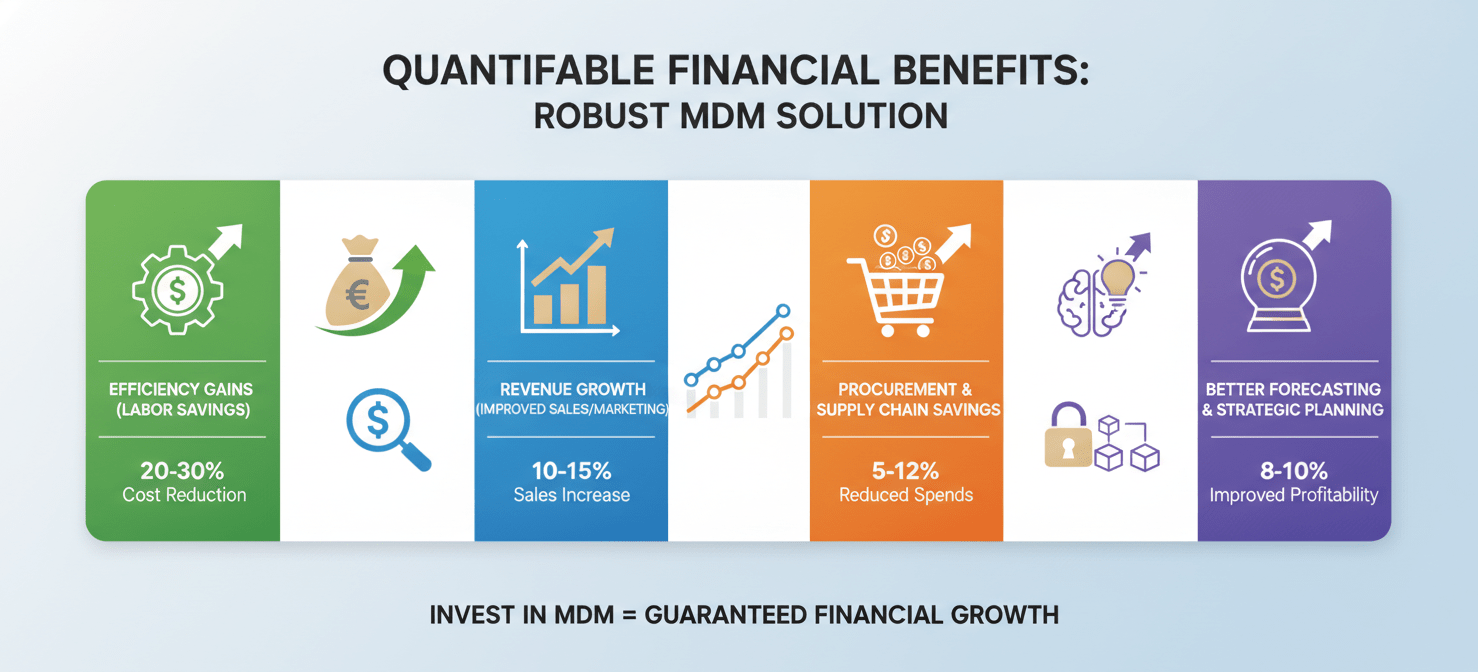
First, identify efficiency gains. MDM automates many manual data reconciliation tasks. By calculating the time saved and multiplying it by employee wages, you can project direct cost savings in labor. For example, if MDM eliminates 200 hours of manual report consolidation per month across the finance department, that translates into a clear, quantifiable operational saving.
Next, project revenue growth. A single view of the customer enables more effective marketing campaigns, improved sales targeting, and better customer service. For instance, with reliable product data, e-commerce teams can reduce product returns and improve online conversion rates. You can model this by projecting a modest, conservative increase in key metrics—such as a 1% increase in customer retention or a 0.5% increase in average order value—and calculating the resulting revenue impact.
In addition, consider procurement and supply chain savings. With a single, authoritative source of supplier and product data, you can consolidate purchasing to leverage volume discounts and reduce off-contract spending. Negotiating SaaS contracts becomes easier when you have a clear picture of your vendor relationships across the entire enterprise. A 2% reduction in procurement costs through better supplier data management can translate into millions of dollars in savings for a large organization.
Finally, improved data analytics leads to better forecasting and strategic planning. With a trusted data foundation, your financial planning and analysis (FP&A) team can build more accurate revenue forecasts and operating budgets. While harder to quantify, the value of increased confidence in strategic decisions is a significant benefit that should be included in the qualitative assessment of the MDM ROI.
Conclusion
Ultimately, evaluating an MDM solution is not about finding the cheapest vendor; it’s about identifying the best long-term value. A superficial analysis focused only on the initial license fee will inevitably lead to budget overruns and an underperforming investment. A comprehensive analysis of the total cost of ownership—encompassing all direct, indirect, and operational costs—is the only way to make a fiscally sound decision.
By rigorously quantifying not only the costs but also the financial benefits of operational efficiency, risk mitigation, and revenue enablement, you can build a business case that stands up to scrutiny. This detailed approach transforms the conversation from a simple cost-center expenditure to a strategic investment in the data foundation that drives business performance. The final calculation isn’t just about what you spend; it’s about what you prevent your company from losing. And in the world of enterprise data, what you don’t know can, and will, hurt your bottom line.
To truly understand the value and build a robust business case for your MDM investment, consider exploring a solution further by scheduling a demo or experiencing the capabilities firsthand with a free Binadox trial.
 7-day free trial