




Large Language Models (LLMs) are powerful tools, but their operational costs can quickly escalate, turning a promising project into a financial drain. As usage scales, API bills often grow much faster than anticipated, driven by token volume and model choice. The key to sustainable growth is not to stop using these models, but to use them more efficiently. This guide provides seven actionable strategies to help you reduce LLM costs without sacrificing the quality of your application’s output. By implementing these practical techniques, your team can gain control over your spending and build more economically viable AI-powered products.
Key takeaways
- Model Routing: Instead of using one powerful model for all tasks, route simpler queries to cheaper, faster models. This single change can reduce costs by 40-70%.
- Caching and Batching: Implement caching to reuse answers for repeated queries, and use batching for non-urgent tasks to get discounts of up to 50% from providers like OpenAI and Anthropic.
- Token and Prompt Optimization: Every token has a cost. Systematically trimming prompts, summarizing chat histories, and limiting output length directly cuts expenses on every API call.
1. Optimize Your Prompts
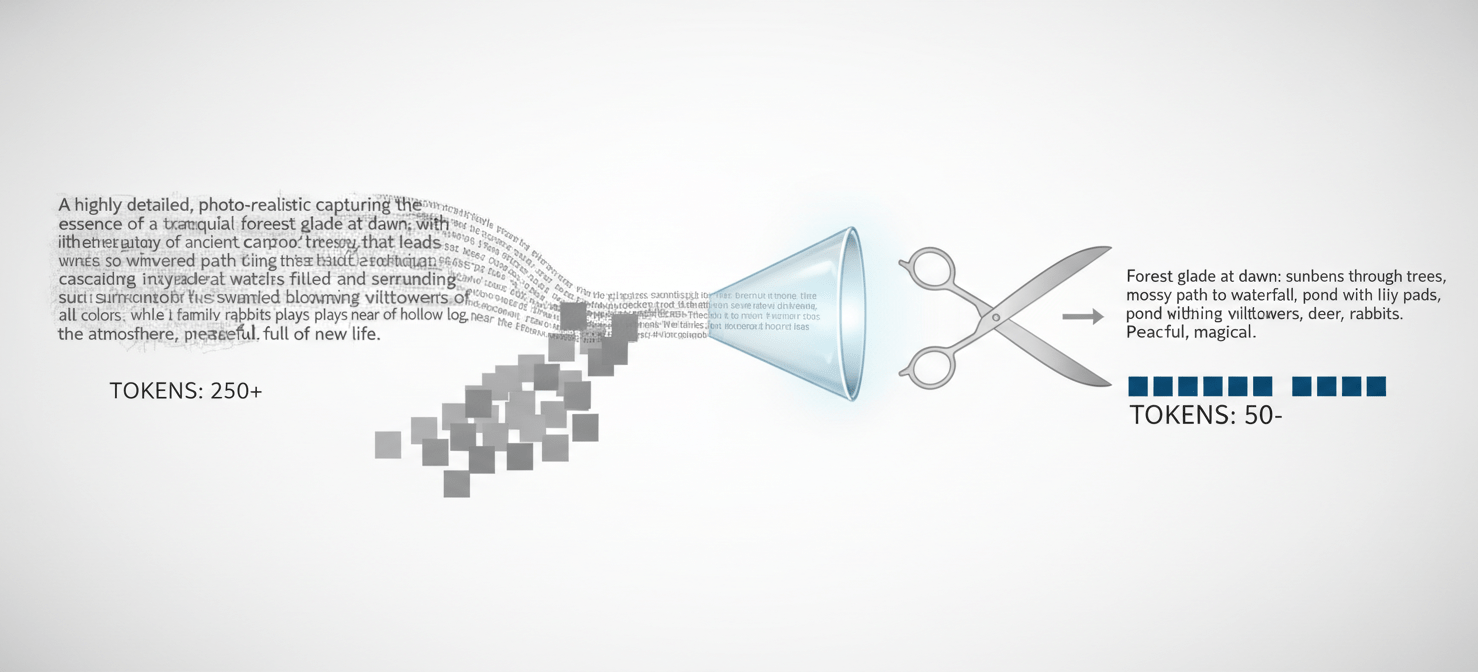
The number of tokens you send to and receive from a model is a primary driver of cost. Therefore, prompt engineering is one of the most direct ways to manage expenses. Every word, space, and punctuation mark counts.
Trim the Fat
Review your prompts for unnecessary words or instructions. For example, lengthy pleasantries like “please” or overly detailed instructions that the model already understands can often be removed without impacting the quality of the response. Similarly, examine your system prompts—the fixed instructions sent with every request. These are often a source of repeated, expensive tokens. Caching these stable prefixes can significantly lower costs.
Control the Output
Use parameters like max_tokens to set a firm limit on the length of the model’s response. This prevents the model from generating overly long or rambling answers, which directly translates to wasted tokens and higher costs. For tasks that require concise answers, like summarization or classification, setting a low token limit is an easy win. Additionally, adjusting the temperature parameter to a lower value (e.g., 0.3-0.5) can produce more focused and less verbose outputs, indirectly reducing token count.
2. Choose the Right Model for the Job
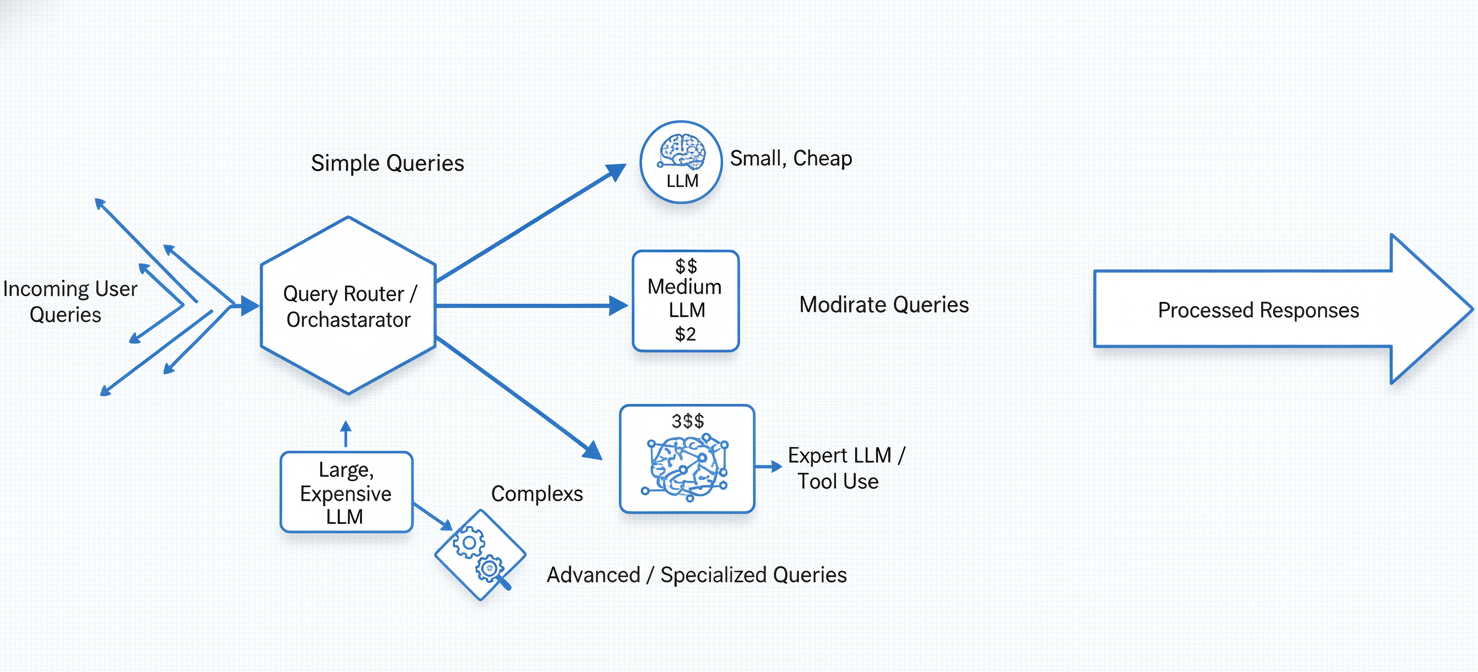
Not every task requires a state-of-the-art, flagship model. In fact, a significant portion of requests sent to expensive models could be handled just as effectively by smaller, cheaper alternatives. This is the principle behind model routing, a powerful strategy for LLM cost optimization.
Implement a Model Cascade
A model cascade, or router, is a system that intelligently directs incoming prompts to the most appropriate and cost-effective model. Simple, low-stakes queries like text formatting or basic data extraction can be sent to highly affordable models. For instance, OpenAI’s gpt-4o-mini is significantly cheaper than gpt-4o for many common tasks. More complex requests involving deep reasoning or multi-step analysis can then be escalated to the more powerful models.
How to Choose
Start by analyzing your application’s workload. Identify the different types of tasks the LLM performs and classify them by complexity. Then, test smaller models on the less complex tasks to see if they meet your quality standards. Many teams discover that 80-90% of their queries can be handled by less expensive models without any noticeable difference to the end-user. This tiered approach ensures you only pay for high-performance reasoning when you actually need it, potentially cutting your overall spend by more than half.
3. Implement a Caching Strategy
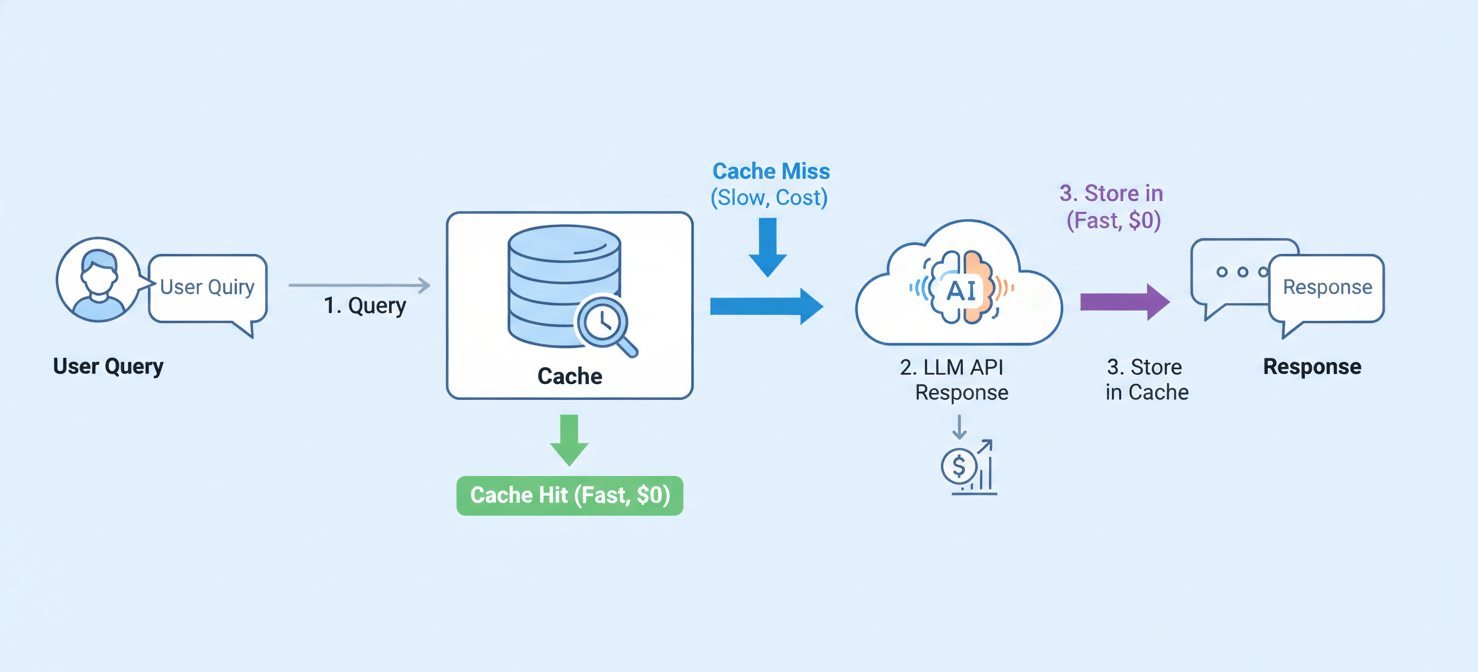
Caching is a fundamental technique in software engineering that can be applied effectively to reduce LLM costs and improve latency. The core idea is simple: store the results of previous API calls and reuse them when the same or a similar request is made again.
Exact-Match Caching
The most straightforward form of caching is storing the exact response for an identical request. This is highly effective in applications where users frequently ask the same questions or run the same commands. Before making a new API call, your system first checks the cache. If a matching entry is found (a “cache hit”), the stored response is returned immediately, avoiding the API call entirely.
Semantic Caching
A more advanced approach is semantic caching, which stores responses based on the meaning of a prompt, not just the exact wording. This method uses vector embeddings to determine if an incoming query is semantically similar to one that has already been answered. If the similarity score is above a certain threshold, the cached response is returned. This is particularly useful for chatbots and Q&A systems where users might phrase the same question in many different ways.
Provider-Level Caching
Many LLM providers have built-in caching features. For example, OpenAI automatically caches parts of prompts longer than 1,024 tokens, charging a discounted rate for the cached portion. Anthropic offers a similar feature, which can lead to savings of up to 90% on cached input tokens. To maximize your chances of a cache hit, structure your prompts so that the static, unchanging content (like system instructions or document context) appears at the beginning.
4. Fine-Tune Smaller, Specialized Models
While large, general-purpose models are incredibly capable, they are often overkill for specialized tasks. Fine-tuning a smaller, open-source model on your own data can create a highly accurate and much more cost-effective alternative.
Fine-tuning adapts a pre-trained model to excel at a specific domain or task, such as interpreting legal documents or analyzing medical records. A well-tuned 7-billion-parameter model can often outperform a massive generalist model like GPT-4 on a narrow task, but at a fraction of the inference cost.

This approach requires an upfront investment in data preparation and training, but it can lead to significant long-term savings, especially for high-volume applications. Techniques like Parameter-Efficient Fine-Tuning (PEFT), including methods like LoRA and QLoRA, further reduce the computational cost of this process by only updating a small subset of the model’s weights.
5. Leverage Quantization and Pruning
For teams running their own models, quantization is a powerful technique to reduce LLM costs and memory usage. Quantization is the process of converting a model’s weights from high-precision floating-point numbers (like 32-bit floats) to lower-precision formats, such as 8-bit or 4-bit integers.
This compression makes the model significantly smaller, reducing memory requirements and often speeding up inference because less data needs to be moved. While there can be a small trade-off in accuracy, for many applications, the performance difference is negligible, while the cost savings are substantial.
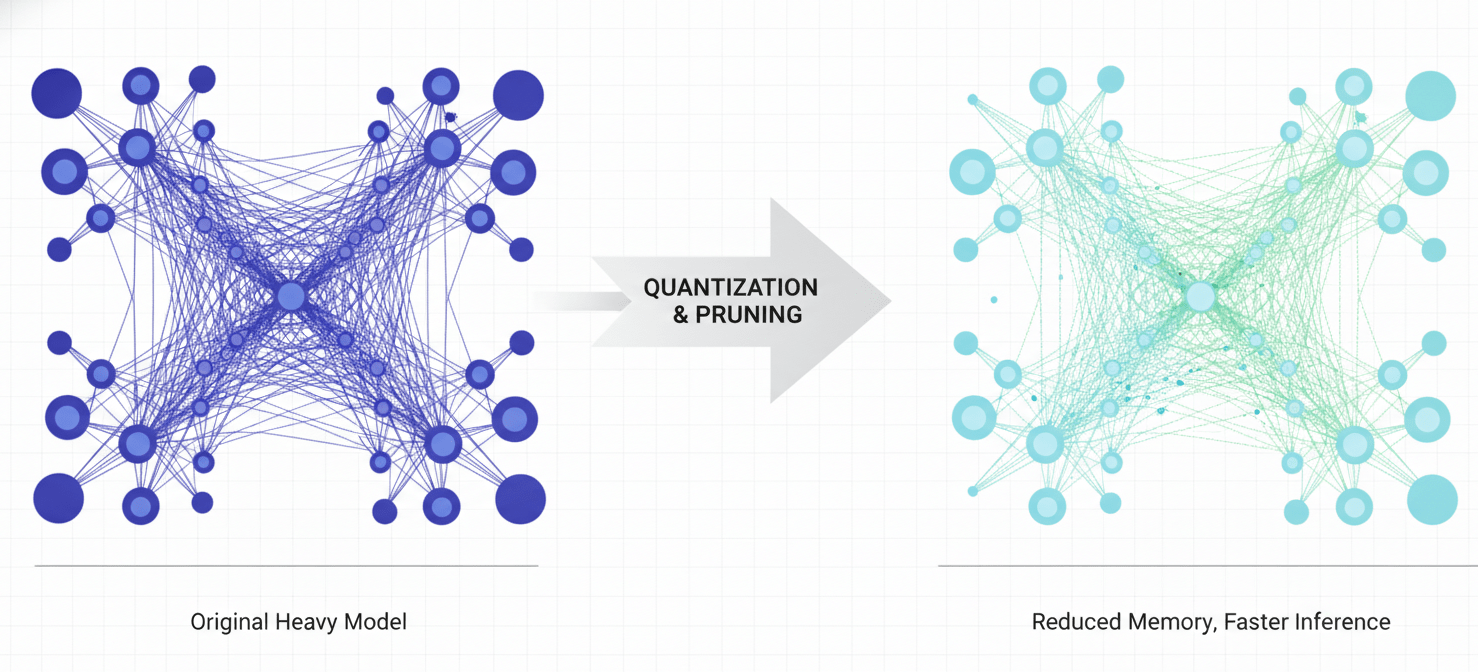
Pruning is a related technique that involves removing unnecessary neurons or connections from the model, further reducing its size and computational complexity without significantly impacting performance. Both methods are key for deploying LLMs efficiently, especially on resource-constrained hardware.
6. Monitor and Analyze Your Usage to reduce LLM costs
You cannot optimize what you cannot measure. To effectively reduce LLM costs, you must have clear visibility into how your application is using the API. This means implementing robust monitoring and analytics to track key metrics.
Start by breaking down your costs by model, feature, team, and even individual customers. This will help you identify which parts of your application are driving the most spend. Are expensive models being used for simple tasks? Is a specific feature creating runaway agent loops?
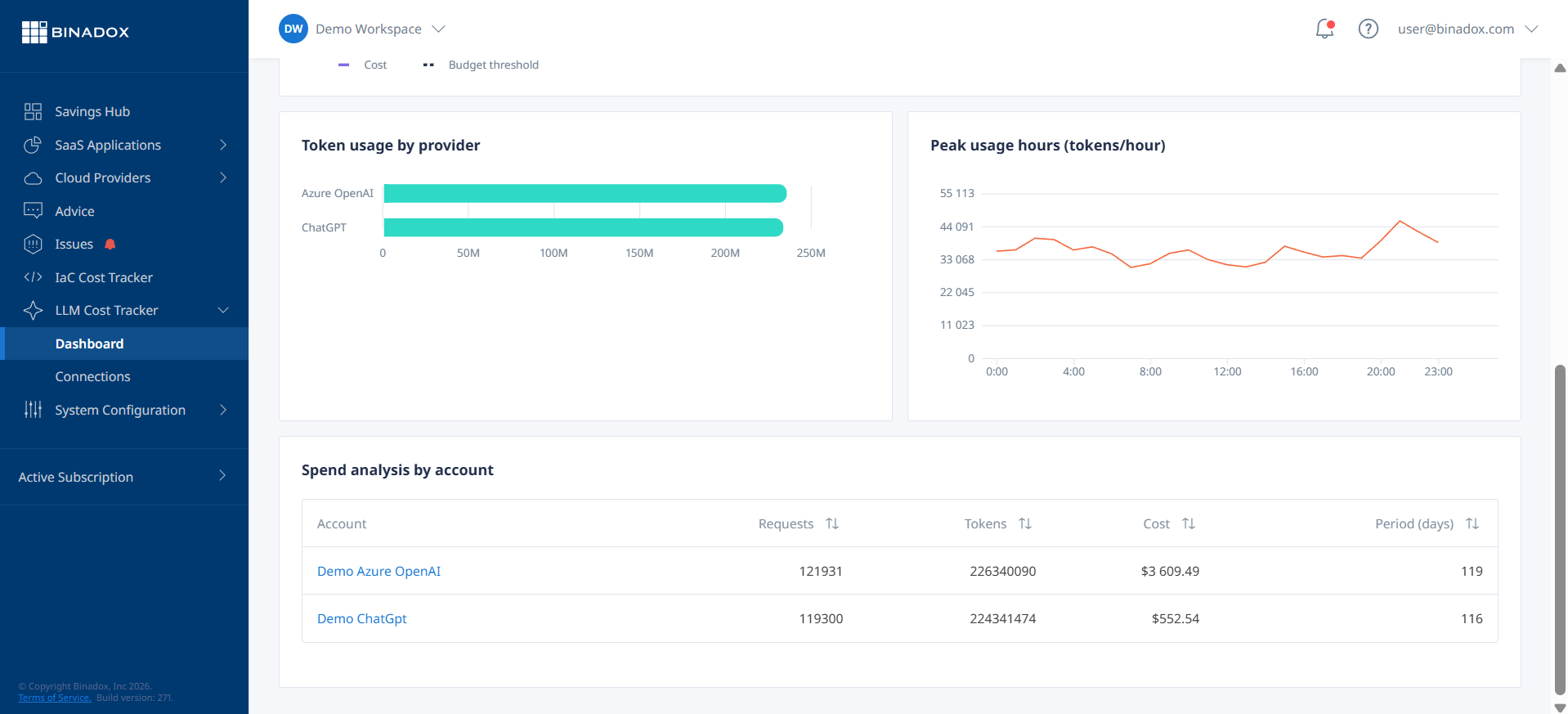
Set up dashboards and alerts to track token consumption, request frequency, and cost per transaction. Many third-party tools can provide this level of observability. Once you understand your usage patterns, you can make informed decisions about where to apply the other optimization strategies discussed in this article. Regularly reviewing these metrics is crucial for maintaining control over your expenses as your application scales.
7. Batch Your API Requests
If your application has tasks that do not require an immediate response, batching is one of the easiest ways to achieve significant savings. Both OpenAI and Anthropic offer batch processing APIs that provide a flat 50% discount on token costs.
Instead of sending requests one by one as they arrive, you can group them into a single batch and submit them for asynchronous processing. The provider will then process the requests and return the results within a 24-hour window.
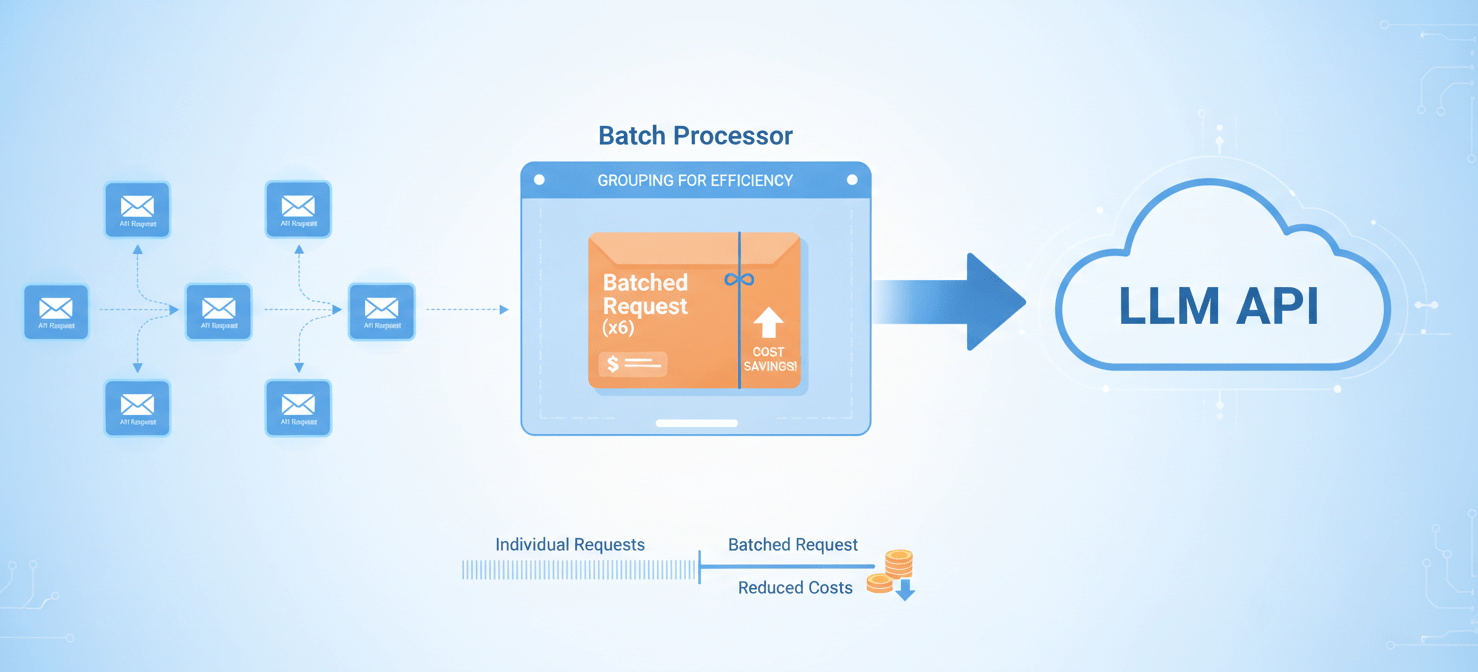
This approach is ideal for workloads like data analysis, content generation, or summarizing daily reports. For any task where a user is not waiting for a real-time response, batching effectively cuts your costs in half with minimal changes to your workflow.
Conclusion
The narrative that scaling AI is unavoidably expensive is a misconception. Most cost overruns are not a model problem but an architecture problem, stemming from systems designed for demos rather than production. The strategies outlined here—from smarter model routing and aggressive caching to disciplined prompt engineering and batch processing—are not isolated tricks. They represent a systematic approach to building cost-efficient AI systems. By implementing these practical measures, your team can gain control over expenditures and stop the surprise bills. Ultimately, the path to sustainably scaling your application is to treat LLM cost optimization as an ongoing practice, not a one-time fix. This is how you reduce LLM costs for the long term.
To move beyond reactive fixes and establish sustainable cost control, you can start free with Binadox to begin optimizing your LLM usage today, or if you’d like a deeper dive into tailored solutions, book a demo with our experts.
 7-day free trial