



As a FinOps lead, you are tasked with bringing financial accountability to the variable spend model of the cloud. However, an often-overlooked area of that cloud spend is the sprawling, decentralized world of Software-as-a-Service (SaaS). Without a dedicated system of record, your team is likely struggling with incomplete cost allocation, battling shadow IT, and manually reconciling invoices. A purpose-built saas management platform provides the visibility and control necessary to apply FinOps principles to this growing category of spend, turning chaotic subscription data into a well-managed portfolio. This allows you to move beyond simple expense tracking and into strategic cost optimization and accurate forecasting.
Key takeaways
- Generic expense tools miss the mark; you need a platform that understands SaaS-specific data like license tiers, usage metrics, and renewal dates.
- Focus on core FinOps features: granular cost allocation, automated license optimization, and deep integrations with your existing financial and IT systems.
- A strong business case for a new platform should project savings of at least 15-30% on SaaS spend through license reclamation and renewal optimization.
- Successful implementation hinges on integrating the platform with your IdP, ERP, and accounting software to create a single source of truth for showback and chargeback.
Why a Generic Spend Management Tool Isn’t Enough
Your organization already has tools for tracking expenses. An ERP, accounting software, and maybe even a general cloud cost management tool are in your stack. So, why add another platform? The simple answer is that SaaS has unique characteristics that generic tools are not equipped to handle. Consequently, they fail to provide the granular data your FinOps team needs.
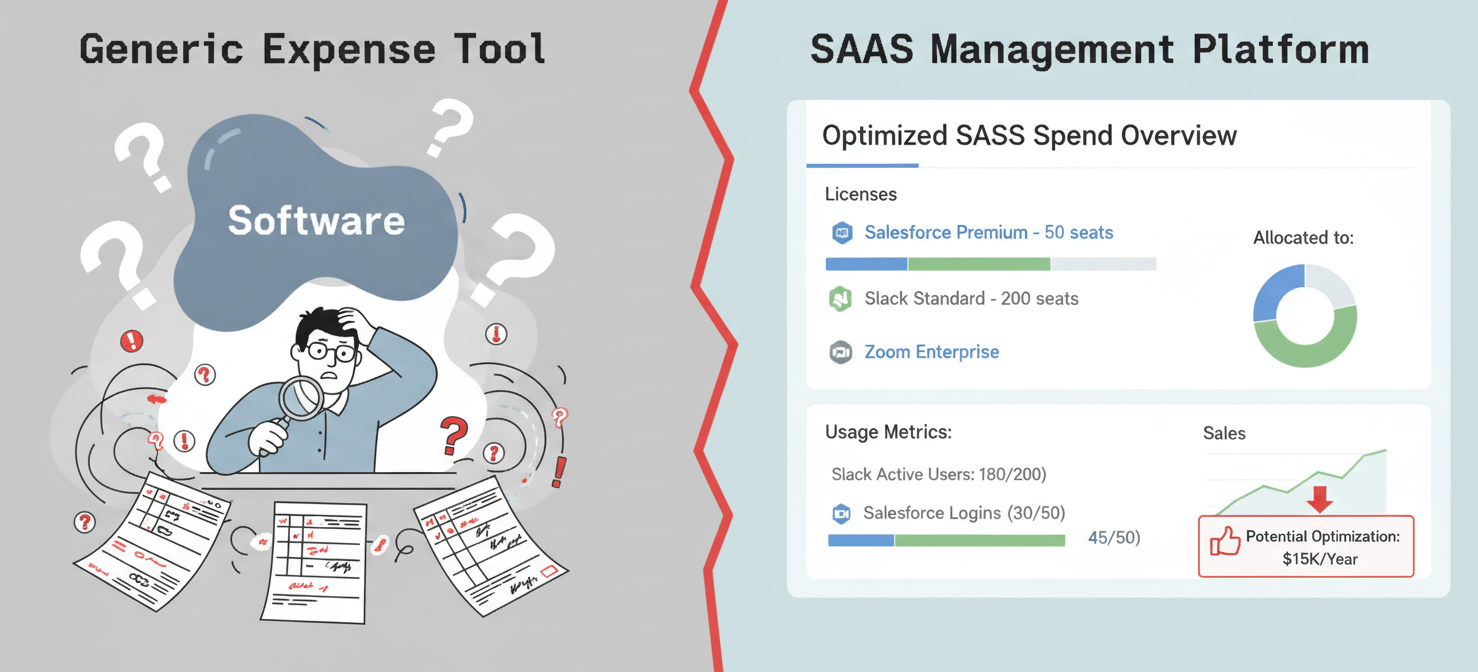
For example, a typical expense tool might see a single monthly charge from a vendor. It can categorize this as “software,” but it cannot break it down further. It doesn’t know that this single charge covers 50 premium licenses and 200 standard licenses, allocated across ten different business units. Furthermore, it has no visibility into whether those 250 licenses are even being used.
This lack of detail makes accurate cost allocation impossible. Instead of precise chargebacks based on departmental usage, you are forced to use imprecise methods like headcount allocation. This approach often leads to friction with department heads who feel they are paying for resources they don’t use. In addition, without usage data, you cannot proactively harvest unused licenses or downgrade users to less expensive tiers. You are left managing renewals in the dark, often renewing contracts for far more seats than are actually needed. A dedicated SaaS management tool, in contrast, is built to solve exactly these problems.
Core FinOps Features to Look For in a SaaS Management Platform
When evaluating a saas management platform, your focus should be on features that directly support FinOps goals: visibility, allocation, and optimization. These platforms go beyond simple inventory lists to provide actionable financial insights. Look for a solution that delivers on the core capabilities that enable data-driven decision-making for your team.
Granular Cost Allocation and Attribution
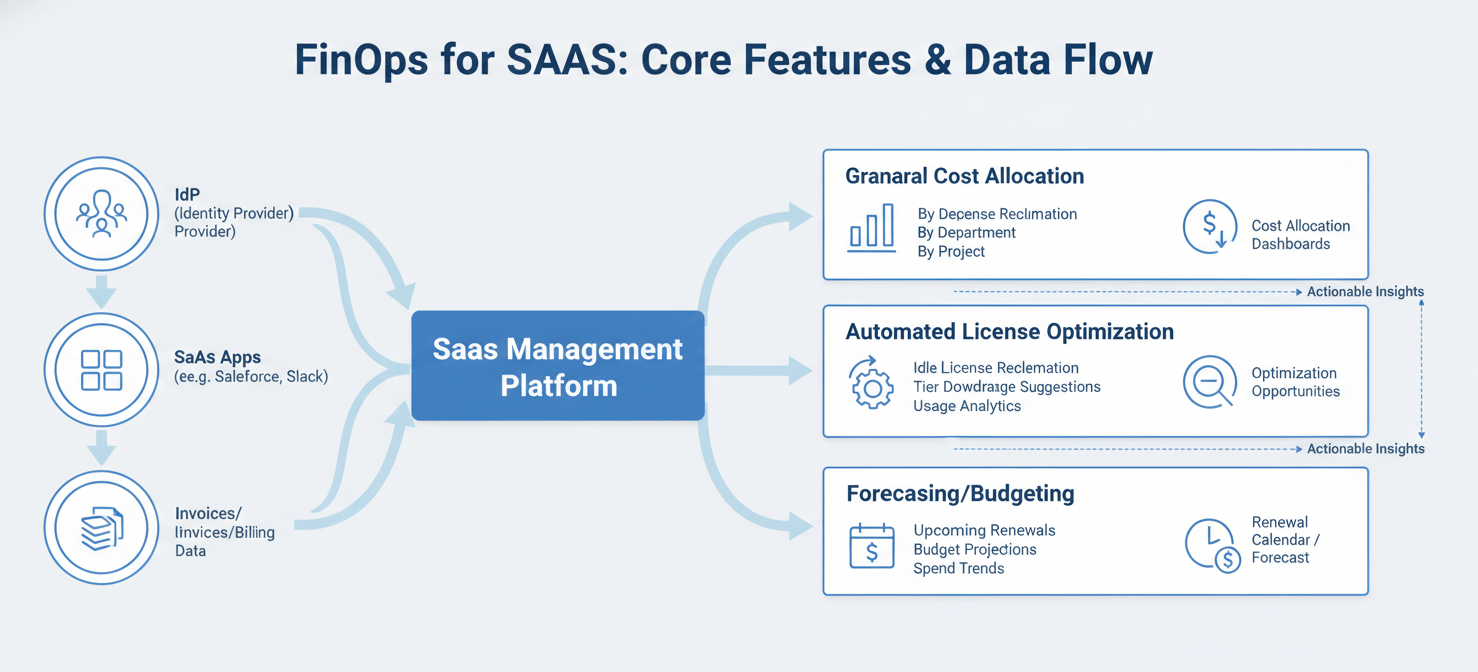
The foundation of any FinOps practice is the ability to accurately attribute costs to the teams and projects that incur them. For SaaS, this means moving beyond the invoice line item. Your chosen platform must be able to ingest data from multiple sources—including direct integrations with SaaS applications, identity providers (IdP), and HR systems—to map every single license to a specific user, department, and cost center.
This capability is what transforms a messy expense category into a manageable one. As a result, you can implement accurate showback or chargeback models. When a department lead questions their software budget, you can present them with a detailed dashboard showing exactly which employees are using which applications and at what license tier. This level of transparency builds trust and empowers departmental leaders to take ownership of their own SaaS spend.
Automated License and Subscription Optimization
A significant portion of SaaS spend is pure waste. It includes licenses assigned to former employees, redundant applications serving the same function, and premium-tier licenses for users who only need basic features. A robust saas subscription management tool automates the process of finding and eliminating this waste.
Look for features like:
- De-provisioning Workflows: The platform should integrate with your IdP (like Okta or Azure AD) to automatically flag and de-provision licenses when an employee leaves the company.
- Usage Monitoring: It must connect directly to key applications to pull usage data. This allows you to identify inactive users who can have their licenses reclaimed and placed back into a license pool.
- License Tier Analysis: The software should help you identify users on expensive premium plans who are not using any of the premium features, allowing you to downgrade them to a cheaper tier without impacting their work.
These automated processes reduce the manual effort required from your team and generate direct, measurable cost savings. For instance, companies can often reduce their SaaS spend by up to 30% within the first year of implementing a management platform, according to some industry analyses.
Forecasting and Budgeting
Effective FinOps isn’t just about cutting costs today; it’s about predicting and planning for them tomorrow. Your SaaS management software should provide the data necessary for accurate forecasting. A key feature here is a comprehensive renewal calendar that alerts your team well in advance of contract end dates—typically 90 to 120 days out.
This advance notice is critical. It gives you time to analyze usage data, consult with business stakeholders, and decide whether to renew, renegotiate, or terminate the contract. Without this system, teams are often caught off guard by auto-renewals, locking them into another year of an underutilized or overpriced tool. The platform should also allow you to model the financial impact of different scenarios, such as headcount changes or migrating to a different license tier, to improve budget accuracy.
Integration: The Key to Actionable Insights
A SaaS management platform cannot operate in a silo. Its value is directly proportional to the quality and breadth of its integrations with your core IT and financial systems. Without deep, bidirectional integrations, the platform becomes just another dashboard instead of a central hub for decision-making. Therefore, you must scrutinize a vendor’s integration capabilities.
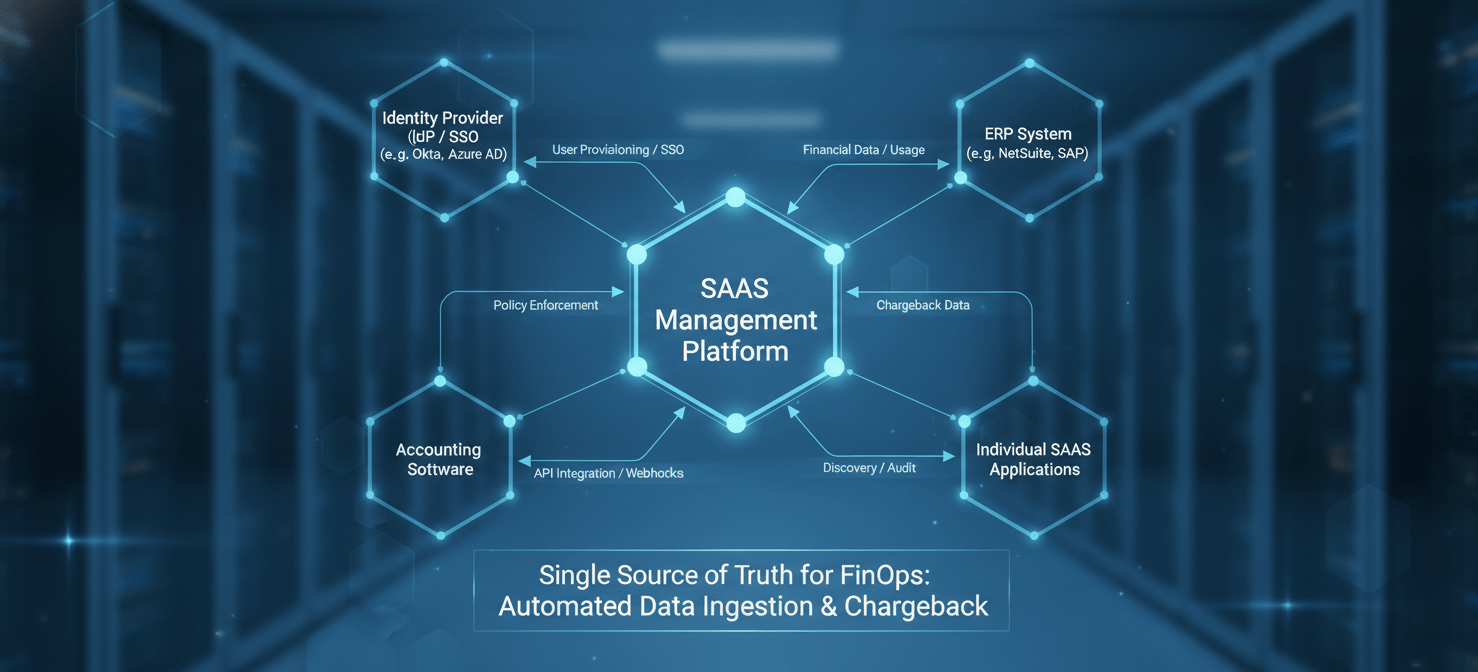
The most critical integration is with your Identity Provider (IdP) and Single Sign-On (SSO) solution, such as Okta or Microsoft Azure AD. This connection is the primary way the platform discovers who is using which applications. It provides the foundational data for mapping licenses to employees.
Equally important are integrations with your financial stack. Connecting to your ERP (like NetSuite or SAP) and accounting software (like QuickBooks) allows the platform to automatically ingest spending data and, in turn, push back accurate allocation data. This automates the chargeback process, eliminating hours of manual reconciliation for your finance team. For example, by connecting directly to your ERP, the platform can assign the cost of a specific Salesforce license to the correct departmental cost center automatically. This creates a closed-loop system that ensures financial data is consistent and reliable across all systems.
Evaluating ROI and Building the Business Case
Adopting a new platform requires a clear business case, and for a FinOps team, that case must be built on a strong return on investment (ROI). The good news is that the ROI for a saas management platform is often straightforward to calculate and compelling to present to leadership. Your business case should focus on three primary areas of value.
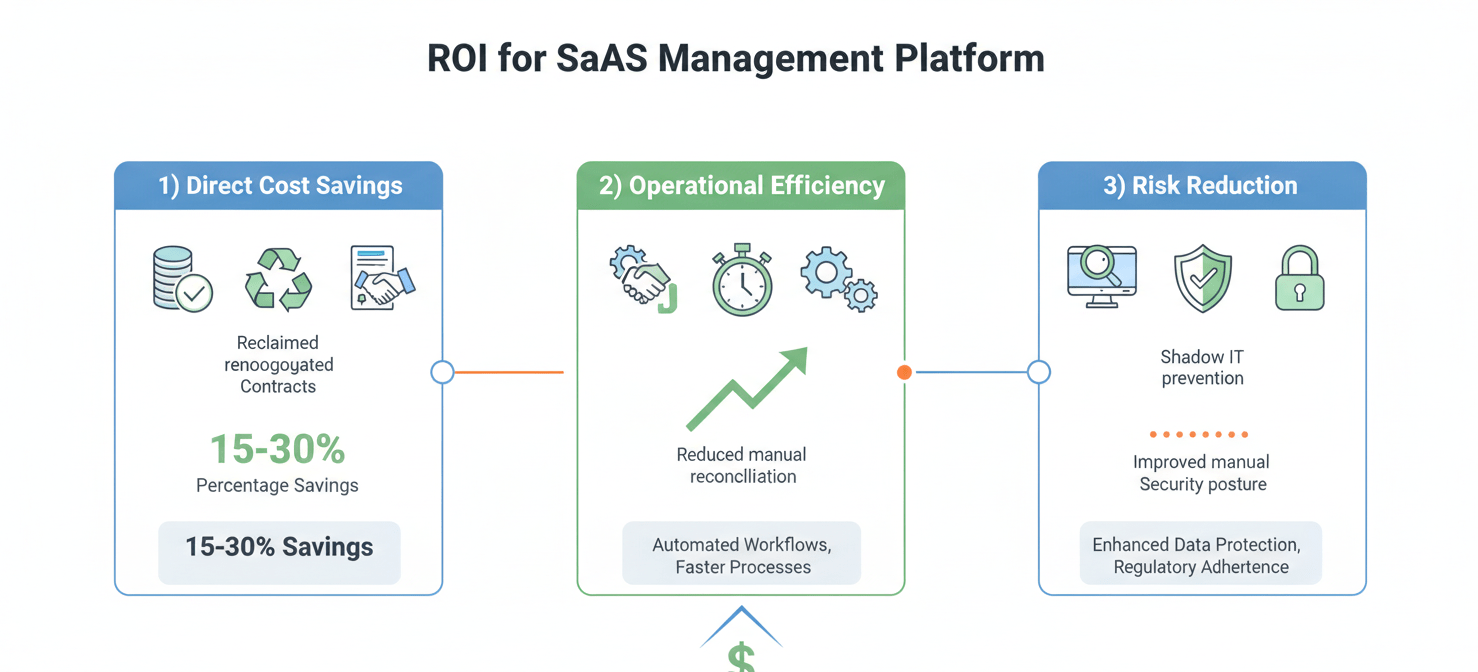
First, calculate the direct cost savings from spend optimization. Start by analyzing your current SaaS spend. Based on industry benchmarks, you can conservatively estimate a 15-20% reduction in costs from reclaiming unused licenses, eliminating redundant applications, and right-sizing subscriptions. For an organization spending $2 million annually on SaaS, that translates to $300,000 to $400,000 in direct savings. Presenting a clear path to these savings is the most powerful part of your proposal.
Second, quantify the value of operational efficiency. Consider the amount of time your team currently spends manually tracking renewals in spreadsheets, chasing down contract owners, and reconciling invoices. A SaaS management platform automates these tasks. Estimate the hours saved per month and multiply that by your team’s blended hourly rate. This represents a soft-cost saving that frees up your analysts to focus on more strategic initiatives.
Finally, highlight the benefits of risk reduction. While harder to quantify, this is a critical point for leadership. Improved oversight of SaaS reduces the risk of data breaches from unsanctioned applications (shadow IT) and ensures compliance with data privacy regulations like GDPR. Centralized vendor management also strengthens your negotiation position during renewals. While you may not put a hard dollar amount on this, it’s a crucial part of a comprehensive business case.
Conclusion
Choosing a saas management platform is not about adding another tool to the stack; it is about acquiring a foundational capability for your FinOps practice. Generic tools simply lack the depth to manage the unique lifecycle of SaaS subscriptions, leaving your team to navigate a maze of decentralized purchasing, opaque usage, and manual accounting. A dedicated platform provides the specialized visibility needed to allocate costs accurately, the automation required to optimize spend systematically, and the integrations necessary to make the data actionable. The goal is to stop reacting to last month’s invoices and start proactively shaping next quarter’s software strategy. After all, you can’t optimize what you can’t see, and you certainly can’t allocate costs for services you don’t even know you’re paying for.
To gain this essential visibility and control over your SaaS spend, consider exploring how a purpose-built platform can transform your FinOps practice; you can start your free Binadox trial to experience its capabilities firsthand or book a demo for a personalized walkthrough.
 7-day free trial