



Software-as-a-Service (SaaS) has become the operational backbone for modern businesses, but managing these tools is a growing challenge. Without a deliberate strategy, your organization can easily lose control over costs, security, and efficiency. Effective saas renewal management is the process of proactively overseeing your company’s software subscriptions to control spending, assess value, and ensure tools align with business goals. It transforms a reactive, often chaotic task into a strategic function that directly impacts your bottom line.
Key takeaways
- Proactive Management is Crucial: A structured renewal process should begin 90-120 days before a contract ends to provide enough time for evaluation and negotiation.
- Visibility Unlocks Savings: Organizations waste an average of $19.8 million annually on unused SaaS licenses, with nearly half (46%) of all licenses going unused.
- Data-Driven Decisions are Key: Tracking metrics like user adoption, license utilization, and renewal rates allows you to eliminate redundant tools and negotiate better contract terms based on actual usage.
- Centralization is Non-Negotiable: Managing renewals via spreadsheets is inefficient and error-prone. A centralized SaaS management platform provides a single source of truth for all contracts, spending, and usage data.
What Is SaaS Renewal Management?
SaaS renewal management is the systematic process of tracking, evaluating, and making decisions about your company’s software subscriptions as they approach their renewal dates. It’s more than just paying an invoice; it’s a strategic evaluation to ensure every tool provides a return on investment (ROI). This process involves monitoring contract end dates, understanding usage patterns, assessing business needs, and negotiating terms with vendors.
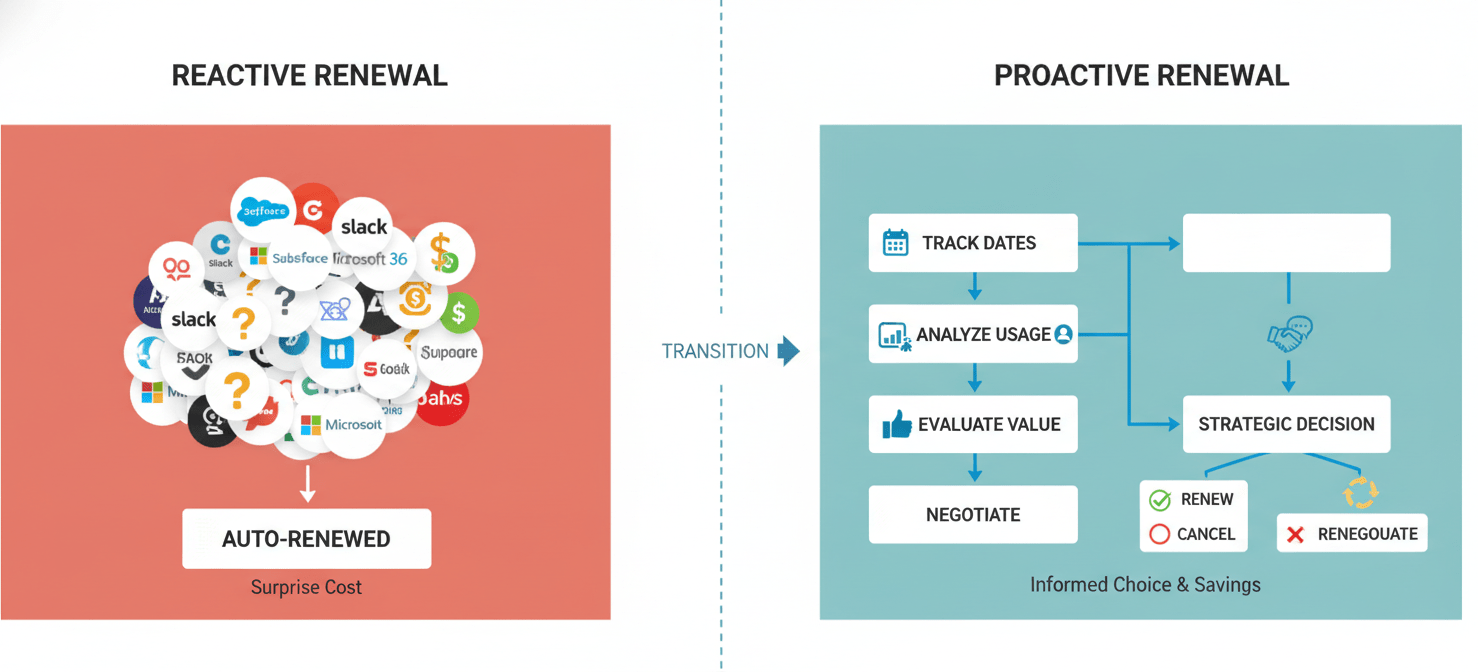
The goal is to move from a passive, automatic renewal culture to an active, intentional one. Instead of letting subscriptions roll over without scrutiny—often with surprise price hikes—a proper software renewal tracking system ensures that every renewal is a conscious choice. This proactive approach helps you avoid paying for “shelfware”—software that is paid for but rarely used—and ensures your teams have the right tools to succeed.
An effective SaaS renewal process involves stakeholders from IT, finance, procurement, and the business units using the software. By working together, these teams can make informed decisions that align with both departmental needs and overall company objectives.
Why Is Tracking SaaS Renewals So Critical?
Failing to track SaaS renewals effectively can have significant financial and operational consequences. With the average enterprise managing hundreds of SaaS applications, the complexity and cost can quickly spiral out of control. Here’s why a disciplined approach is essential.
Cost Control and Waste Reduction
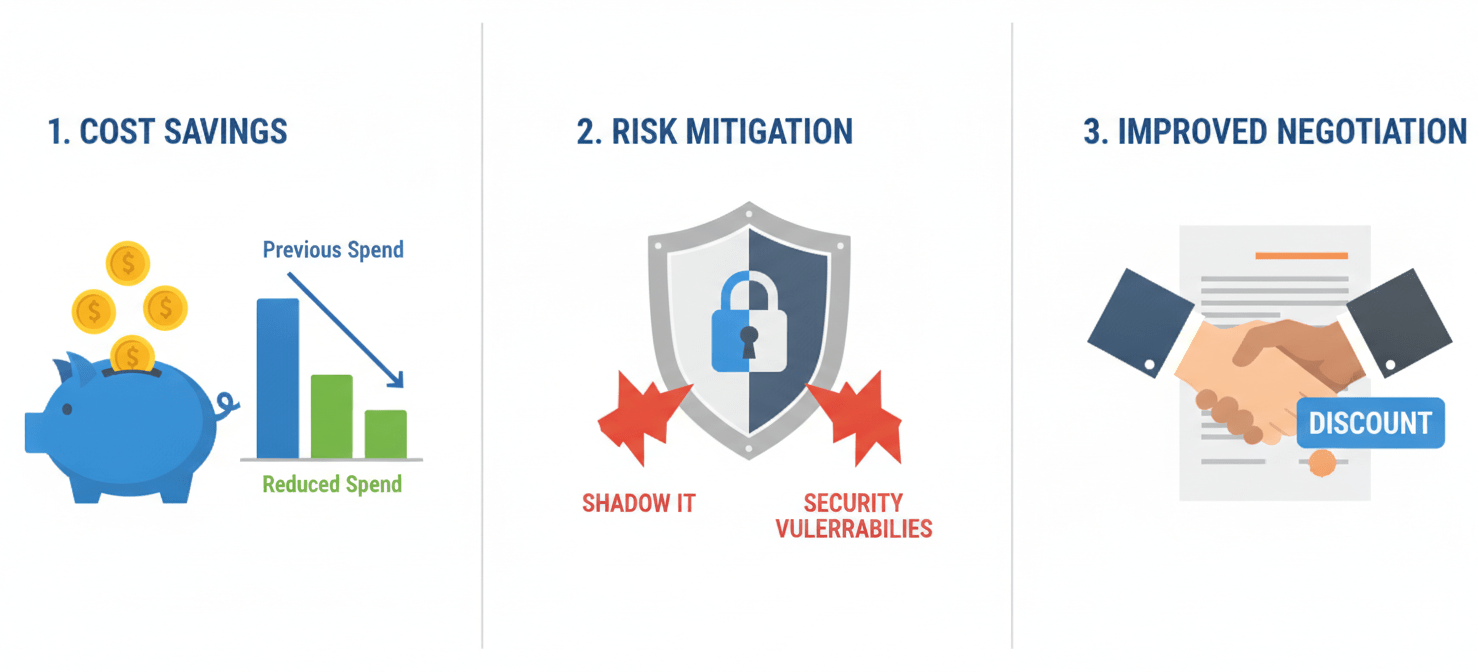
The most immediate benefit of tracking SaaS renewals is significant cost savings. Research shows that organizations waste millions of dollars annually on unused or underutilized software licenses. In many companies, up to 46% of SaaS licenses are not actively used, representing a massive financial drain.
Proactive renewal management allows you to identify this waste. By analyzing usage data before a renewal date, you can “rightsize” your subscriptions—reducing seat counts, downgrading to a more appropriate pricing tier, or eliminating the software altogether if it no longer provides value. This prevents you from paying for licenses assigned to former employees or for premium features your team never uses.
Avoiding Unwanted Auto-Renewals
A vast majority of SaaS contracts—as high as 89%—include an auto-renewal clause. These clauses are designed for vendor convenience, not customer benefit. Without a tracking system, it’s easy to miss the cancellation window for a tool you no longer need, locking your company into another year of unnecessary expense. A centralized renewal calendar with automated alerts is the first line of defense against these costly surprises.
Enhanced Security and Compliance
Untracked software, often called “Shadow IT,” poses a significant security risk. When employees sign up for applications without IT oversight, these tools may not meet your company’s security and compliance standards. A formal renewal process forces a regular review of each application’s security posture, ensuring it aligns with your data protection policies. It provides an opportunity to verify that vendors are compliant with regulations like GDPR or SOC 2 and to offboard tools that create unacceptable risks.
Improved Negotiation Leverage
Knowledge is power in any negotiation. When you approach a vendor armed with detailed data on your team’s usage, you are in a much stronger position to negotiate favorable terms. You can push for discounts based on low adoption, request more flexible licensing models, or benchmark the vendor’s pricing against competitors. Starting the process 90-120 days before the renewal date gives you ample time to explore alternatives, further strengthening your negotiating stance.
Common Challenges in the SaaS Renewal Process
While the benefits are clear, implementing an effective software renewal tracking system comes with its own set of hurdles. Many organizations struggle with the same recurring problems that lead to wasted spend and operational friction.
Lack of Centralized Visibility
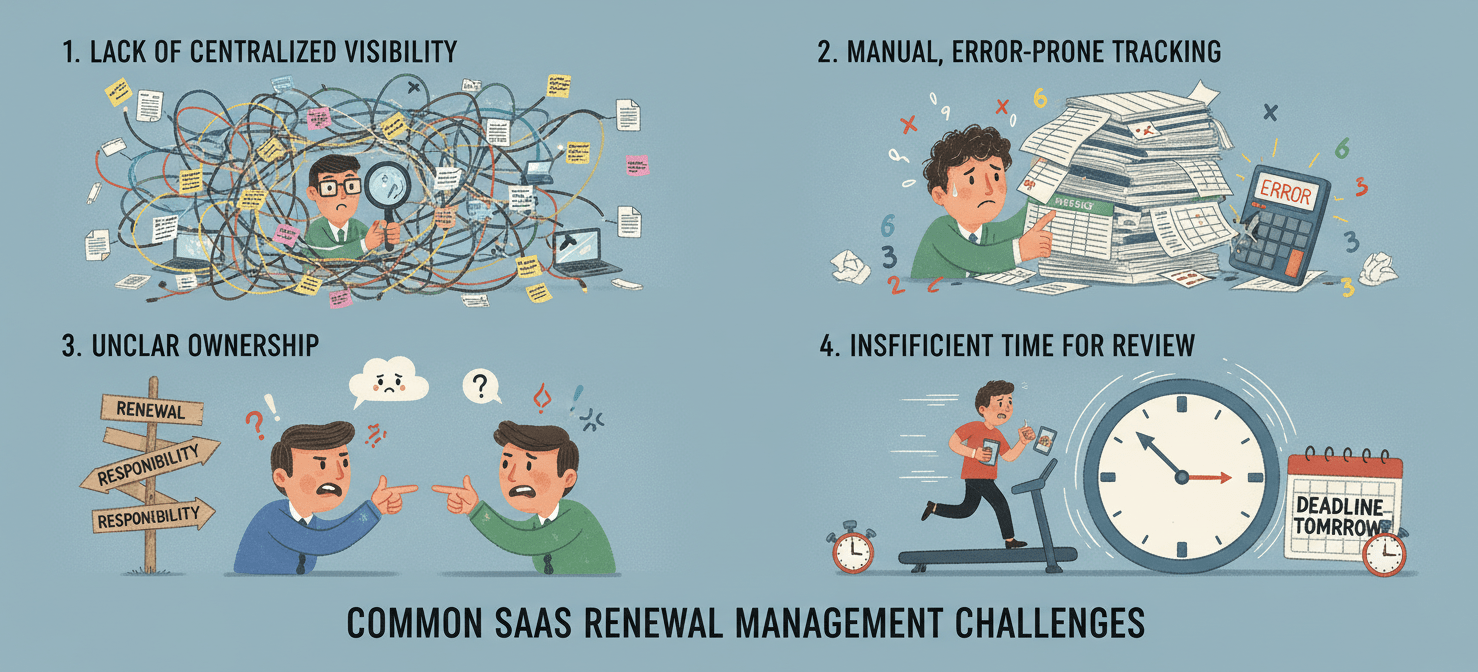
One of the biggest challenges is decentralized purchasing. When individual employees or departments can buy software independently, it creates a fragmented and chaotic SaaS landscape. Contracts and renewal dates are scattered across different inboxes and spreadsheets, making it nearly impossible for IT or finance teams to get a complete picture of the company’s software stack. This lack of a single source of truth is a primary driver of missed renewals and redundant subscriptions.
Manual and Error-Prone Tracking
Many companies still rely on spreadsheets to manage their SaaS renewals. While seemingly simple, this method is highly inefficient and prone to human error. Spreadsheets are difficult to maintain, offer no automated alerts, and provide no insights into software usage. As the number of SaaS applications grows, manual tracking becomes unsustainable, leading to missed deadlines and costly mistakes.
Unclear Ownership and Accountability
If no one is clearly responsible for a specific software subscription, its renewal will likely happen without any strategic review. Is IT responsible? Or the department that uses it most? Or finance? Without a designated owner, there is no one to assess the tool’s value, analyze usage data, or manage the relationship with the vendor. This ambiguity often results in a default decision to renew, regardless of the tool’s actual performance or necessity.
Insufficient Time for Review
Effective renewal management cannot be a last-minute scramble. Waiting until the week before a contract expires leaves no time for a proper evaluation, usage analysis, or negotiation. Many vendors require a 30, 60, or even 90-day notice for cancellation, meaning a late review forces you into an auto-renewal. A proactive process that starts months in advance is essential to make thoughtful, data-driven decisions.
A Step-by-Step Guide to Effective SaaS Renewal Management
Creating a structured and repeatable SaaS renewal process is the key to overcoming common challenges and taking control of your software stack. Follow these steps to build a system that saves money and improves efficiency.
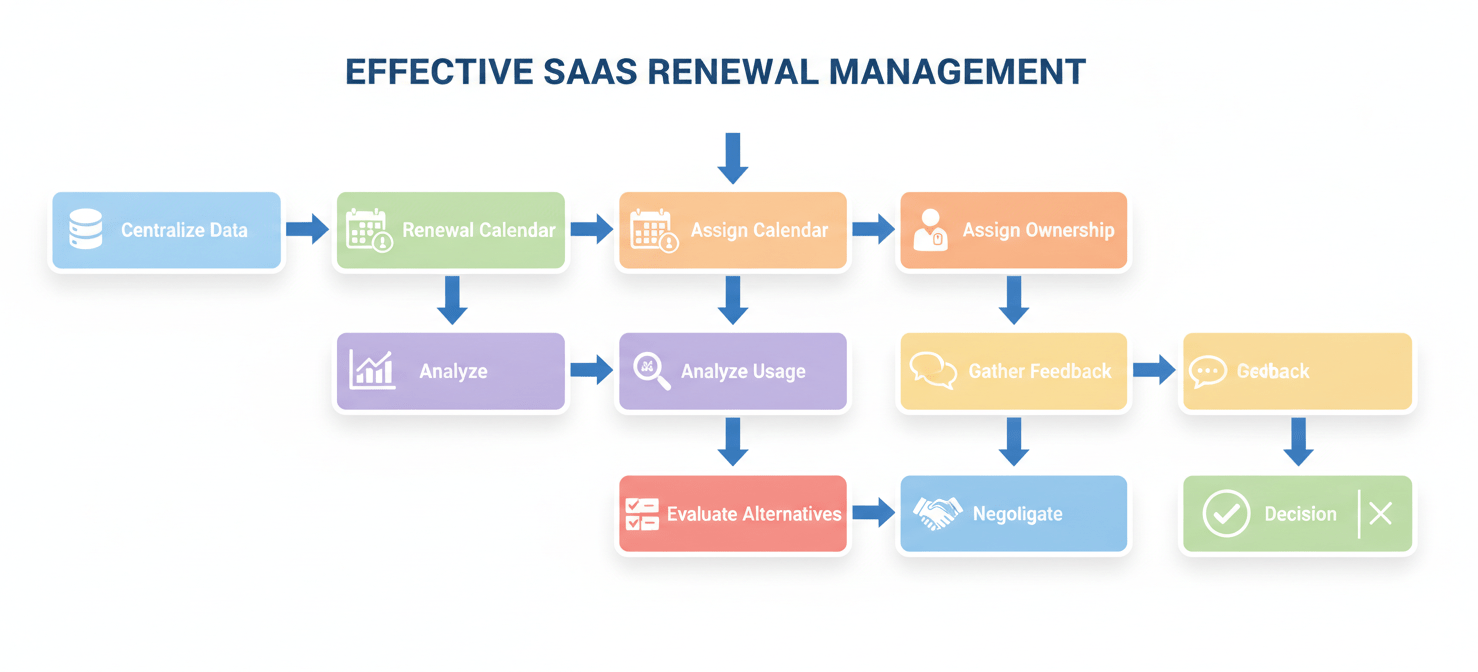
1. Centralize All SaaS Contracts and Data
The first step is to create a single, centralized inventory of all your SaaS applications. You cannot manage what you cannot see. This involves gathering every software contract and documenting key information, including:
- Vendor name and contact information
- Contract start and end dates
- Renewal date and notification period
- Annual or monthly cost
- Number of licenses
- Designated internal owner
While a spreadsheet can be a starting point, a dedicated SaaS management platform is far more effective for maintaining this inventory and providing real-time visibility.
2. Establish a Renewal Calendar with Automated Alerts
Once you have a centralized inventory, create a renewal calendar that tracks all upcoming contract end dates. The most critical feature of this calendar is automated alerts. Set up notifications to be sent to the relevant stakeholders—such as the application owner, IT, and finance—at key intervals, for example, 90, 60, and 30 days before the renewal date. This ensures that no renewal slips through the cracks and that the review process begins with plenty of time.
3. Assign Clear Ownership for Each Application
Every single SaaS tool in your inventory must have a designated owner. This individual is responsible for leading the renewal process for that application. The owner is typically a leader within the department that uses the software most heavily. Their responsibilities include gathering user feedback, assessing the tool’s business value, and acting as the primary point of contact for the vendor. This clear assignment of responsibility ensures accountability and prevents renewals from being overlooked.
4. Analyze Usage and Adoption Data
Before making any renewal decision, you must understand how—and if—the software is being used. This is where data becomes critical. Analyze login frequency, feature adoption, and overall user engagement to determine the tool’s true value. If you find that a significant number of licenses are unused or that employees are only using a fraction of the tool’s features, you have a strong case for reducing your license count or downgrading your plan.
5. Gather Feedback from Users
Quantitative data tells part of the story, but qualitative feedback from your team is equally important. Survey the employees who use the software to understand their experience. Do they find the tool valuable? Does it help them perform their jobs more effectively? Are there any friction points or missing features? This feedback can reveal whether a tool is a critical part of a team’s workflow or a source of frustration that should be replaced.
6. Evaluate Alternatives and Benchmark Pricing
Never assume the incumbent vendor is your only option. As part of the renewal process, take the time to research alternative solutions. A competitor may offer better features, a more intuitive user interface, or a more attractive price point. Furthermore, use this research to benchmark the current vendor’s pricing. Armed with this information, you can enter negotiations with a clear understanding of the market and what constitutes a fair deal.
7. Negotiate from a Position of Strength
With your usage data, user feedback, and competitive research in hand, you are ready to negotiate. Contact the vendor well in advance of the renewal deadline to discuss your findings. If usage is low, ask for a discount or a reduction in seats. If you have found a cheaper alternative, use it as leverage. Remember that it is almost always more expensive for a vendor to acquire a new customer than to retain an existing one, which gives you a significant advantage.
8. Make a Data-Informed Decision
Finally, based on all the information you have gathered, make a clear decision:
- Renew: The tool provides clear value, usage is high, and the terms are favorable.
- Renegotiate: The tool is valuable, but the contract needs to be adjusted (e.g., fewer licenses, different tier, better price).
- Cancel: The tool is underutilized, no longer meets business needs, or a better alternative exists.
Document this decision and the reasoning behind it to inform future renewal cycles.
Key Metrics to Track for SaaS Renewals
To effectively manage your SaaS renewals, you need to track the right key performance indicators (KPIs). These metrics provide the data-driven insights necessary to assess the value of your software investments and make informed decisions.
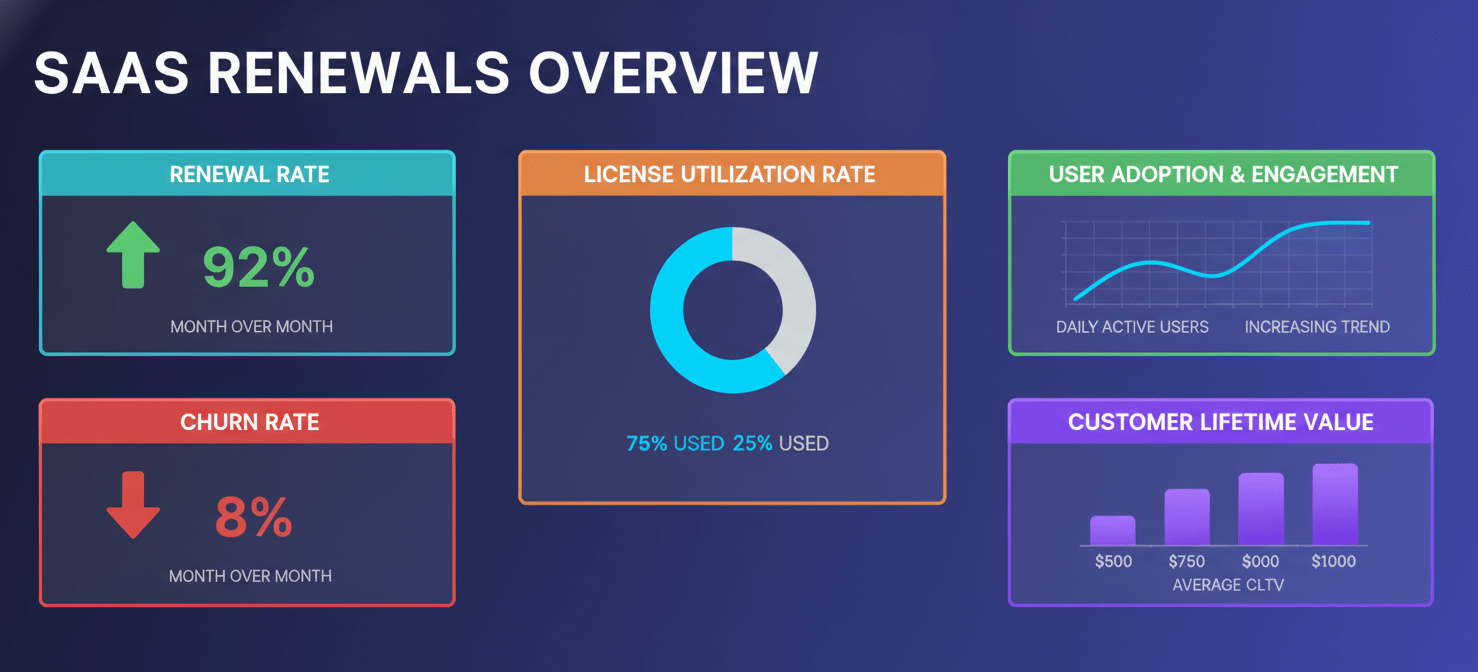
Renewal Rate
The renewal rate is one of the most fundamental metrics, measuring the percentage of customers who choose to renew their subscriptions. While often used by SaaS vendors themselves, it’s also a valuable internal metric. A high renewal rate for a particular tool across your organization indicates that users find it valuable and essential to their workflows. Conversely, a low renewal rate can signal dissatisfaction or a lack of perceived value, prompting a deeper investigation before the next renewal cycle.
License Utilization Rate
This metric calculates the percentage of purchased licenses that are actively being used. It is calculated by dividing the number of active users by the total number of licenses purchased. A low utilization rate is a clear sign of wasted spend and an immediate opportunity for cost savings. For example, if you are paying for 100 licenses but only 60 employees have logged in over the past 90 days, you can confidently reduce your seat count at renewal time.
User Adoption and Engagement
Beyond just logging in, it’s important to understand how deeply users are engaging with a tool. Track metrics such as:
- Frequency of use: How often do users log in (daily, weekly, monthly)?
- Feature adoption: Are users leveraging the key features that justify the cost of the software?
- Session duration: How much time are users spending in the application?
Low engagement can indicate that a tool is not well-integrated into workflows or that users need additional training.
Churn Rate
Churn rate measures the percentage of customers who cancel their subscriptions over a specific period. Internally, you can think of this as the rate at which your teams decide not to renew a particular software. Tracking churn across your SaaS portfolio helps you identify which tools are consistently failing to deliver value. A high churn rate for a specific application is a red flag that it may not be a good fit for your organization.
Customer Lifetime Value (CLV)
Customer Lifetime Value predicts the total revenue a business can expect from a single customer account. While a vendor-centric metric, it’s useful for internal evaluation as well. By understanding the long-term cost of a particular SaaS tool, you can better assess its overall ROI. A high CLV for a tool that is deeply embedded in your operations might justify a higher price, while a low CLV for a peripheral tool might make it a candidate for cancellation.
Tools and Software for Tracking SaaS Renewals
As your organization’s SaaS portfolio grows, manual tracking methods like spreadsheets become impractical and risky. Dedicated SaaS management platforms (SMPs) provide the automation and visibility needed to manage renewals effectively. These tools centralize your software inventory, automate alerts, and provide deep insights into spending and usage.
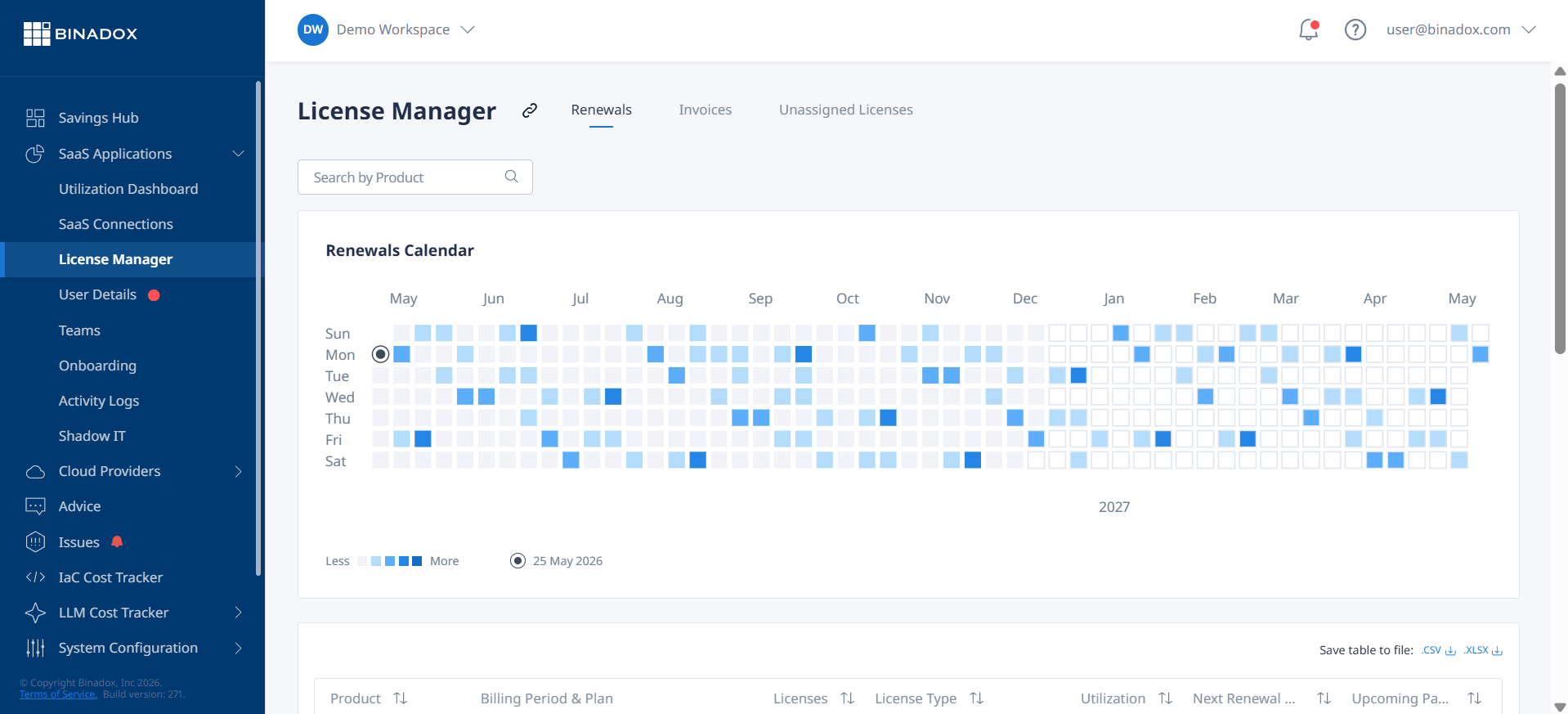
Key Features of SaaS Management Platforms
When evaluating software for tracking renewals, look for these essential features:
- Automated Discovery: The ability to automatically discover all SaaS applications in use across your organization, including “Shadow IT,” by integrating with finance and identity systems.
- Centralized Contract Management: A single repository to store all your SaaS contracts, track key dates, and manage vendor information.
- Renewal Calendar and Alerts: An automated system that provides timely notifications about upcoming renewals to prevent last-minute surprises.
- Usage and Utilization Tracking: Detailed analytics on how employees are using software, allowing you to identify inactive licenses and underutilized tools.
- Spend and Budgeting Tools: Features that help you track SaaS spending by department, forecast future costs, and manage your overall software budget.
- Workflow Automation: The ability to create automated workflows for renewal approvals, routing requests to the right stakeholders based on predefined rules.
Popular SaaS Management Platforms
Several robust platforms are available to help you streamline your software renewal tracking. Some of the leading solutions include:
- Zylo: An enterprise-focused platform that provides comprehensive discovery, optimization, and governance features.
- BetterCloud: A tool that combines SaaS management with security and automation capabilities, allowing you to manage and secure your SaaS environment.
- Cledara: A platform designed to help companies manage, control, and automate their software subscriptions.
- Torii: A SaaS management platform that emphasizes automated discovery and provides detailed insights into application usage and spending.
By leveraging one of these tools, you can move from a reactive, manual process to a proactive, automated, and data-driven SaaS renewal strategy.
Best Practices for Optimizing Your SaaS Renewal Strategy
A successful SaaS renewal management program goes beyond simply tracking dates. It requires a strategic mindset focused on continuous optimization. By adopting these best practices, you can maximize the value of your software investments and drive significant cost savings.
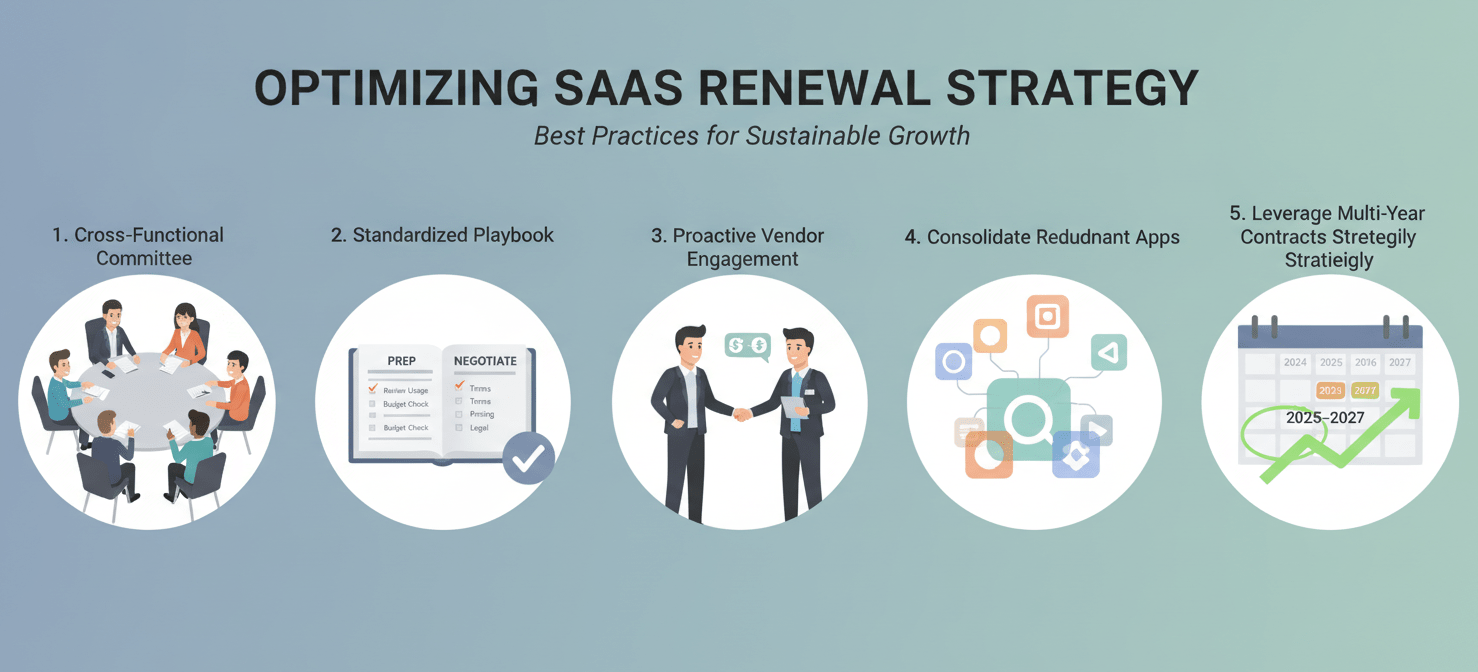
Establish a Cross-Functional Renewal Committee
Create a dedicated team with representatives from IT, Finance, Procurement, and key business departments to oversee the renewal process. This committee should meet regularly to review upcoming renewals, analyze usage data, and make collective decisions. This cross-functional approach ensures that renewal decisions are aligned with the strategic goals of the entire organization, not just the needs of a single department.
Develop a Standardized Renewal Playbook
Document your renewal process in a formal playbook that outlines the steps, roles, and responsibilities for every renewal. This playbook should define the timeline for the renewal process (e.g., starting 120 days out), the data that needs to be collected, and the criteria for making a renew or cancel decision. A standardized process ensures consistency and prevents important steps from being missed.
Proactively Engage with Vendors
Don’t wait for the vendor to send you a renewal notice. Initiate the conversation early, at least 90 days before the contract expires. This proactive engagement signals that you are taking the renewal seriously and gives you more time to negotiate. Use this opportunity to discuss your usage, ask about new features or pricing tiers, and address any issues you have experienced with the product or support.
Consolidate Redundant Applications
During your renewal reviews, you will likely discover multiple applications with overlapping functionality being used by different teams. For example, you might find three different project management tools or two separate file-sharing services. Renewals provide the perfect opportunity to consolidate these redundant applications. By standardizing on a single tool, you can often negotiate a better enterprise-level price, reduce administrative overhead, and improve cross-team collaboration.
Leverage Multi-Year Contracts Strategically
While long-term contracts can be risky, they can also offer significant savings. If a SaaS application is critical to your business operations and has consistently high usage, consider negotiating a multi-year contract in exchange for a substantial discount. However, only do this for core, stable tools where your future needs are predictable. For newer or less critical applications, a one-year term provides more flexibility to adapt as your needs change.
Conclusion
Ignoring the complexities of software renewals is no longer a viable option. The costs are too high, the risks are too great, and the potential for waste is enormous. Effective saas renewal management is not merely an administrative task for the IT department; it is a critical business function that demands a proactive, data-driven, and collaborative approach. By transforming your renewal process from a last-minute scramble into a structured, strategic review, you can eliminate millions in wasted spend, strengthen your security posture, and ensure your teams are equipped with the tools they actually need to succeed. The choice is simple: either control your SaaS stack, or let it control you.
To truly take command of your software ecosystem and unlock significant savings, consider exploring our platform with a free trial, or if you prefer a guided tour, you can book a personalized demo to see how it fits your specific needs.
 7-day free trial