



When your team deploys resources in a private Azure virtual network, they often still need outbound internet access for updates, APIs, or other external services. Azure NAT Gateway provides a secure and scalable way to manage this outbound connectivity without exposing your virtual machines to inbound traffic. However, understanding the nuances of Azure NAT Gateway pricing is crucial to avoid unexpected costs. This article breaks down the charges, focusing specifically on the data processed component, to help you manage your cloud spend effectively.
Key takeaways
- Azure NAT Gateway billing has two primary components: a fixed hourly charge for the gateway resource and a variable charge for data processed.
- The data processed cost is approximately $0.045 per gigabyte (GB) for all data flowing out of and back into your network through the gateway.
- Billing for the gateway resource starts the moment it’s created, even if it’s not associated with a subnet or processing any traffic.
- You can optimize costs by analyzing traffic patterns with tools like Azure Monitor and ensuring resources are located in the same region to minimize data transfer.
How Azure NAT Gateway Billing Works
Azure NAT Gateway simplifies outbound connectivity, but its billing model requires attention. The service charges for two distinct things: the existence of the NAT Gateway resource itself and the volume of data it processes.
First, you are billed an hourly rate for each NAT Gateway you provision. This charge applies from the moment the gateway is created until it is deleted. Importantly, the hourly fee accrues regardless of whether the gateway is actively processing traffic or even attached to a subnet. Forgetting to deprovision a NAT Gateway after a test or temporary deployment is a common source of unnecessary costs.
Second, and often more significantly, you are charged for the data that flows through the gateway. This is the “data processed” cost. It’s calculated on a per-gigabyte basis and applies to all outbound traffic initiated from your private subnets as well as the corresponding return traffic. This two-way measurement means that a single request to an external service will incur charges for both the outgoing request and the incoming response.
The Two Main Components of Azure NAT Gateway Pricing
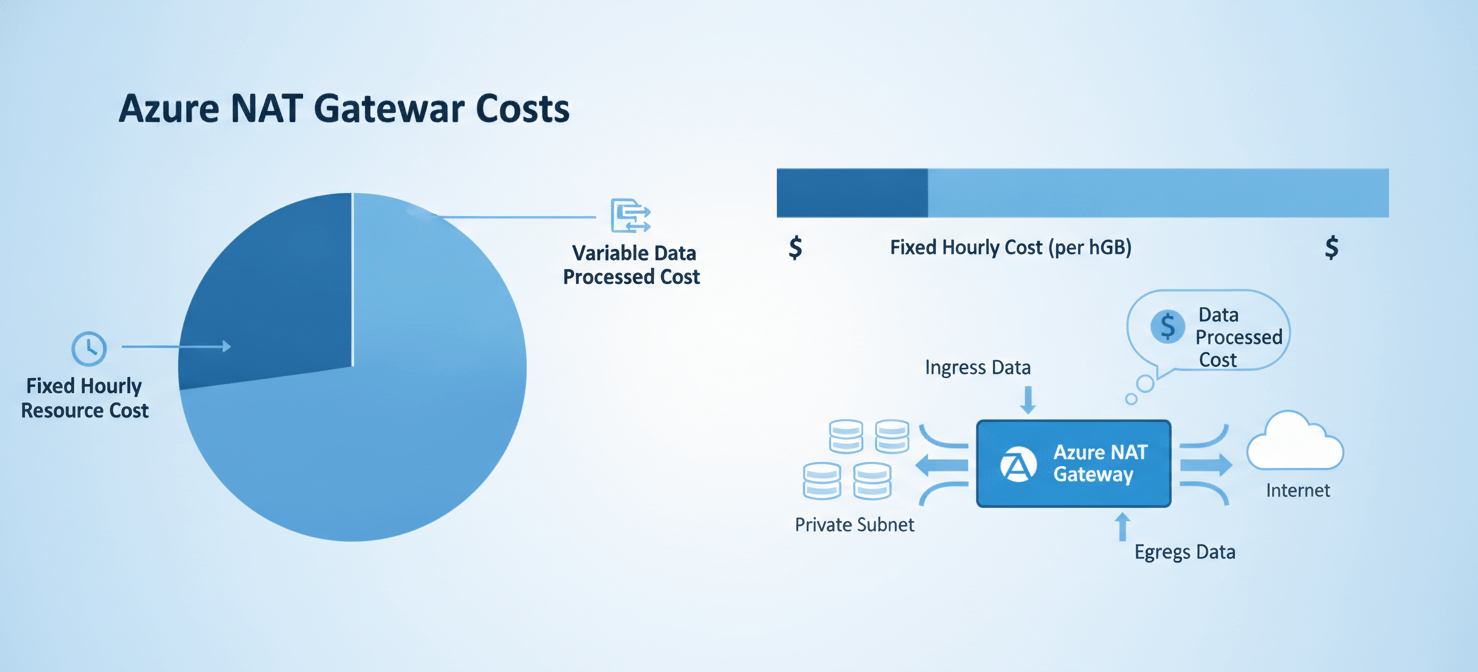
To budget accurately, it’s essential to understand both parts of the pricing structure. The total cost is a sum of the fixed resource fee and the variable data fee.
Resource Hours
The NAT Gateway resource is billed at a fixed hourly rate, which is approximately $0.045 per hour. This translates to a predictable monthly baseline cost for just having the service active. Even a partial hour of usage is billed as a full hour. Therefore, simply creating and deleting a gateway within a few minutes will still result in a charge for one full hour of use.
Data Processed
The more dynamic component is the Azure NAT Gateway data processed cost. Azure charges approximately $0.045 per GB of data that the gateway processes. This includes both data leaving your virtual network (egress) and the response data coming back in (ingress). For applications that transfer large volumes of data, this per-GB fee can quickly become the dominant portion of your monthly bill. It’s also worth noting that in addition to the NAT Gateway’s data processing fee, standard Azure bandwidth charges for data transfer out of Azure data centers may also apply.
Factors Influencing Data Processed Costs
Several factors can impact your total data processing charges. Understanding these drivers is the first step toward managing your NAT Gateway cost explained.
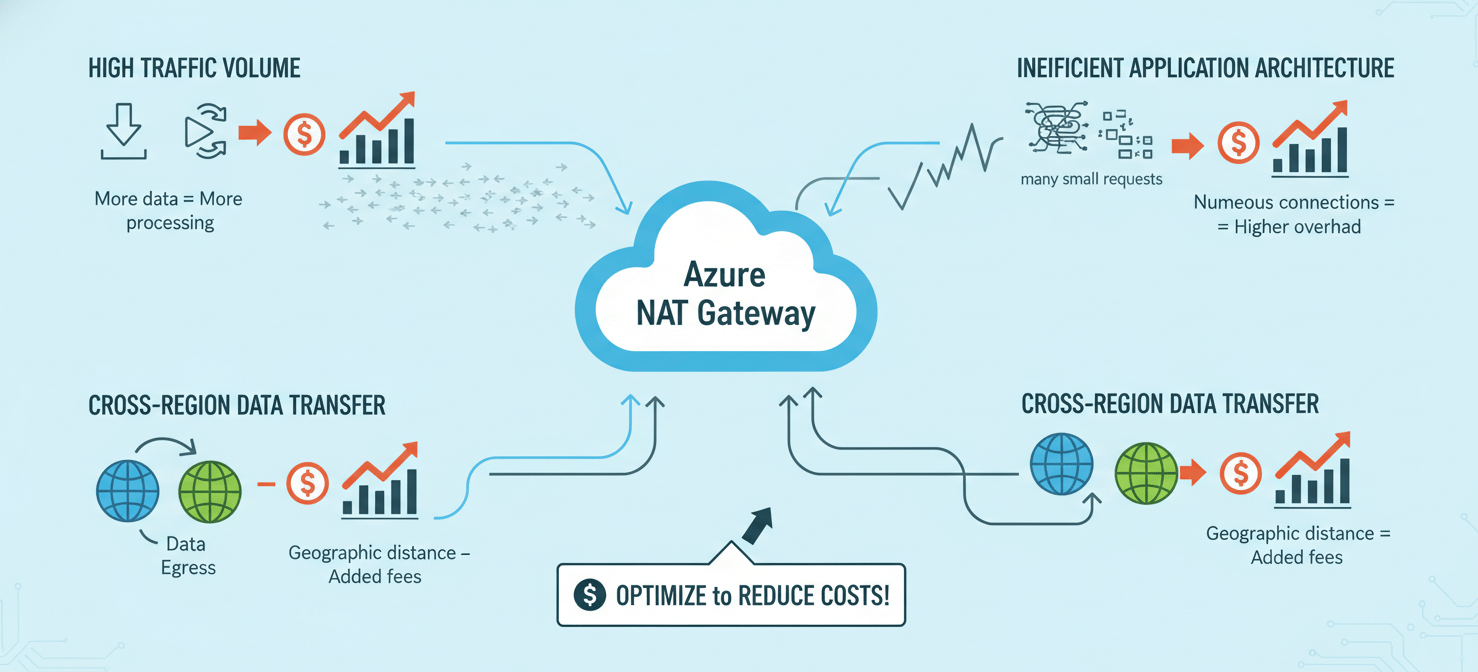
The primary driver is, unsurprisingly, traffic volume. Applications that frequently download large files, stream media, or interact with chatty external APIs will generate more processed data and, as a result, higher costs. For example, a virtual machine pulling down software updates or a database backing up to an external storage location will contribute directly to these charges.
Application architecture also plays a significant role. A poorly optimized application that makes numerous inefficient requests to an outside service will incur higher data costs than a streamlined one. Similarly, the location of your resources matters. While traffic within the same virtual network is not processed by the NAT Gateway, communication across different Azure regions can sometimes be routed in ways that increase data transfer costs. Keeping interdependent resources within the same region is a best practice for cost optimization.
Finally, the number of NAT Gateways you deploy can affect costs. While each gateway has its own hourly charge, consolidating outbound traffic from multiple subnets through a single gateway can sometimes be more cost-effective than deploying separate gateways for each. However, this depends on your specific network architecture and performance requirements.
Strategies to Manage and Optimize Your NAT Gateway Costs
You can take several practical steps to control your Azure NAT Gateway expenses without compromising on functionality.
First, it is crucial to monitor your traffic. Use tools like Azure Monitor and Network Watcher to get a clear picture of which resources are generating the most outbound traffic. By enabling and analyzing flow logs, your team can identify high-volume data flows and pinpoint specific applications or virtual machines responsible for the bulk of your data processing charges.
Next, optimize your application’s communication patterns. Where possible, reduce the frequency and size of data transfers. For instance, implement caching strategies to avoid repeatedly fetching the same data from external sources. For interactions with Azure PaaS services like Azure Storage or SQL Database, consider using Private Link. This service routes traffic over the Azure private backbone instead of the public internet, which can bypass the NAT Gateway entirely for those connections and improve security.
Furthermore, practice good resource hygiene. Regularly review your Azure environment for unused or forgotten NAT Gateways. An idle gateway provides no value but continues to incur hourly charges. Implementing a regular cleanup schedule or using Azure Policy to identify orphaned resources can prevent these unnecessary costs from accumulating over time.
Conclusion
Azure NAT Gateway is an essential service for securing outbound connectivity for private resources. However, its pricing model, particularly the data processed component, requires careful management. The total cost is a combination of a fixed hourly fee and a variable per-gigabyte charge that applies to both outbound and return traffic. By understanding these components, monitoring your network traffic diligently, and optimizing your application architecture, you can effectively manage your Azure NAT Gateway pricing. Failing to track these costs is like leaving a meter running in a taxi you’ve already exited—it’s a silent, unnecessary drain on your budget that is entirely avoidable with a bit of oversight.
To effectively manage these nuanced costs and prevent unnecessary drains on your budget, you might consider experiencing Binadox’s capabilities firsthand, or for a more personalized discussion, schedule a demonstration with our team.
 7-day free trial