



Shadow IT—the use of any application or service without your IT department’s knowledge or approval—is more than just a nuisance. It’s a significant security blind spot. When employees use unapproved cloud apps, they can expose your organization to data breaches and compliance violations. This raises a critical question for security teams: can your existing network firewall help? Using a firewall for cloud app discovery is a foundational step, but it’s crucial to understand both its capabilities and its limits in the fight against shadow IT.
Key takeaways
- Firewalls can discover shadow IT by analyzing traffic logs to identify connections to unknown cloud services.
- This method is most effective for on-premise and office-based employees whose traffic routes through the corporate network.
- However, firewalls often lack deep visibility into encrypted traffic and cannot monitor activity from remote workers who are not on a VPN.
- For comprehensive discovery, organizations should combine firewall analysis with other tools, such as a Cloud Access Security Broker (CASB), which provides more granular control and visibility.
How Firewalls Discover Unsanctioned Cloud Apps
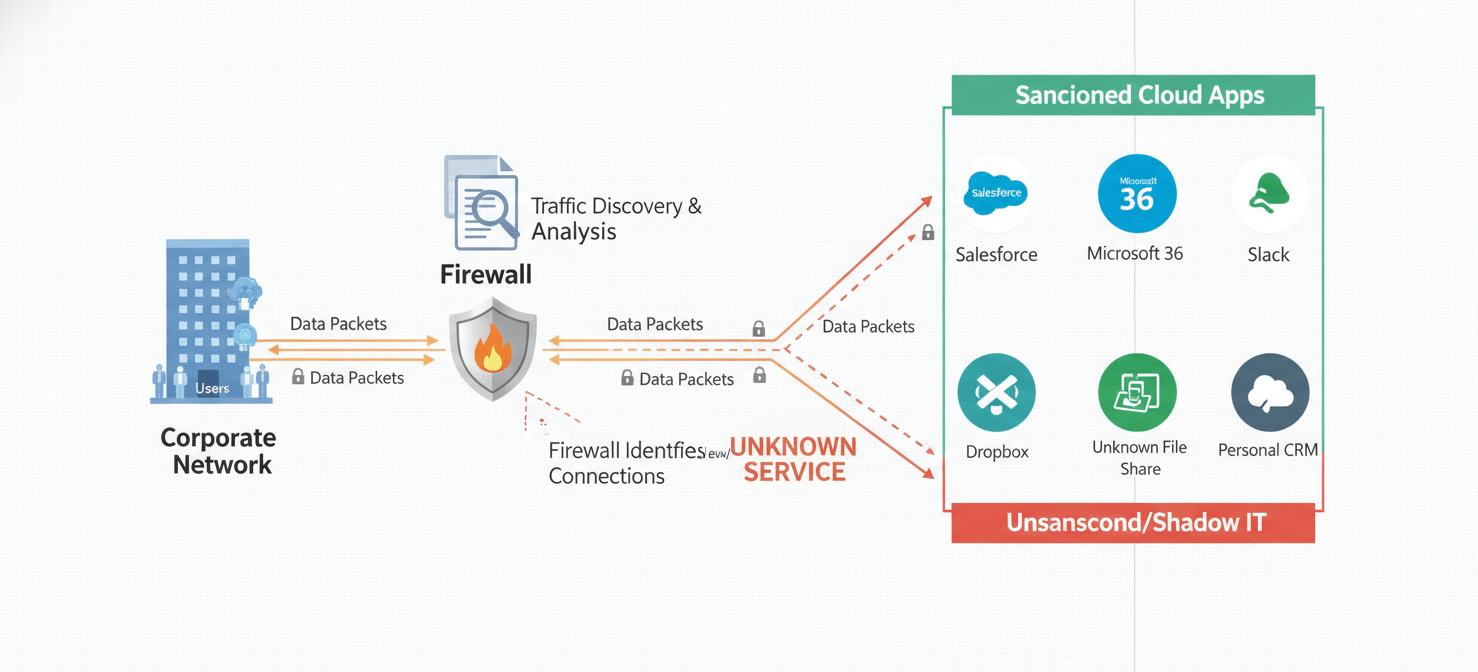
Your firewall is the gatekeeper for network traffic, inspecting data packets that enter and leave your corporate network. This central position makes it a valuable source of intelligence for identifying shadow IT. The process relies on analyzing the firewall’s logs, which record the source, destination, and volume of all network traffic.
The Role of Network Traffic Analysis for SaaS
By using network traffic analysis for SaaS discovery, your team can parse firewall logs to spot connections to cloud application domains and IP addresses. For example, a sudden spike in data moving to an unrecognized file-sharing service could indicate that a department has adopted a new tool without approval.
Modern Next-Generation Firewalls (NGFWs) enhance this capability. They can often identify specific applications, not just IP addresses, even within encrypted HTTPS traffic. This allows for more precise identification of services like Slack, Trello, or Dropbox. The firewall essentially creates an inventory of cloud services being accessed from within the network, which you can then compare against your list of sanctioned applications.
What Firewall Logs for Shadow IT Can (and Can’t) Tell You
Relying solely on firewall logs for shadow IT discovery provides a solid starting point, but it doesn’t offer a complete picture. Understanding these limitations is key to building a robust security strategy.
Strengths of Firewall Log Analysis
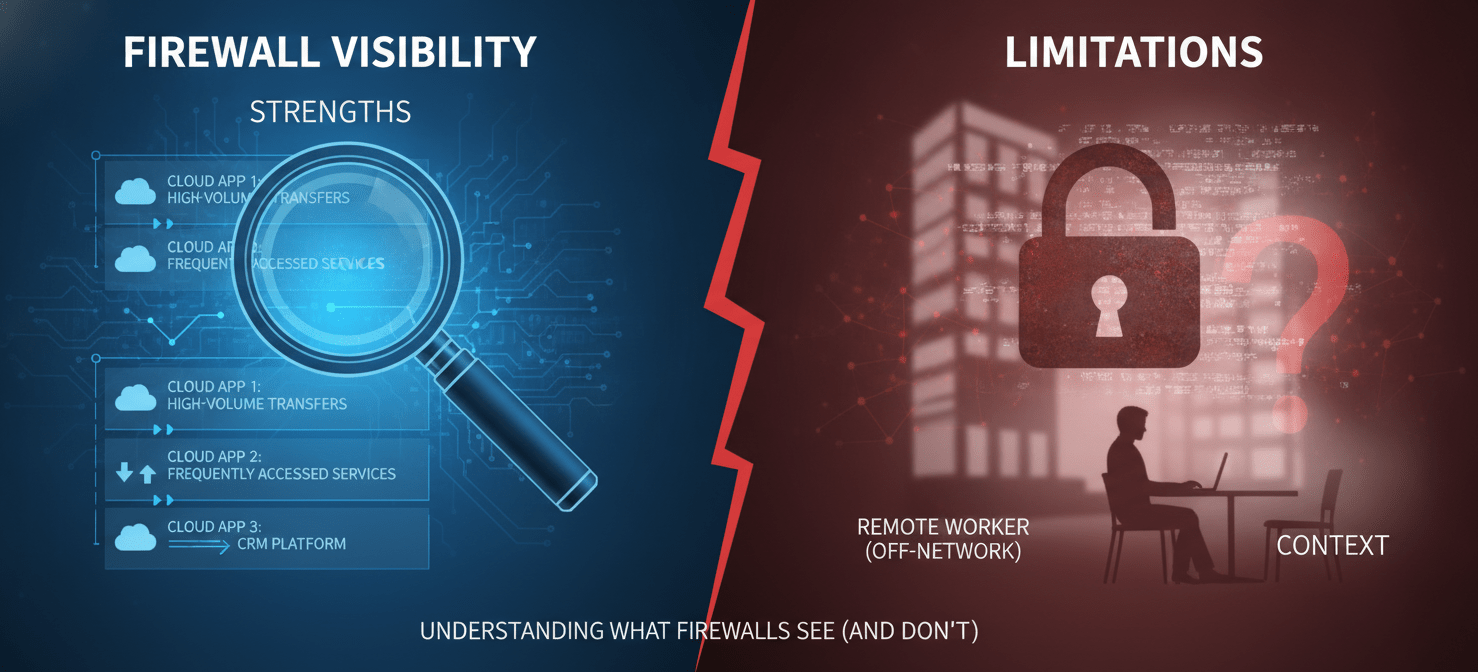
The primary strength of using a firewall for this purpose is that it leverages existing infrastructure. You don’t need to deploy new agents to every endpoint. It provides a broad overview of application usage across the entire on-premise network. This method is effective at identifying:
- High-volume data transfers: Large uploads or downloads to unsanctioned cloud storage.
- Frequently accessed services: Identifying which unapproved apps are most popular among employees.
- Basic usage patterns: Pinpointing which departments or user groups are the biggest adopters of shadow IT.
Critical Limitations and Blind Spots
However, the firewall’s view is limited, especially in the modern, hybrid work era. Key weaknesses include:
- Encrypted Traffic: While some firewalls have decryption capabilities, they are not always enabled due to performance overhead or privacy concerns. Without decryption, the firewall may only see that a user connected to a broad service like Amazon Web Services, not the specific application being used.
- Remote and Mobile Workers: If employees work from home or a coffee shop without connecting to the corporate VPN, their traffic never passes through the firewall. As a result, their use of unsanctioned cloud apps is completely invisible to this discovery method.
- Lack of Context: A firewall log can tell you that a user connected to an application, but it can’t tell you what they did. It doesn’t reveal if they uploaded sensitive customer data, shared confidential documents, or simply logged in to check messages. This lack of granular detail makes it difficult to assess the actual risk.
Beyond the Firewall: Integrating with a CASB
Because of these limitations, a firewall for cloud app discovery should be seen as one component of a broader strategy. To gain true visibility and control, you need to integrate its findings with a Cloud Access Security Broker (CASB).
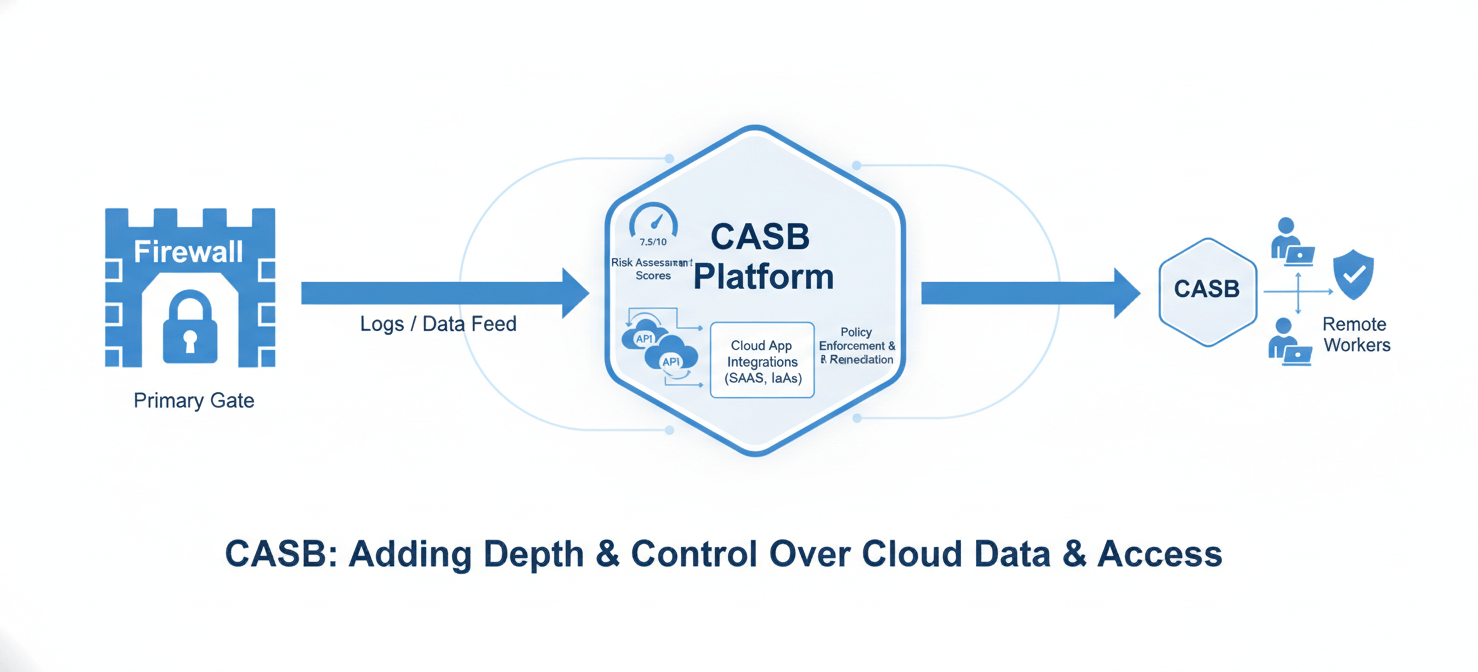
A CASB is a security policy enforcement point that sits between cloud service users and cloud applications. It can ingest firewall logs to get a baseline of app usage, but it adds several critical layers of functionality that firewalls lack.
For instance, a CASB can analyze firewall logs and automatically assess the risk of each discovered application based on over 90 factors, such as compliance certifications and security controls. Solutions like Microsoft Defender for Cloud Apps can analyze traffic logs from various firewalls to provide a detailed risk assessment. This helps you prioritize which shadow IT instances pose the greatest threat.
Furthermore, CASBs offer API-based integrations that monitor activity directly within sanctioned apps, providing the deep contextual visibility that firewalls cannot. They can also enforce granular policies, such as blocking the upload of sensitive data to any unsanctioned application, regardless of whether the user is on the corporate network.
Conclusion
So, can a firewall for cloud app discovery stop shadow IT? The answer is no—not on its own. While analyzing firewall logs is an essential first step for identifying unsanctioned applications used on your corporate network, it’s an incomplete solution. The rise of remote work and encrypted traffic creates significant blind spots that firewalls cannot address.
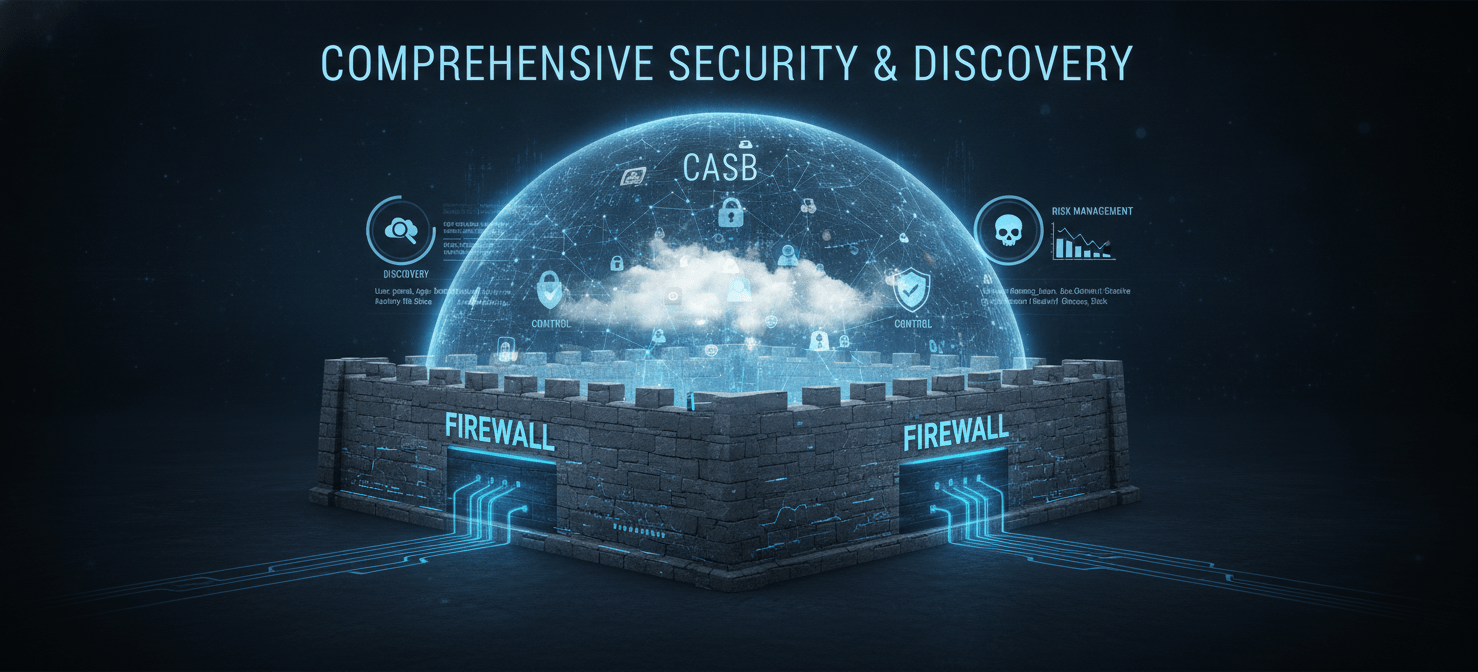
Think of your firewall as a perimeter guard that logs who enters and leaves the main gate. It provides valuable intelligence, but it can’t see what happens once someone is off the property. For a complete security picture, you must supplement the firewall’s broad view with the deep, contextual intelligence of a CASB. By combining these tools, your team can move from simply discovering shadow IT to actively managing its risks.
To move beyond basic firewall logs and truly manage shadow IT risks, discover how our platform provides comprehensive cloud app visibility; you can easily try the discovery free or book a 15-min demo to explore its full capabilities.
 7-day free trial