



Choosing the right Amazon S3 storage class is a critical decision that directly impacts your cloud spending and data accessibility. With multiple tiers available, each designed for specific access patterns, making an informed choice can feel complex. This S3 storage class cost comparison focuses on two of the most distinct options: S3 Standard, the default for general-purpose storage, and the S3 Glacier family, built for long-term data archiving. Understanding the fundamental differences in their pricing models and retrieval capabilities is the first step toward optimizing your storage costs without compromising on performance when you need it.
Key takeaways
- Vast Price Difference: S3 Standard storage costs around $0.023 per GB-month, while S3 Glacier Deep Archive can be as low as $0.00099 per GB-month—a potential cost reduction of over 95% for the right data.
- Retrieval Time is Key: S3 Standard offers millisecond access to your data. In contrast, retrieving data from S3 Glacier Flexible Retrieval can take minutes to hours, and S3 Glacier Deep Archive can take up to 48 hours.
- Retrieval Costs Matter: S3 Standard has no per-GB retrieval fees. However, all Glacier classes have retrieval fees that can be significant, making them unsuitable for frequently accessed data.
- Minimum Durations Apply: Glacier storage classes have minimum storage duration requirements (90 days for Flexible Retrieval, 180 for Deep Archive), and deleting data early still incurs charges for the full period.
What are S3 Storage Classes?
Amazon S3 offers a range of storage classes tailored to different data access, resiliency, and cost needs. Think of them as different tiers of service for your data. Each class is built for a specific purpose, from high-performance workloads to long-term digital preservation. The core idea is to allow you to pay a price that matches how you actually use your data.
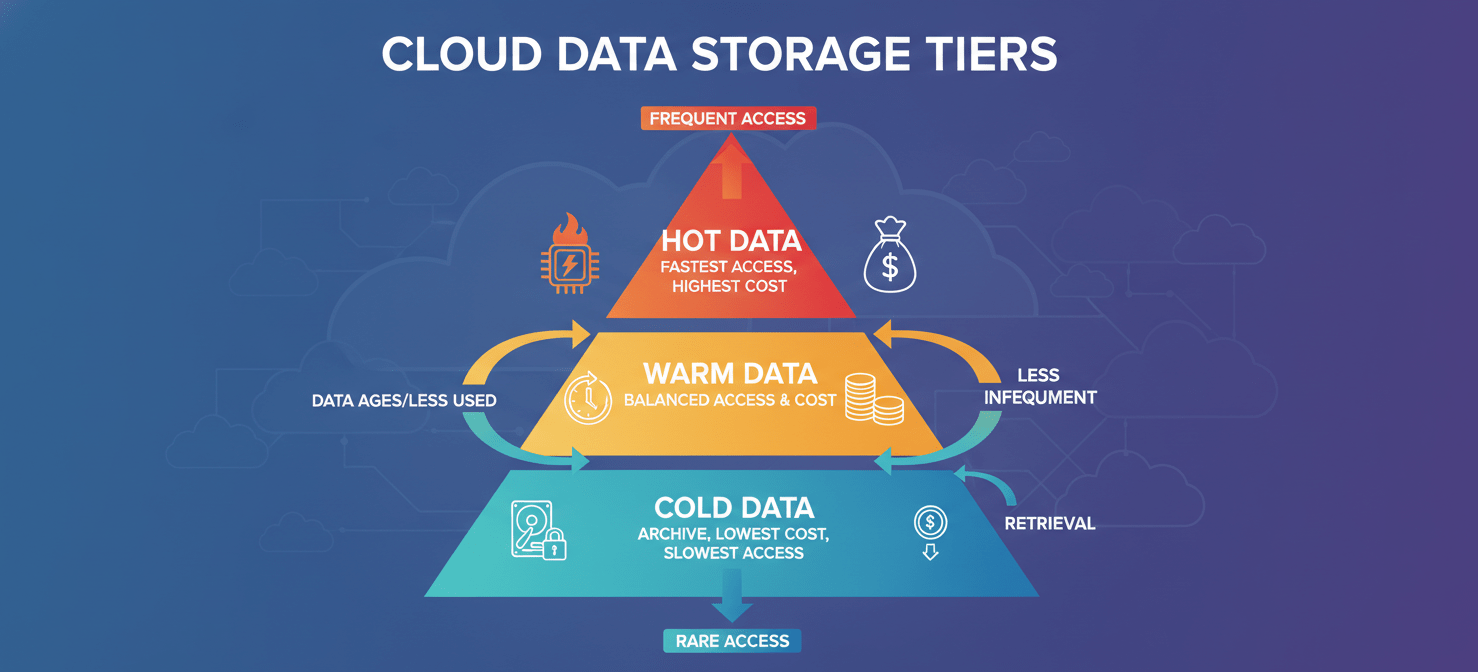
The main trade-off is between storage cost and access speed. Classes designed for frequently accessed data have higher storage costs but faster, cheaper retrieval. Conversely, classes designed for archiving have extremely low storage costs but slower and more expensive retrieval processes. AWS provides these options so your team can avoid paying premium prices for data that is rarely, if ever, touched.
These classes include options for general-purpose storage, data with unknown or changing access patterns, infrequent access, and deep archival. By selecting the right class—either when you upload an object or by using lifecycle policies to transition data automatically—you can significantly reduce your monthly AWS bill.
S3 Standard: The Default for Frequently Accessed Data
S3 Standard is the default storage class and is designed for “hot” data that requires frequent access with low latency. If an application needs to read or write data regularly, such as for dynamic websites, content distribution, or big data analytics, S3 Standard is the intended choice.

Performance and Pricing Model
This storage class delivers high throughput and millisecond access, ensuring that your applications remain responsive. It stores data redundantly across a minimum of three Availability Zones, providing high durability and availability.
The pricing for S3 Standard is straightforward for access but the most expensive for pure storage.
- Storage Cost: You pay a per-gigabyte monthly fee. For the first 50 TB, this is typically around $0.023 per GB.
- Request Costs: There are small charges for API requests like PUT, COPY, POST, and GET.
- Retrieval Fees: Crucially, there are no additional fees for retrieving your data, which makes it cost-effective for workloads with high access rates.
This model makes costs predictable for active data. You pay more to store it, but you can access it as much as you need without incurring extra per-gigabyte retrieval charges.
S3 Glacier: The Archival Solution
The S3 Glacier family consists of storage classes purpose-built for data archiving and long-term retention at a very low cost. These are ideal for data that is rarely accessed but must be kept for compliance, regulatory reasons, or as a final backup. There are three primary Glacier tiers:

- S3 Glacier Instant Retrieval: For archive data that is accessed infrequently but requires millisecond retrieval when needed.
- S3 Glacier Flexible Retrieval: A flexible option with retrieval times ranging from minutes to hours.
- S3 Glacier Deep Archive: The lowest-cost storage in the cloud, designed for data accessed once or twice a year, with retrieval times of 12 hours or more.
The Trade-off: Cost vs. Retrieval Time
The primary benefit of the Glacier classes is their extremely low storage cost. S3 Glacier Deep Archive, for example, can cost as little as $0.00099 per GB-month, which is more than 95% cheaper than S3 Standard.
However, this saving comes with significant trade-offs:
- Retrieval Process: Unlike S3 Standard where you can directly access data, objects in Glacier Flexible Retrieval and Deep Archive must first be “restored.” This is an asynchronous process where you initiate a request and wait for a temporary copy of the data to become available.
- Retrieval Time: The waiting period varies by class and the retrieval tier you select. S3 Glacier Flexible Retrieval offers Expedited (1-5 minutes), Standard (3-5 hours), and Bulk (5-12 hours) options. S3 Glacier Deep Archive takes 12-48 hours.
- Retrieval Cost: In addition to request fees, there is a per-gigabyte fee to retrieve data from any Glacier class. These fees can make it expensive to restore large volumes of data, potentially negating the storage cost savings if access is more frequent than anticipated.
Furthermore, Glacier classes have minimum storage durations (e.g., 90 days for Flexible Retrieval), and deleting objects before this period incurs a pro-rated charge for the remaining time.
S3 Storage Class Cost Comparison: A Head-to-Head Analysis
The decision between S3 Standard and S3 Glacier hinges almost entirely on your data access patterns. Storing data that you expect to access less than once a year in S3 Standard results in overpaying for storage. Conversely, storing frequently accessed data in S3 Glacier will lead to frustrating delays and surprisingly high retrieval bills.
Scenario 1: Active Website Assets
Imagine you are storing 1 TB of image and video assets for a dynamic website. This data is accessed constantly throughout the day.
- S3 Standard: Storage would cost approximately $23 per month (1,000 GB * $0.023/GB). All data retrieval is included, so access by thousands of users incurs no extra per-GB fees. This is the correct and cost-effective choice.
- S3 Glacier: While storage might only cost $3.60 per month (1,000 GB * $0.0036/GB) with Flexible Retrieval, this choice is operationally unviable. Every time a user needs an image, the application would have to wait minutes or hours for it to be restored, and you would pay a per-GB retrieval fee for each access. The costs would quickly spiral, and the user experience would be terrible.
Scenario 2: Long-Term Compliance Archive
Now, consider a 10 TB archive of financial records that must be retained for seven years for regulatory compliance. You expect to access this data less than once a year, if ever.
- S3 Standard: Storing this data would cost around $2,830 per year. This is expensive for data that is almost never touched.
- S3 Glacier Deep Archive: The storage cost would be approximately $120 per year. This represents a massive saving of over 95%. If you do need to retrieve a small portion of the data once, the retrieval fee and the 12-hour wait are acceptable trade-offs for the enormous storage savings.
Which S3 Storage Class Should You Use?
Choosing which S3 storage class to use requires an honest assessment of your data’s lifecycle.
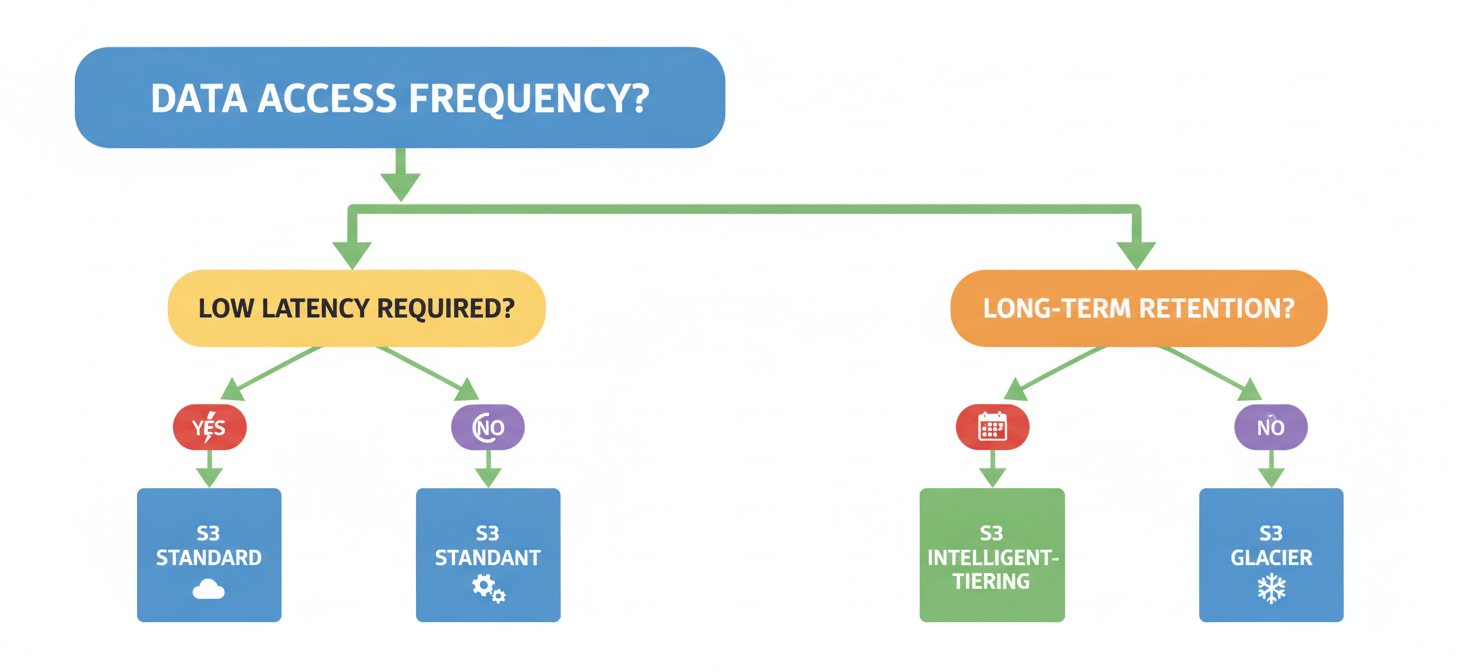
Use S3 Standard when:
- Data is accessed frequently (more than once a month).
- Your application requires low latency and high throughput performance.
- Access patterns are unpredictable, and you cannot risk retrieval delays.
- There are no retrieval fees, making it suitable for active workloads.
Use S3 Glacier (Flexible or Deep Archive) when:
- You are archiving data for long-term retention (months or years).
- Data is accessed very rarely, such as for compliance, legal records, or disaster recovery.
- You can tolerate retrieval times ranging from minutes to many hours.
- Minimizing storage cost is the absolute top priority, and retrieval costs are an acceptable trade-off for infrequent access.
Beyond Standard and Glacier: What About Intelligent-Tiering?
For data with unknown or changing access patterns, a direct S3 intelligent tiering vs standard comparison is worthwhile. The S3 Intelligent-Tiering storage class offers a hybrid approach. It automatically moves your data between different access tiers based on your usage patterns, aiming to provide the lowest cost without performance impact or operational overhead.
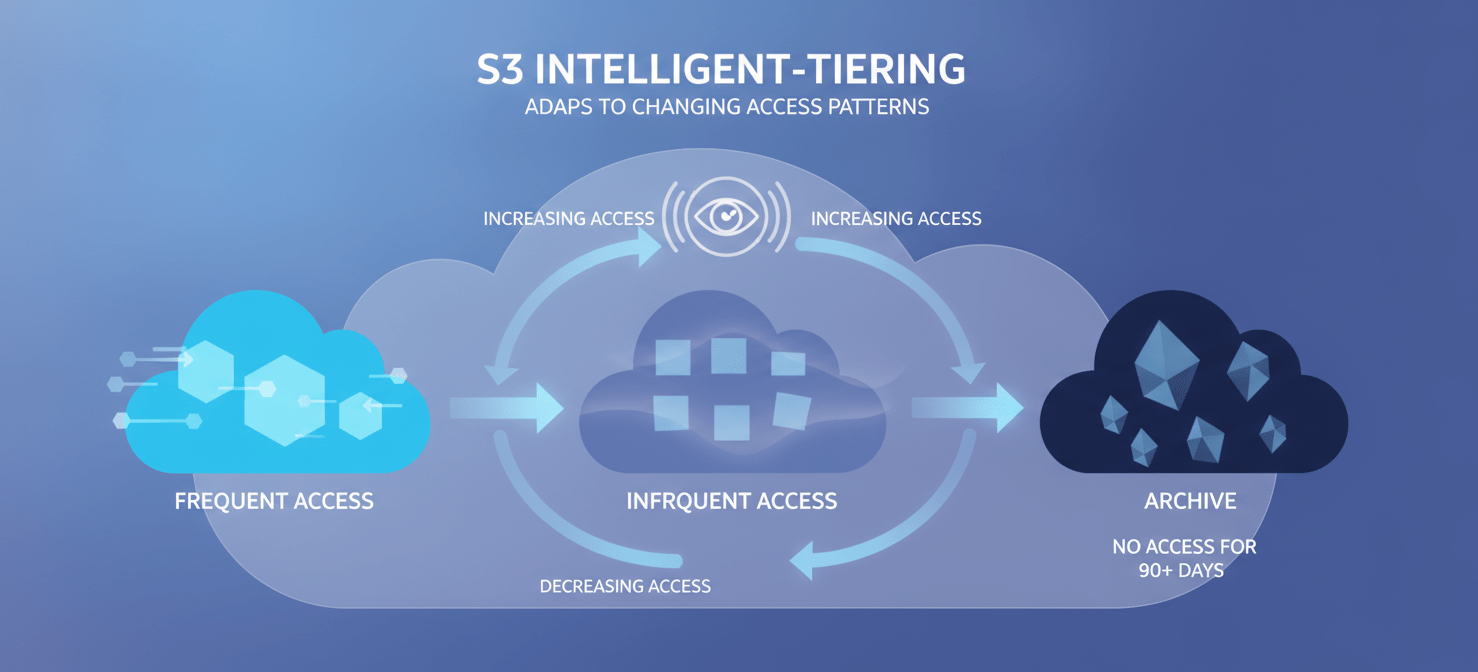
Here’s how it works:
- Objects are initially placed in a Frequent Access tier, priced the same as S3 Standard.
- If an object isn’t accessed for 30 consecutive days, S3 automatically moves it to an Infrequent Access tier, saving you money.
- If the object is accessed again, it’s automatically moved back to the Frequent Access tier.
For a small monthly monitoring fee per object, Intelligent-Tiering automates cost optimization. It eliminates the guesswork, making it an excellent default choice for many workloads where access patterns are not clearly defined. There are no retrieval fees for accessing data within its automatic tiers, combining the benefits of Standard’s easy access with the cost savings of lower-tier storage.
Conclusion
Ultimately, the S3 storage class cost comparison between Standard and Glacier is a lesson in matching the tool to the task. S3 Standard is the high-performance, readily available default for active data, and you pay a premium for that convenience. S3 Glacier is the polar opposite: a remarkably cheap, deep-freeze archive where data is stored away for the long haul, with the expectation that you can wait—and pay—to thaw it out on the rare occasion it’s needed. Forcing one to do the job of the other is a recipe for either a bloated bill or a crippled application. Therefore, analyzing your access patterns isn’t just a suggestion; it’s the central mechanism for making a financially sound decision in your S3 storage class cost comparison.
To ensure your S3 strategy is truly optimized, understanding your data patterns is key; discover how Binadox can streamline this process by requesting a personalized demonstration, or see the platform in action with a complimentary Binadox trial.
 7-day free trial