



In any large enterprise, uncontrolled technology spending quietly undermines cloud budgets and introduces risk. This “shadow IT”—resources and software procured outside of official IT channels—is a significant driver of cost overruns and a major blind spot for financial governance. For FinOps leads and cost analysts, identifying this hidden spend is not just about cleanup; it’s about reclaiming control over the cloud cost narrative. The right finops tools are essential for this task, transforming opaque billing data into a clear map of ownership and accountability. Without them, your team is essentially trying to balance a budget with incomplete ledgers.
This article explores the tools and strategies that bring shadow IT out of the darkness and into your cost allocation dashboards. We will examine how these platforms work, what features matter most for attribution, and which solutions lead the market in providing the visibility necessary for effective cloud financial management.
Key takeaways
- Shadow IT frequently accounts for 30% to 40% of total IT spending in large enterprises, creating significant budget variances.
- Effective FinOps tools discover hidden spend by integrating with multiple data sources, including expense reports, SSO logs, and network traffic analysis, not just cloud provider billing files.
- Automated tagging and resource grouping are critical features that can increase cost allocation coverage from a baseline of 60-70% to over 95% within the first three months of implementation.
- Leading platforms can identify three times more unauthorized applications than manual methods, often reducing overall SaaS spending by up to 25% through the consolidation of duplicative tools.
The High Cost of Hidden Cloud Spend
Shadow IT is any technology, from a SaaS subscription to a cloud server, used without explicit approval from the IT department. It often starts with good intentions—an engineer spinning up a new database for a pilot project or a marketing team signing up for a new analytics tool to meet a deadline. However, this decentralized purchasing creates significant financial and operational challenges.
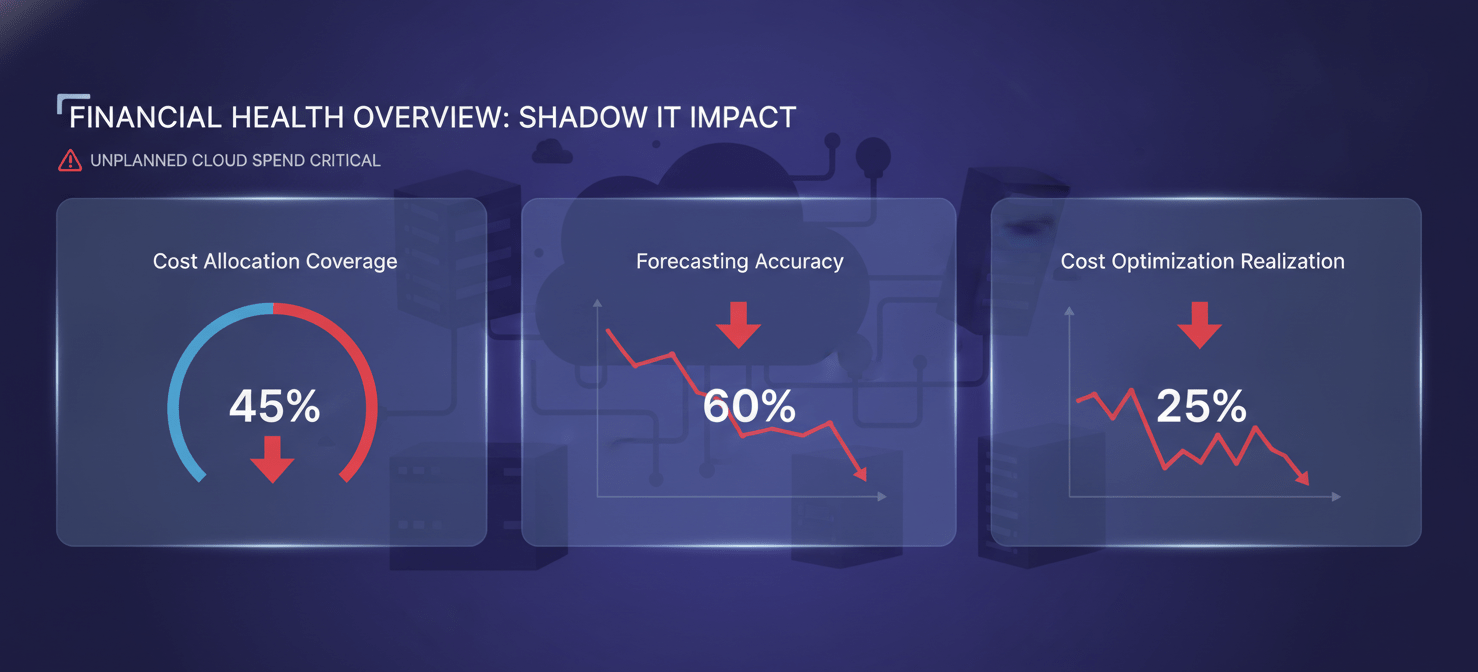
For FinOps teams, the primary impact is on the accuracy of budgets and forecasts. When a substantial portion of technology spend happens outside of established procurement channels, financial models become unreliable. In large organizations, this hidden spend can represent 30-40% of the entire IT budget. This isn’t a minor variance; it’s a systemic flaw in financial oversight that makes accurate chargeback and showback impossible.
The Impact on Your KPIs
The consequences of unmanaged shadow IT ripple through every core FinOps KPI:
- Cost Allocation Coverage: Untagged or unowned resources cannot be allocated. They end up in a generic “unallocated” bucket, which obscures the true cost of projects and business units. While achieving 100% allocation is difficult, a high percentage of unallocated costs signals a lack of visibility and control.
- Forecasting Accuracy: Hidden SaaS subscriptions and unmanaged cloud resources introduce volatility. A forecast based only on known workloads and official procurement will consistently miss the mark, eroding trust between finance, IT, and engineering. This problem is getting worse as dynamic AI workloads make forecasting even harder.
- Cost Optimization Realization: You cannot optimize what you cannot see. Opportunities for rightsizing, purchasing reserved instances, or consolidating duplicative software licenses are missed when resources are not centrally tracked. One of the most direct costs is paying for the same functionality multiple times across different teams.
Furthermore, shadow IT introduces significant security and compliance risks. Unmanaged applications may not meet corporate security standards, and data stored in these systems can be exposed, leading to costly breaches. An incident involving shadow data can increase the average cost of a data breach by over 16%.
How FinOps Tools Expose Shadow IT
Modern FinOps platforms move beyond simply analyzing billing data from AWS, Azure, or GCP. They integrate a wide range of data sources to build a comprehensive inventory of all technology in use, whether it was officially procured or not. This multi-source approach is the key to systematically uncovering hidden spend.
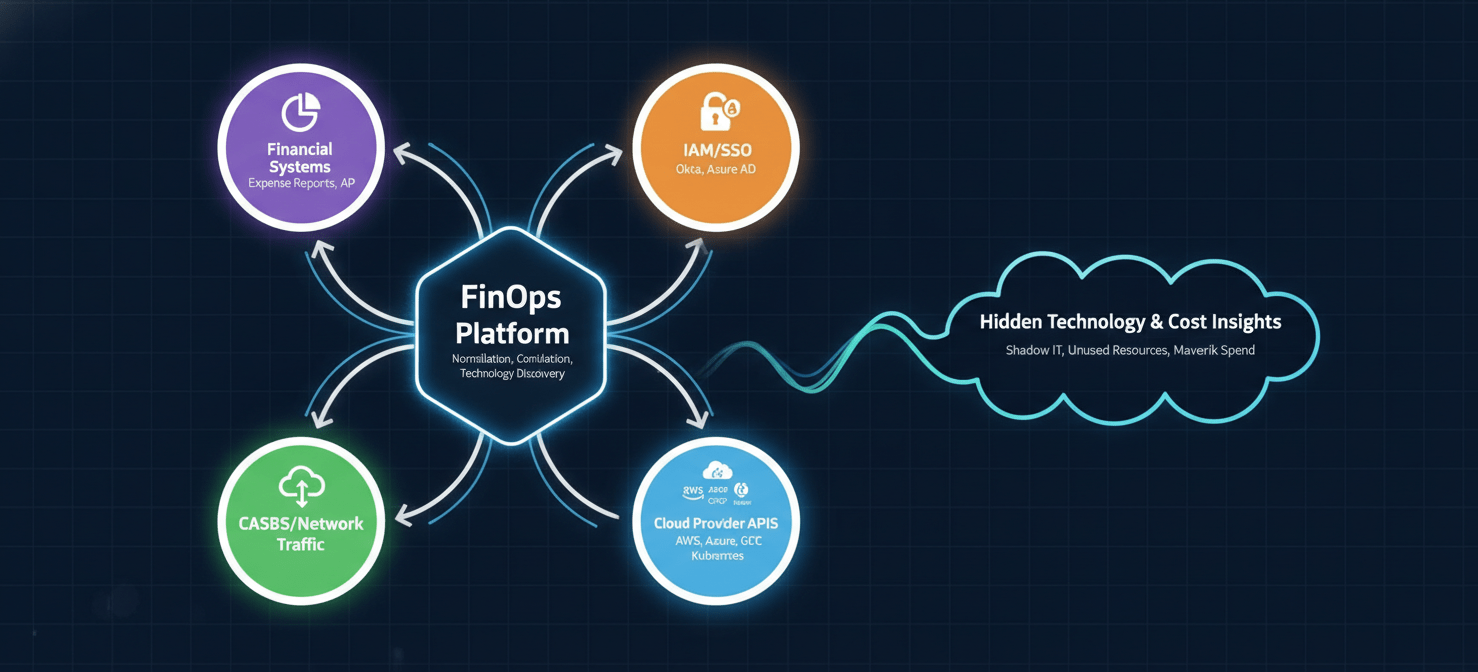
The discovery process typically involves several layers of data ingestion and analysis:
- Financial Data Integration: The most direct method involves integrating with financial systems. By analyzing expense reports, accounts payable records, and corporate credit card statements, these tools can flag recurring payments to technology vendors that don’t correspond to any approved purchase orders.
- Identity and Access Management (IAM) Integration: Connecting to Single Sign-On (SSO) platforms like Okta or Azure AD provides a clear view of which users are accessing which applications. If employees are logging into a SaaS tool that isn’t on the approved vendor list, it’s a clear indicator of shadow IT.
- Cloud Access Security Brokers (CASBs) and Network Analysis: CASBs monitor network traffic between users and cloud services, identifying which applications are being accessed regardless of how they were purchased. This method is highly effective at discovering browser-based SaaS applications that might not leave a clear financial trail.
- Cloud Provider and Kubernetes Integration: Beyond basic billing files, advanced tools pull data directly from cloud provider APIs and Kubernetes clusters. This allows them to identify resources that lack proper ownership tags or are part of projects that don’t map to a known cost center.
Once this data is collected, the platform normalizes and correlates it. For example, it can match a recurring charge on a credit card statement to user login data from an SSO provider and network traffic logs. This creates a clear, evidence-based picture of unmanaged technology, complete with usage data and associated costs.
Key Features to Look for in FinOps Tools for Shadow IT
When evaluating cloud FinOps tools to tackle shadow IT, focus on capabilities that directly address the challenges of discovery, attribution, and governance. Not all cost management platforms are created equal in this regard. Many are excellent at optimizing known resources but lack the deep discovery features needed to find the unknown.
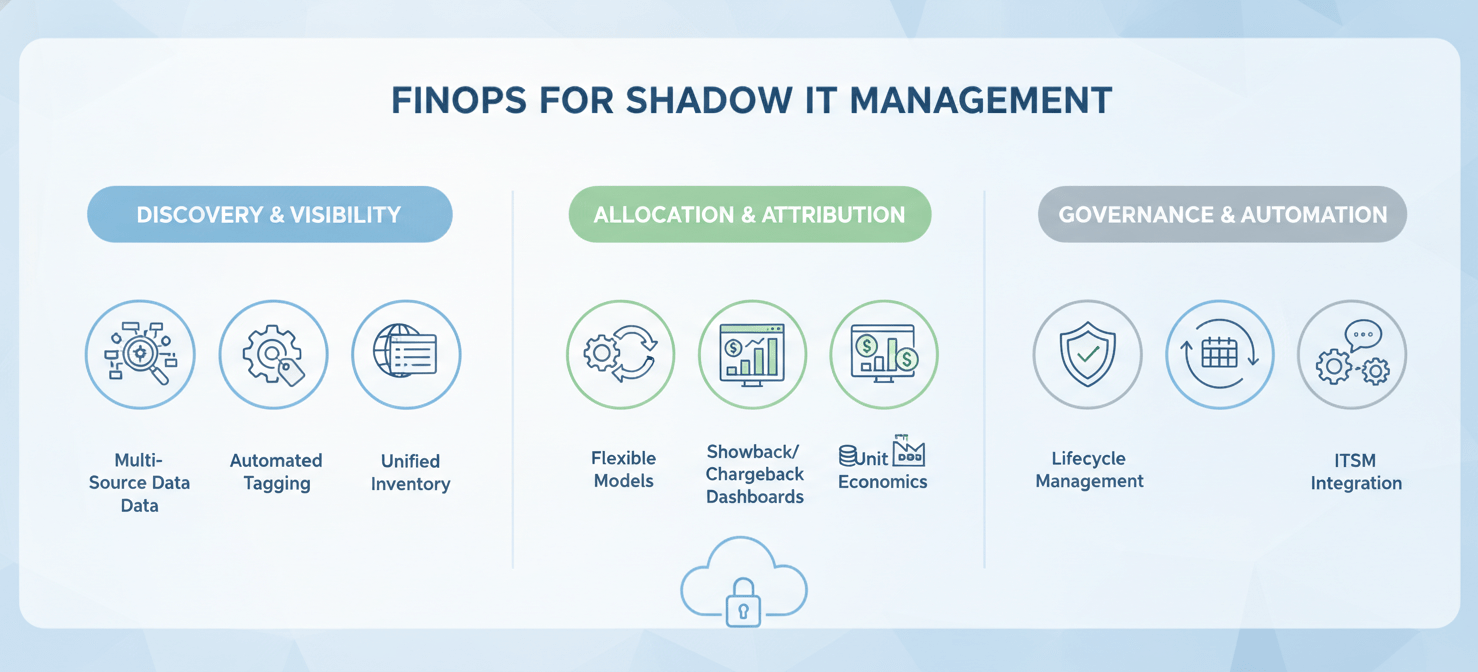
Foundational Discovery and Visibility Capabilities
Your primary goal is to create a complete and accurate inventory. Look for platforms that offer:
- Multi-Source Data Ingestion: The tool must connect to more than just your cloud provider billing streams. Essential integrations include expense management systems (e.g., Expensify, SAP Concur), SSO/IAM platforms, and CASBs. This is non-negotiable for comprehensive SaaS discovery.
- Automated Resource Tagging and Grouping: Manual tagging is unreliable and doesn’t scale. Leading tools use automation and business rules to apply metadata to resources based on their context, such as the account they were created in or the user who provisioned them. This helps you retroactively apply ownership to untagged legacy resources.
- A Unified Asset Inventory: The platform should present all discovered resources—from EC2 instances to SaaS licenses—in a single, searchable inventory. This allows your team to see the complete picture of technology assets, regardless of their source or type.
Advanced Allocation and Attribution Features
Once resources are discovered, you need to assign ownership and allocate costs. Key features include:
- Flexible Cost Allocation Models: The tool should support various allocation methods, including proportional allocation of shared costs and rule-based attribution. For example, you should be able to distribute the cost of a shared database based on the usage metrics of the applications that connect to it.
- Showback and Chargeback Dashboards: The platform must provide clear, customizable dashboards that allow you to show business units their total technology spend, including both official and previously hidden costs. This transparency is the first step toward building accountability.
- Unit Economics and Business Context Mapping: Top-tier tools allow you to map costs to business-relevant metrics, such as cost per customer or cost per feature. This reframes the conversation from “How much are we spending on AWS?” to “How much does it cost to run Product X?”
Governance and Automation Workflows
Discovery is only half the battle. The tool must also help you manage what you find. Look for:
- Policy Enforcement and Guardrails: The ability to set and enforce tagging policies is crucial. The tool should be able to automatically identify non-compliant resources and trigger alerts or remediation workflows.
- Lifecycle Management: For discovered SaaS applications, the platform should help you manage the entire lifecycle, from initial discovery to approval, renewal, or decommissioning.
- Integration with IT Service Management (ITSM): Connecting the FinOps tool to platforms like ServiceNow or Jira allows you to automate the process of creating tickets for unapproved software or untagged resources, streamlining the remediation process.
Top FinOps Tools for Taming the Shadows
The market for FinOps companies has matured, with several platforms offering strong capabilities for shadow IT discovery and management. While native cloud provider tools like AWS Cost Explorer and Azure Cost Management are useful for basic visibility, they are generally insufficient for uncovering spend that occurs outside their own ecosystems. For comprehensive discovery, a third-party platform is almost always necessary.
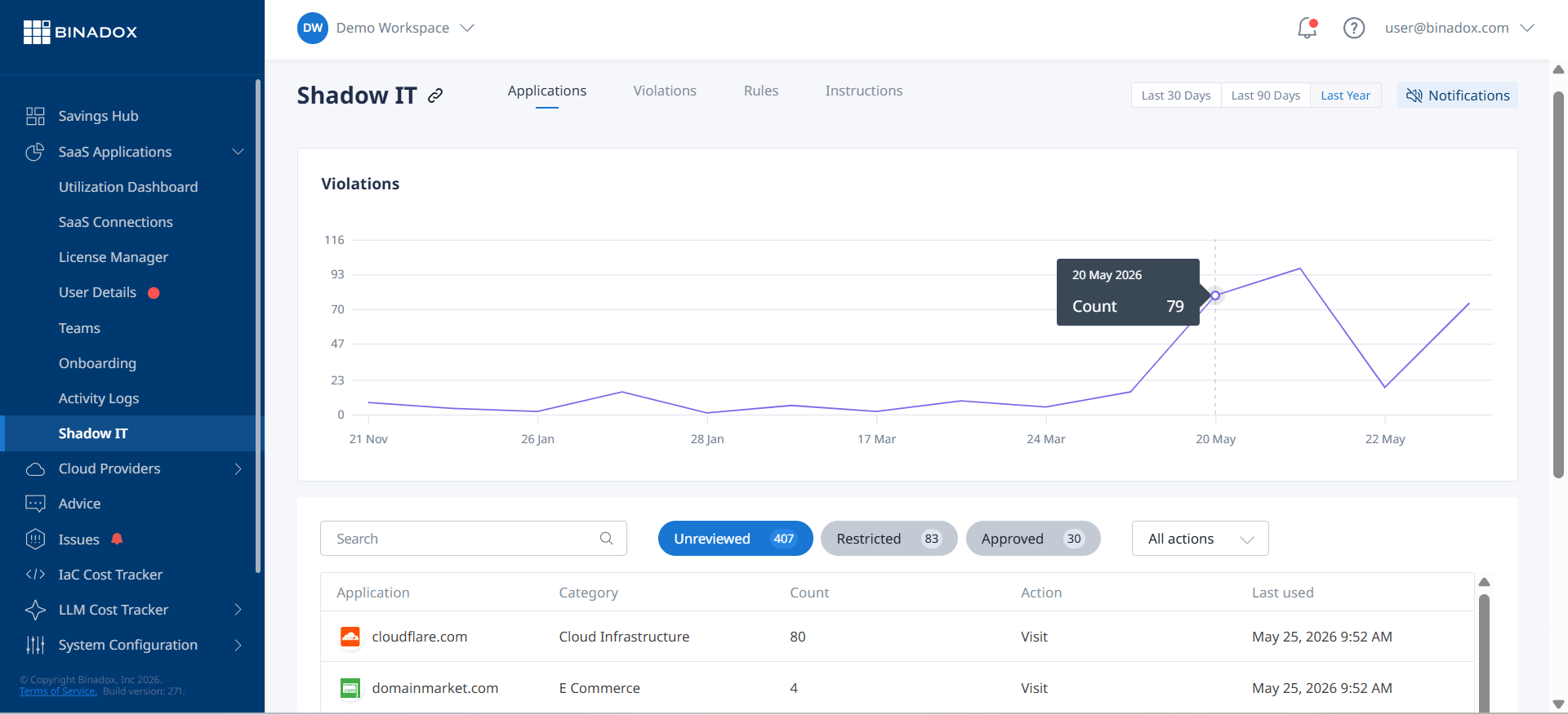
Finout: This platform is designed for enterprise-scale FinOps and excels at unifying billing data from multiple clouds and SaaS tools into a single, holistic view called a “MegaBill.” It uses a business mapping engine to attribute costs without relying solely on tags, which is particularly effective for allocating costs from complex, shared infrastructure.
CloudZero: Known for its focus on providing granular, hourly cost intelligence to engineering teams. CloudZero organizes cloud spend into business-centric dimensions, such as cost per feature or cost per customer, making it easier to have value-based conversations with product and engineering leaders.
Flexera One: Offers a comprehensive IT visibility solution that covers both on-premises and multi-cloud environments. Its strength lies in its ability to manage software licensing costs alongside cloud infrastructure spend, providing a true total cost of ownership view that is critical for large enterprises with complex hybrid estates.
ServiceNow Cloud Cost Management: As part of a broader ITSM platform, ServiceNow provides strong workflow and governance capabilities. It excels at integrating cost data into automated governance processes, helping organizations not only discover shadow IT but also enforce policies and manage the approval and remediation lifecycle.
Zylo: While focused specifically on SaaS management rather than IaaS, Zylo is a leader in discovering shadow SaaS spend. It uses an AI-powered discovery engine that integrates with financial systems and other data sources to identify all software subscriptions, making it an excellent complementary tool for a FinOps practice focused on controlling SaaS sprawl.
Other notable platforms include IBM Cloudability, Harness Cloud Cost Management, and Vantage, each offering a unique set of features for cost visibility, allocation, and optimization. The right choice depends on your organization’s specific needs, existing toolchain, and the maturity of your FinOps practice.
Implementing a Shadow IT Discovery Process
Deploying a tool is only the first step. To effectively and continuously manage shadow IT, you need a structured process that integrates the tool’s capabilities into your team’s regular operating rhythm. This process should be collaborative, involving stakeholders from finance, IT, and engineering.
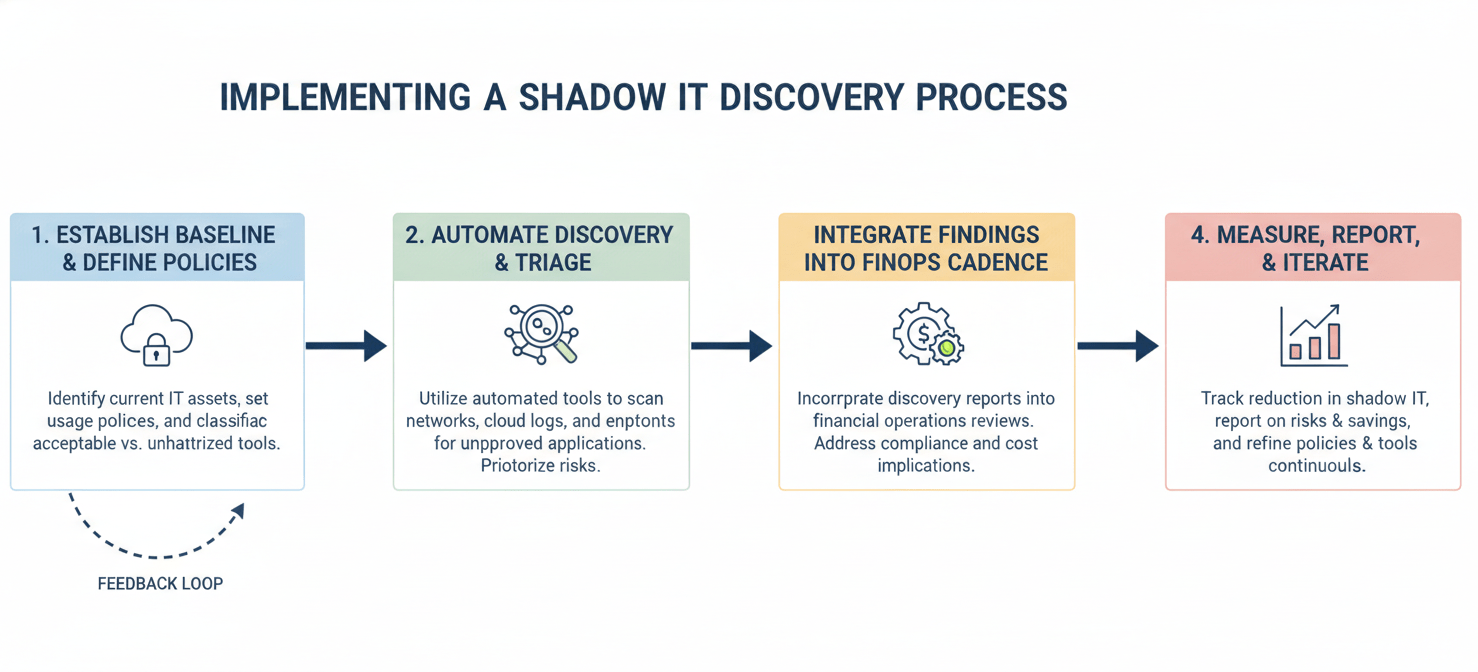
Step 1: Establish a Baseline and Define Policies
Before you can measure improvement, you need to understand your starting point. Use your chosen FinOps tool to conduct an initial discovery sweep across all data sources. This will give you a baseline measurement for key metrics like the percentage of untagged resources and the total cost of unmanaged SaaS applications.
Simultaneously, work with IT security and procurement to define clear policies for technology acquisition and resource tagging. Your tagging policy should specify mandatory tags for all cloud resources, such as cost-center, owner, and environment. These policies provide the foundation for automated governance.
Step 2: Automate Discovery and Triage
Configure your FinOps platform for continuous, automated discovery. Set up alerts to notify your team whenever a new, unapproved application or a non-compliant resource is detected.
Establish a triage process for these alerts. Not all shadow IT is problematic; some of it represents legitimate business needs that aren’t being met by existing tools. Your triage process should aim to:
- Identify the owner and business purpose.
- Assess the tool for security and compliance risks.
- Check for redundant functionality with existing, approved tools.
This process should be designed to make a quick decision: approve and onboard the tool, migrate the users to an existing solution, or decommission it.
Step 3: Integrate Findings into Your FinOps Cadence
Incorporate a review of newly discovered shadow IT into your regular FinOps meetings. Use the dashboards in your tool to show each business unit a complete view of their technology spend, including both sanctioned and unsanctioned items.
This creates a powerful feedback loop. When engineering leaders see the full cost of unmanaged resources attributed to their teams, they become active partners in improving tagging compliance and controlling costs. This transforms the conversation from a confrontational “You are spending too much” to a collaborative “How can we get this spend under control together?”
Step 4: Measure, Report, and Iterate
Continuously track your progress against the baseline you established in the first step. Your key performance indicators should include:
- Percentage of cloud spend that is fully allocated.
- Percentage of resources that are compliant with your tagging policy.
- Reduction in spend on duplicative SaaS applications.
- Time to detect and resolve new instances of shadow IT.
Report on these metrics to leadership to demonstrate the value of your FinOps practice and the ROI of your investment in a dedicated discovery tool. Use the insights you gain to refine your policies and processes over time.
Conclusion
Ignoring shadow IT is no longer a viable option. It represents a material risk to financial forecasts, a barrier to effective cost optimization, and a significant security vulnerability. For FinOps leads and cost analysts, bringing this hidden spend into the light is a core responsibility. The challenge is that you cannot solve this problem with spreadsheets and manual analysis; the scale and complexity of modern cloud and SaaS environments are simply too great.
Success requires a combination of the right technology and a disciplined, collaborative process. By leveraging modern finops tools that integrate financial, identity, and network data, you can create a truly comprehensive view of your organization’s technology footprint. This visibility, in turn, enables accurate cost allocation, meaningful showback, and intelligent optimization. Ultimately, taming shadow IT is not just about cutting costs—it’s about restoring financial control and ensuring that every dollar spent on technology is a deliberate and value-driven investment. The alternative is to continue managing a budget with a 30% blind spot, which is a gamble no finance professional should be willing to take.
To start gaining this crucial visibility and control over your cloud landscape, you can explore the Binadox platform with a free trial or arrange a personalized demonstration to see its capabilities firsthand.
 7-day free trial