



For finance and procurement teams, cloud infrastructure is no longer a niche IT expense; it is a significant, recurring line item demanding rigorous financial oversight. As your organization leverages Amazon Web Services (AWS), the on-demand, pay-as-you-go model offers flexibility but often at a premium. This is where AWS Reserved Instances (RIs) enter the conversation, not as a simple discount mechanism, but as a strategic financial instrument. Understanding and accurately calculating AWS Reserved Instance ROI is crucial for transforming cloud spend from a reactive operational expense into a predictable, optimized component of your budget. This analysis requires a shift in perspective—viewing RIs through the lens of capital allocation, risk management, and long-term financial planning.
Key takeaways
- Strategic Forecasting: RIs provide budget predictability by locking in costs for one or three years, turning volatile cloud spend into a fixed, forecastable expense.
- Significant Savings: In exchange for a term commitment, RIs offer substantial discounts of up to 75% compared to on-demand pricing, directly improving your cloud ROI.
- Payment Flexibility: AWS offers three payment options—All Upfront, Partial Upfront, and No Upfront—allowing you to align RI procurement with your organization’s capital expenditure strategy and cash flow preferences.
- Breakeven Analysis is Key: A crucial step in RI financial analysis is calculating the breakeven point, typically around 7-9 months, where the savings from the RI surpass the equivalent on-demand cost.
The Strategic Value of RIs Beyond Simple Discounts
While the headline benefit of Reserved Instances is the significant discount over on-demand rates, their strategic value for a finance team extends far deeper. RIs are fundamentally a forecasting and budget control tool. By committing to a one- or three-year term for specific instance capacity, you convert a variable, hard-to-predict operational expense into a stable, forecastable cost. This predictability is invaluable for accurate financial planning, quarterly forecasting, and annual budget allocation.
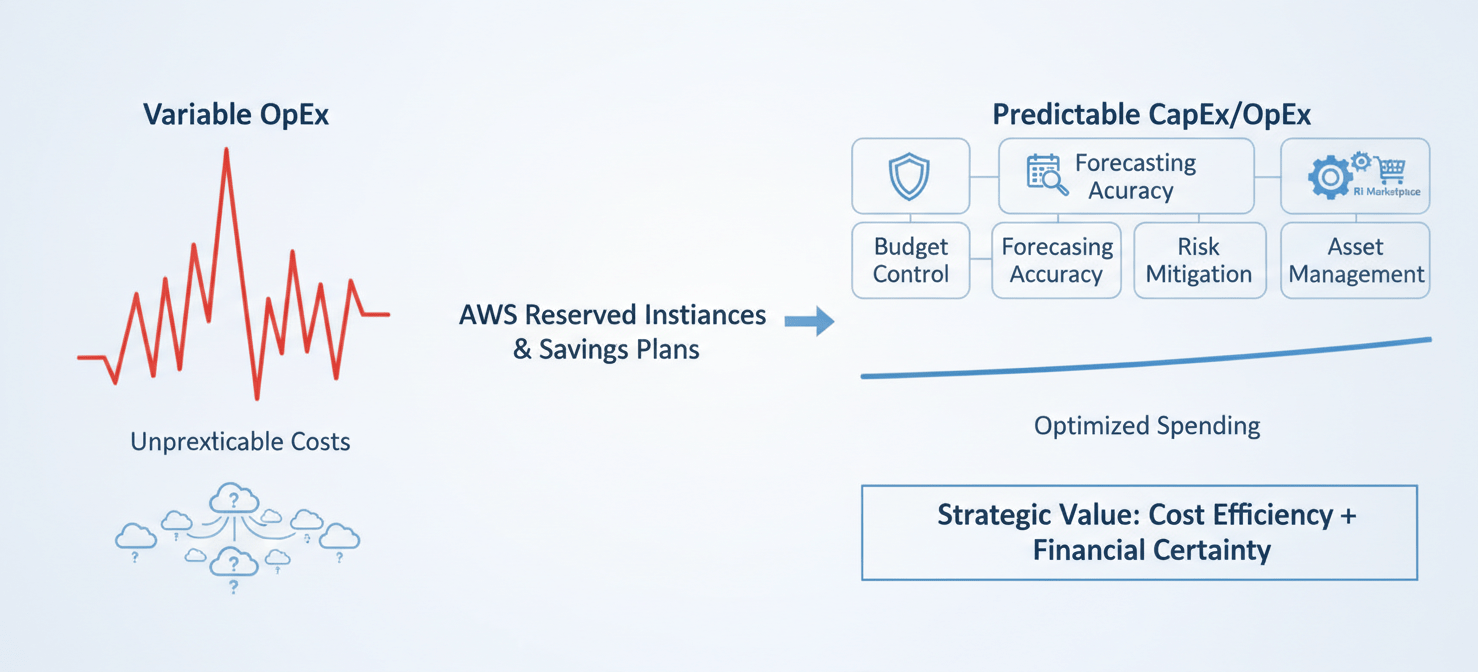
Furthermore, the capacity reservation aspect of some RIs provides an operational assurance that is critical for mission-critical applications. For applications with steady-state demand, guaranteeing that capacity is available, especially in high-demand zones, mitigates operational risk and prevents potential revenue loss from downtime. This transforms the RI from a simple cost-saving measure into a tool for ensuring business continuity.
Finally, viewing RIs as a portfolio of assets allows for more sophisticated financial management. Through mechanisms like the RI Marketplace, your team can potentially sell unused RIs, adding a layer of liquidity to what might otherwise be a fixed commitment. This requires active management and governance but introduces a level of financial flexibility not typically associated with long-term contracts.
Core Concepts: How AWS Reserved Instances (RIs) Work
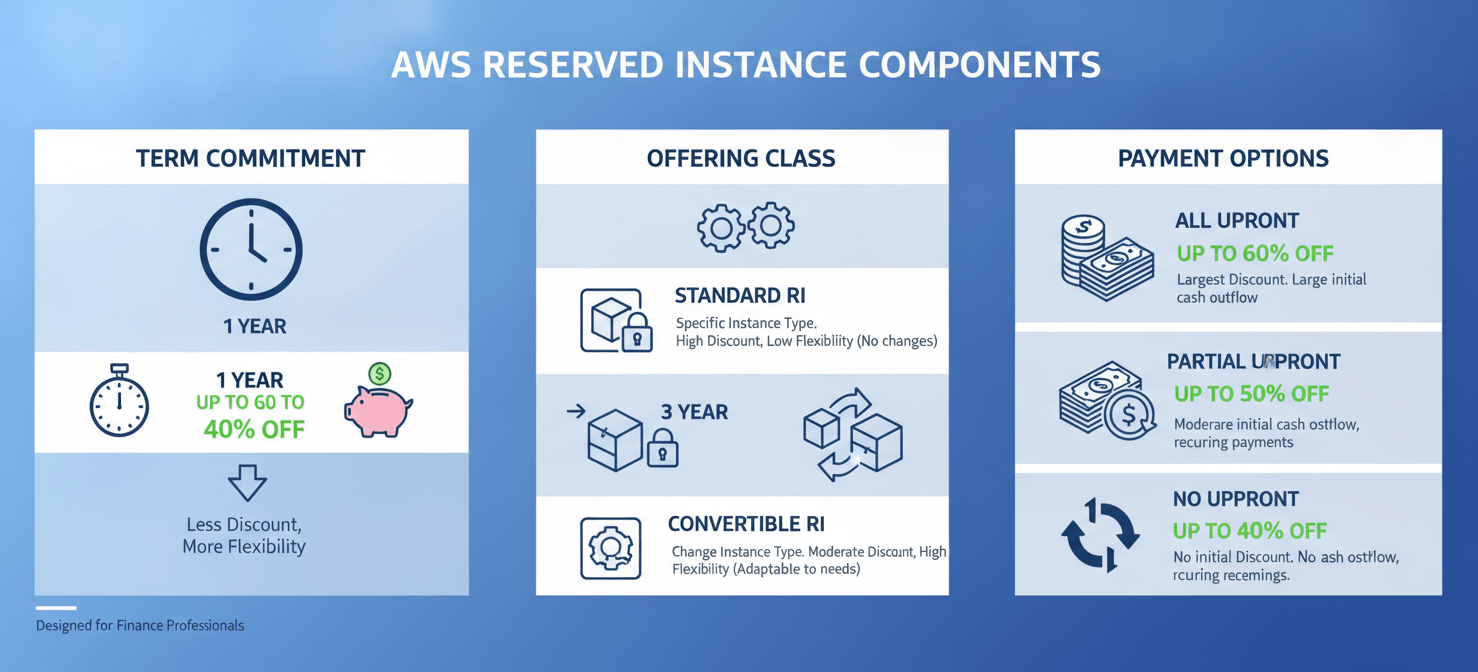
To effectively model the financial impact of RIs, it is essential to understand their core components. RIs are not physical instances but rather a billing discount applied to your account for matching on-demand usage. The discount you receive is determined by three primary factors: term commitment, offering class, and payment option.
Term Commitment and Offering Class
You can commit to either a one-year or a three-year term. As expected, a three-year commitment yields a significantly higher discount than a one-year term, but it also represents a longer-term financial commitment and higher risk if your infrastructure needs change.
There are two main classes of RIs:
- Standard RIs: These offer the highest discount (up to 72%) but are the least flexible. You commit to a specific instance family (e.g., m5), and while you can modify the instance size within that family, you cannot change the family itself. Standard RIs are best suited for highly stable, predictable workloads where you have high confidence in your long-term instance requirements.
- Convertible RIs: These offer a lower discount (up to 66%) but provide the flexibility to change the instance family, operating system, or tenancy during the term. This flexibility is valuable for organizations with evolving application architectures, as it allows you to adapt your RI portfolio to changing technology needs without being locked into a specific instance type.
Payment Options
AWS provides three payment options, allowing you to choose the model that best aligns with your company’s cash flow and capital allocation strategy:
- All Upfront (AURI): You pay the entire cost of the RI in one upfront payment. This option provides the largest discount and is essentially a capital expenditure.
- Partial Upfront (PURI): You pay a portion of the cost upfront and the remainder in monthly installments. This hybrid model balances a significant discount with a lower initial cash outlay.
- No Upfront (NURI): You pay for the RI entirely in monthly installments. While this option offers the lowest discount, it requires no initial capital expenditure and keeps the expense purely operational.
The choice of payment option is a critical financial decision. An All Upfront purchase may offer the best ROI in pure percentage terms, but it requires a significant capital investment that could potentially be used for other high-yield projects. Therefore, the decision should be made in consultation with your treasury and financial planning teams, considering your company’s cost of capital and competing investment opportunities.
A CFO’s Guide to Calculating AWS Reserved Instance ROI
A proper AWS Reserved Instance ROI analysis goes beyond simply comparing the discounted RI rate to the on-demand price. A thorough financial evaluation should incorporate utilization rates, breakeven analysis, and the opportunity cost of capital.
Step 1: Baseline Your On-Demand Spend
The first step is to establish a clear baseline of your current on-demand spending. Using tools like AWS Cost Explorer, you can analyze historical usage data to identify steady-state workloads that are prime candidates for RIs. Filter your usage by instance type, region, and operating system over a period of at least 30-60 days to get a reliable picture of consistent demand. AWS Cost Explorer can even provide RI purchase recommendations based on your historical usage, which can be a valuable starting point for your analysis.
Step 2: Calculate the Breakeven Point
The breakeven point is the moment when the cumulative cost of an RI becomes less than the cumulative cost of running the same instance on-demand. To calculate this, you need the upfront cost (if any) and the effective hourly rate of the RI, as well as the on-demand hourly rate.
For example, consider an instance that costs $0.20 per hour on-demand. A one-year, partial upfront RI for this instance might require a $500 upfront payment and have an effective hourly rate of $0.12. The breakeven point would be the number of hours at which the total on-demand cost equals the total RI cost. In this simplified example, the breakeven point is often around the seven to nine-month mark. Any usage beyond this point represents pure savings. This calculation is critical for understanding the risk profile of the investment; if there is a chance the instance will be decommissioned before the breakeven point, the RI purchase may not be financially sound.
Step 3: Model Different Scenarios
Your analysis should not be static. It’s important to model different scenarios based on potential changes in your infrastructure. For example:
- What is the financial impact if a particular application is retired six months into a one-year RI term?
- If you choose a Convertible RI, what are the potential cost implications of exchanging it for a different instance family?
- How does the ROI of a three-year RI compare to a one-year RI, factoring in the increased risk of the longer commitment?
By running these scenarios, you can make a more informed decision that balances potential savings with the inherent risks of a long-term commitment.
RI vs. Savings Plans: A Financial Modeling Perspective
AWS also offers Savings Plans, another commitment-based discount model that provides more flexibility than RIs. From a financial modeling perspective, the key difference lies in the nature of the commitment.
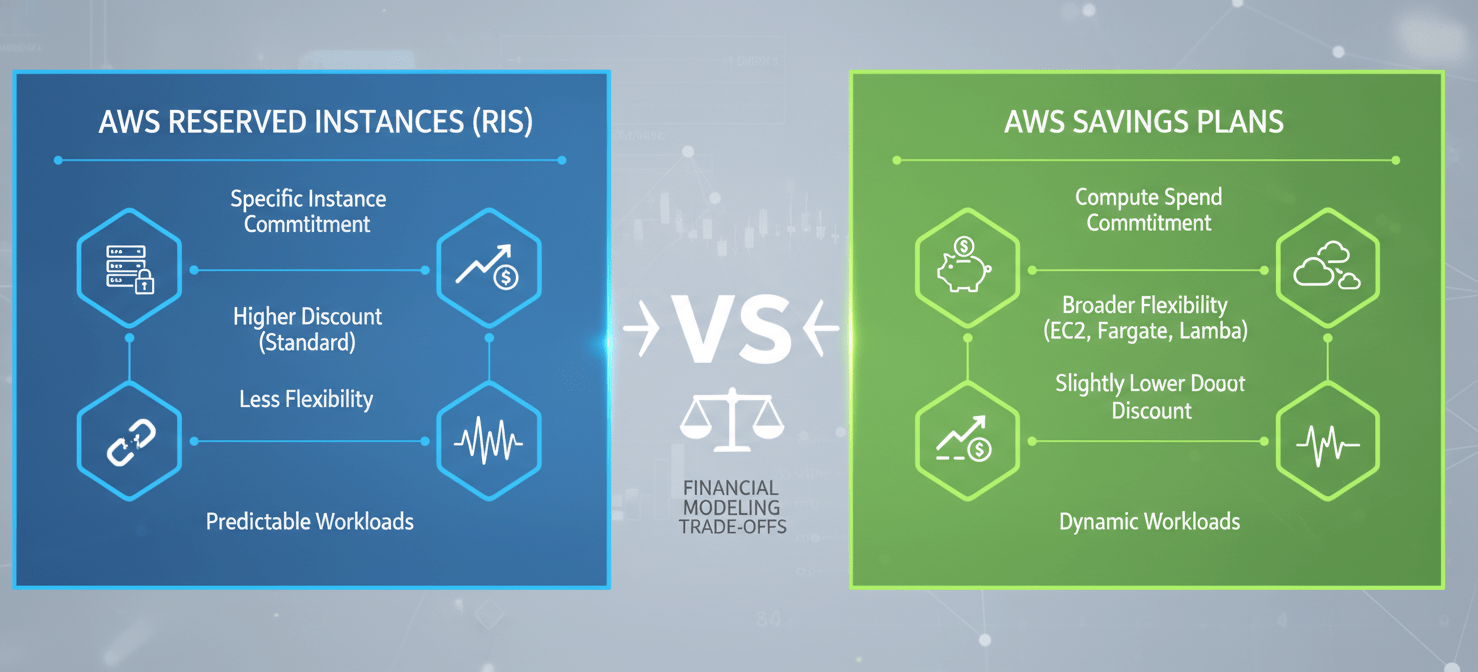
- Reserved Instances are a commitment to a specific instance type in a specific region. This makes them ideal for highly predictable, stable workloads where you can forecast your exact instance needs with a high degree of confidence.
- Savings Plans are a commitment to a certain amount of compute spend (in dollars per hour) across multiple services, including EC2, Fargate, and Lambda. This flexibility makes them a better choice for dynamic workloads or when you anticipate changes in your instance types or compute services.
When modeling the two, consider the trade-off between the potentially deeper discounts of Standard RIs and the greater flexibility of Savings Plans. For your most stable, predictable workloads, a Standard RI might offer the highest ROI. For more variable workloads, or for business units that are still optimizing their cloud architecture, a Savings Plan might be the more prudent financial choice, as it reduces the risk of underutilization.
Governance and Vendor Management for RIs
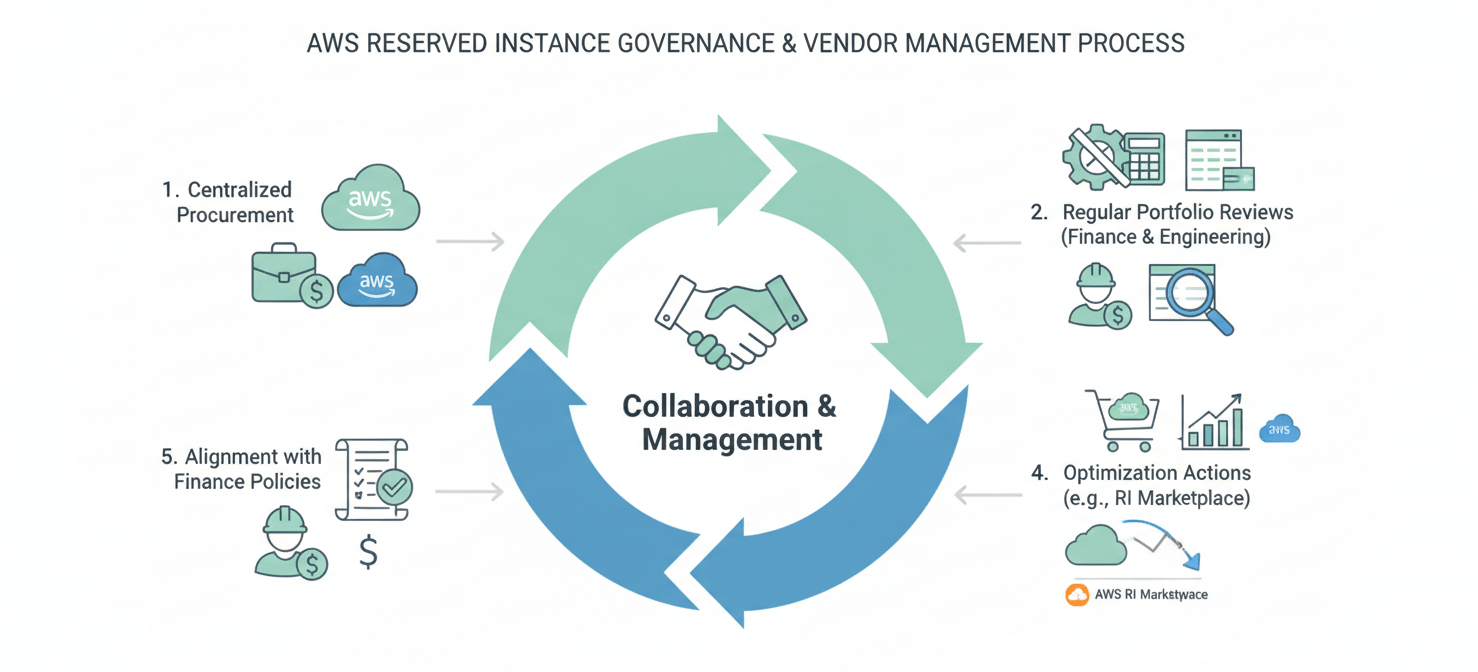
Effective management of an RI portfolio requires strong governance and a strategic approach to vendor management. This is not a “set it and forget it” purchase.
Centralized Procurement and Management
To maximize the benefits of RIs, procurement should be centralized. By purchasing RIs in a primary payer account and sharing them across linked accounts within an AWS Organization, you can ensure that the discounts are applied to any matching instance usage across the entire organization. This consolidated approach prevents individual departments from making siloed purchasing decisions that could lead to underutilized RIs and wasted spend.
Regular Reviews and Optimization
Your finance and procurement teams should establish a regular cadence—at least quarterly—to review your RI portfolio with your cloud engineering teams. This review should analyze RI utilization and coverage reports in AWS Cost Explorer to identify any underutilized RIs. If an RI is consistently underutilized, you may need to work with the engineering team to modify the instance or, if possible, sell the RI on the marketplace.
Aligning with Finance Policies
RI purchases, especially those with upfront payments, should be subject to the same internal controls and approval processes as any other capital expenditure. This includes ensuring that large upfront purchases do not trigger fraud alerts with your financial institution and that they align with departmental budgets and overall company financial policies.
Common Pitfalls in RI Procurement and How to Avoid Them
While RIs can deliver significant savings, there are several common pitfalls that can erode their value.
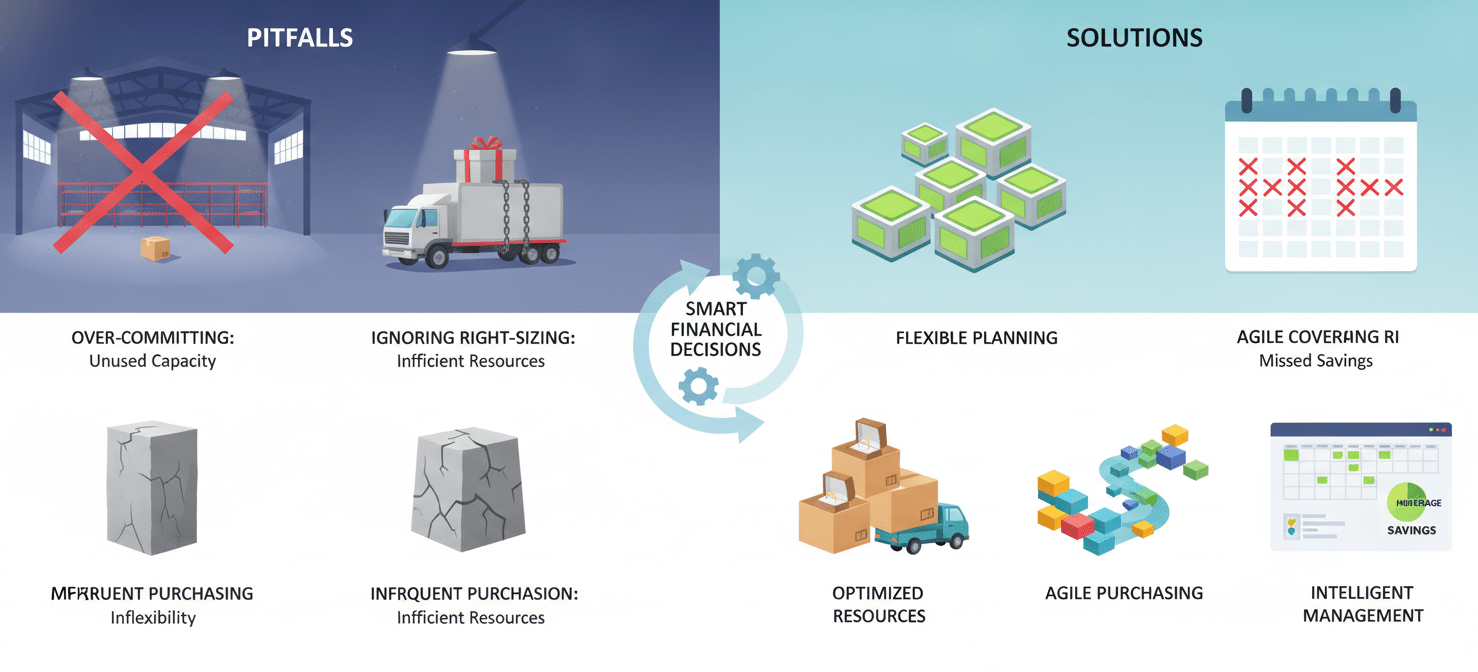
- Over-committing: One of the biggest risks is purchasing RIs for workloads that are not truly stable. A common mistake is to base purchase decisions on short-term usage spikes rather than long-term, steady-state demand. To avoid this, base your analysis on at least 30-60 days of historical data and have frank conversations with your engineering teams about their long-term infrastructure plans.
- Ignoring Instance Right-Sizing: Before purchasing an RI, ensure that the underlying instance is right-sized for its workload. Reserving capacity for an oversized instance locks in waste and diminishes your potential ROI. Encourage your engineering teams to right-size instances before you commit to a one- or three-year term.
- Infrequent Purchasing: Some organizations make large RI purchases once a year. A more effective approach is to make smaller, more frequent purchases on a monthly or quarterly basis. This iterative approach allows you to adapt your RI portfolio to changing business needs and take advantage of new instance types or price reductions from AWS.
- Misunderstanding RI Application: It’s crucial to understand that an RI is a commitment to pay for every hour of the term, regardless of whether you have a matching instance running. It is not a block of hours that can be used intermittently. This is a critical distinction for financial planning and utilization tracking.
Conclusion
Ultimately, AWS Reserved Instances are a powerful financial tool, but they are not a simple “buy and save” proposition. A successful RI strategy requires a sophisticated approach to financial analysis, ongoing governance, and close collaboration between finance, procurement, and engineering teams. By moving beyond a simple discount mindset and embracing a comprehensive approach to calculating AWS Reserved Instance ROI, you can transform your cloud spend from a volatile operational expense into a predictable, optimized, and strategic investment. The key is to treat RI procurement with the same rigor and diligence as any other significant capital allocation decision. After all, a poorly planned RI purchase is not a discount; it’s just a long-term commitment to waste.
To truly master your AWS Reserved Instance ROI and transform cloud spend into a strategic asset, you can begin optimizing your resources with a free Binadox trial or connect with our specialists to arrange a demonstration.
 7-day free trial