



As a FinOps lead, you face a relentless challenge: decentralized SaaS procurement. Every team can independently subscribe to new tools, creating a tangled web of unmanaged expenses, redundant applications, and significant security risks. Your core mission is to bring order to this chaos through robust cost allocation, accurate showback/chargeback, and clear attribution. Effective SaaS spend management tools are no longer a luxury; they are essential for providing the visibility and control needed to optimize cloud and software investments. This article breaks down the key capabilities to look for and evaluates the top platforms designed to meet the specific demands of a FinOps professional.
Key takeaways
- Effective SaaS cost management can reduce software spending by up to 30% through license optimization and eliminating redundant applications.
- Look for tools with strong integration capabilities, particularly with ERP and accounting systems like NetSuite or QuickBooks, to automate cost allocation.
- The primary goal is shifting from reactive discovery to proactive governance of SaaS procurement and usage.
- Successful implementation involves a 4-step process: Discover, Optimize, Govern, and Automate.
The Challenge: Untangling the SaaS Spend Web
The proliferation of SaaS applications creates a significant blind spot for finance and operations teams. When any employee can expense a new subscription, tracking total spend becomes nearly impossible. This decentralized approach leads directly to several critical issues for a FinOps analyst. First, there is a lack of a centralized inventory. Without a single source of truth, you cannot know what you own, who is using it, or if it complies with company policies.

Furthermore, this shadow IT environment complicates cost attribution immensely. How can you accurately charge back departmental software costs when you don’t have clear data on usage or ownership? This directly impacts the accuracy of your financial models and forecasts. In addition, redundant applications are common; multiple departments may pay for separate subscriptions to tools with overlapping functionality, such as project management or design software. Identifying and consolidating these instances is a primary driver of cost savings. Finally, managing renewals and de-provisioning licenses for departing employees becomes a manual, error-prone process, resulting in wasted spend on unused seats.
Core Capabilities of Effective SaaS Spend Management Tools
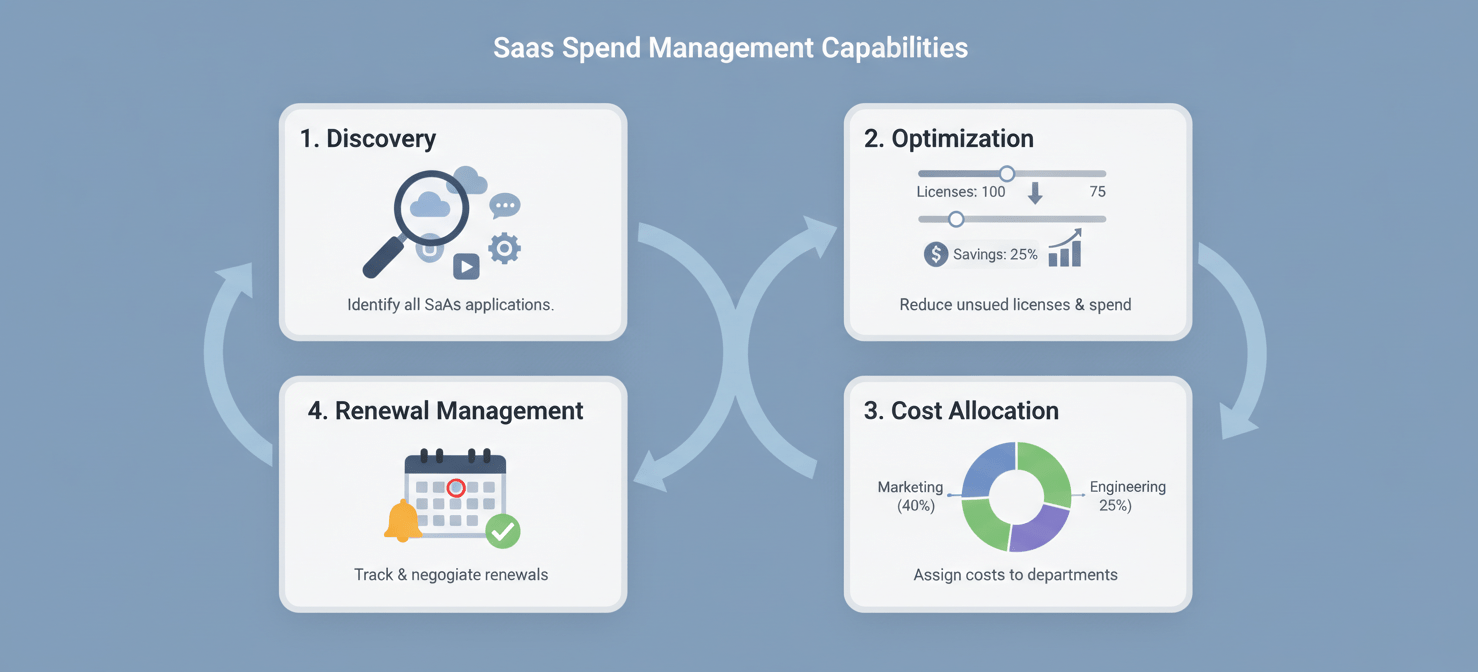
To address these challenges, a robust SaaS spend management tool must provide specific, actionable capabilities tailored to FinOps priorities. These are not just about finding subscriptions; they are about managing the entire lifecycle of your SaaS portfolio to drive financial accountability.
Discovery and Inventory Management
The foundational capability is comprehensive discovery. A top-tier tool must be able to identify every single SaaS application in use across the organization. This is typically achieved by integrating with financial systems (like ERPs, expense platforms, and accounting software) and identity providers (like Okta or Azure AD). The goal is to create a complete, continuously updated inventory. This central repository should detail each application, its cost, renewal date, owner, and the number of provisioned licenses.
License Optimization and Usage Analytics
Once you have a complete inventory, the next step is optimization. This requires visibility into actual employee usage. The platform should track login frequency and feature adoption to identify underutilized or completely unused licenses. For example, if your organization pays for 100 premium seats of a tool but only 60 have been active in the last 90 days, that represents a clear opportunity for cost savings. This data is critical for rightsizing contracts at renewal and eliminating waste. It provides the evidence needed to downgrade plans or de-provision licenses without impacting productivity.
Cost Allocation and Showback/Chargeback
For a FinOps analyst, this is the most critical feature set. A powerful saas cost management tool must simplify the process of attributing software costs to the correct departments, projects, or cost centers. It should allow you to create custom rules for allocation based on departmental ownership or even individual usage data. The platform must generate clear, defensible reports that can be used for showback (informing departments of their consumption) or chargeback (billing them directly). This capability transforms IT and finance from a cost center into a strategic partner that promotes financial accountability across the business.
Renewal and Contract Management
Managing hundreds of SaaS renewal dates manually is a recipe for disaster. An effective tool provides a centralized calendar with automated alerts for upcoming renewals. This gives your team ample time to review usage data, assess the tool’s ongoing value, and negotiate favorable terms with the vendor. Storing all contract details, including pricing tiers and terms of service, within the platform ensures that this critical information is accessible when needed. This proactive approach prevents surprise auto-renewals for unwanted or underutilized software.
Top SaaS Spend Management Platforms for FinOps
Several platforms offer the capabilities needed for effective SaaS spend management, but they differ in their focus and feature depth. Here are a few of the leading options that align well with FinOps objectives.
Binadox
Binadox is built around the allocation problem FinOps teams actually face. Usage Intensity flags abandoned and underutilized licenses down to the individual user, the Renewals Calendar surfaces expirations before auto-renewal locks in another year, and Teams maps costs to departments and cost centers for showback or chargeback. Invoices and payment history are centralized, so a renewal conversation starts from what the vendor actually charged rather than what the contract says. The same dashboard holds AWS, Azure, Google Cloud and DigitalOcean spend, which means one allocation report can cover software and infrastructure together. The platform also covers shadow IT discovery, rightsizing and cost anomaly detection on the infrastructure side, pre-deployment cost analysis for Terraform projects, and LLM spend tracking across providers.
CloudNuro
CloudNuro is an Enterprise AI Adoption Management Platform that helps organizations manage the growing cost and complexity of AI, SaaS, and cloud usage. Its unified approach brings SaaS, Cloud, and AI Management into a single view, giving FinOps teams visibility into technology spend and usage across the enterprise. The platform discovers sanctioned and unsanctioned AI tools, tracks AI and token usage, and attributes spending to the right teams or projects. It also provides right-sized model recommendations and spending controls to help organizations optimize AI costs. Recognized three consecutive times by Gartner in the SaaS Management Platforms Magic Quadrant and named a Leader in the Info-Tech SoftwareReviews Data Quadrant, CloudNuro helps enterprises and government organizations govern technology usage and control spend.
Zluri
Zluri provides a comprehensive platform focused on discovery, management, and automation. It boasts a large library of over 225,000 discoverable applications, ensuring a high degree of accuracy in creating your SaaS inventory. For FinOps teams, its strength lies in its detailed usage analytics and automated workflows for provisioning and de-provisioning. For instance, you can create a workflow that automatically de-provisions all of a departing employee’s SaaS licenses based on a trigger from your HR system. This directly reduces security risks and eliminates license waste. Zluri’s cost allocation features are robust, allowing for detailed showback reporting.
BetterCloud
While often categorized as a SaaS Management Platform (SMP), BetterCloud offers strong capabilities for spend management through its focus on automation and security. Its core strength is its ability to create complex, automated workflows for managing the entire user lifecycle. For a FinOps analyst, this means you can enforce policies for SaaS procurement, automatically reclaim unused licenses, and ensure that access is terminated promptly for offboarding employees. According to their site, BetterCloud integrates with over 80 applications, allowing for granular control over user permissions and license assignments. This focus on automated governance helps prevent uncontrolled spend before it even starts.
Torii
Torii is another powerful platform that excels at automated discovery and action. It creates a real-time map of all your SaaS applications, users, and licenses. Torii’s automation engine allows you to build custom workflows for a variety of FinOps-related tasks, such as sending renewal reminders to application owners or automatically downgrading users to a free plan after a period of inactivity. Torii claims to help customers save up to 25% on their SaaS spend within the first year by identifying waste and optimizing licenses. Its ability to integrate deeply with your existing IT and finance stack makes it a strong contender for teams focused on operational efficiency.
Implementing a SaaS Spend Management Tool: A FinOps Perspective
Deploying a SaaS spend management tool is not just a technical project; it is a strategic initiative that requires careful planning and cross-functional collaboration. As a FinOps lead, your role is to ensure the implementation is focused on driving financial accountability and operational efficiency.
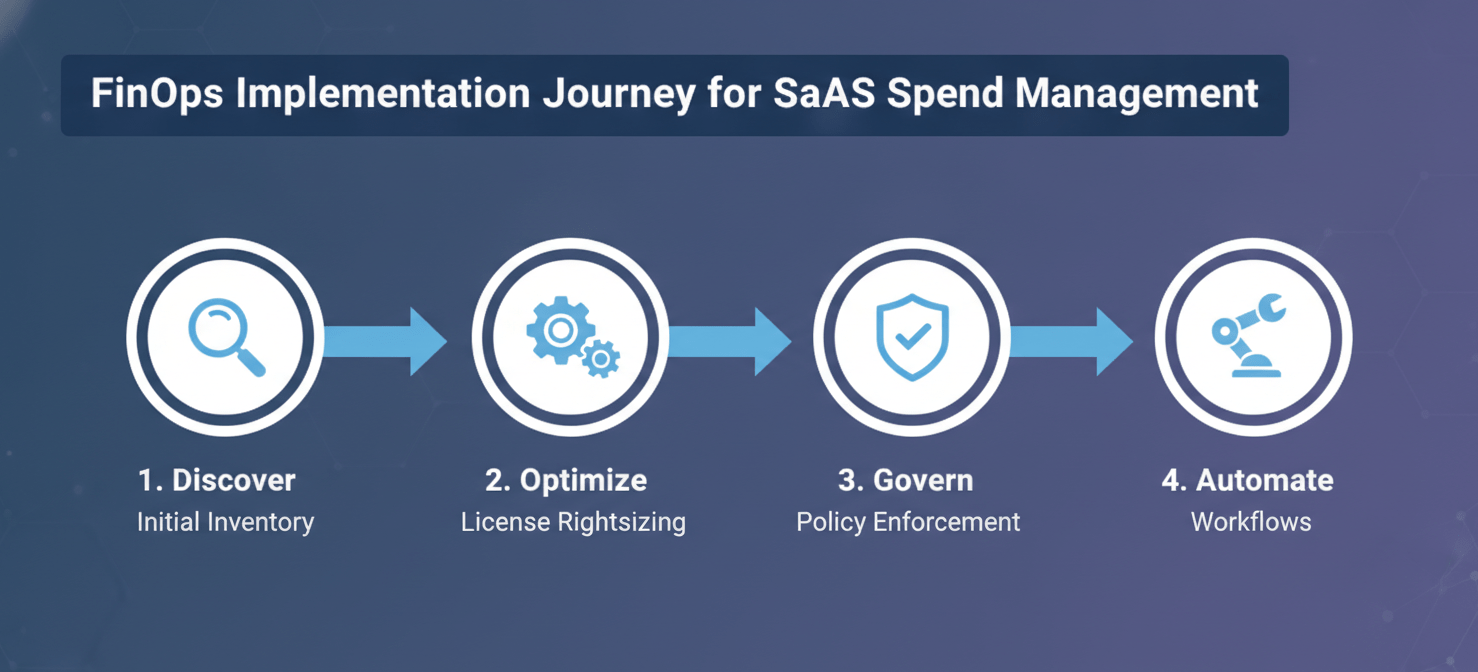
First, begin with a comprehensive discovery phase. Connect the tool to your core financial and identity systems to build an initial inventory. This first pass will likely reveal a significant amount of shadow IT and provide an immediate baseline of your total SaaS spend. Next, focus on optimization by analyzing the usage data. Identify the most obvious opportunities for savings, such as unused licenses or redundant applications. These early wins will help demonstrate the value of the platform and build momentum for the initiative.
Subsequently, establish governance policies. Work with IT, security, and procurement to create workflows for approving new SaaS purchases and managing renewals. The goal is to create a streamlined process that prevents uncontrolled spending without creating unnecessary friction for employees. Finally, automate key processes. Set up workflows for employee onboarding and offboarding to ensure licenses are provisioned and reclaimed in a timely manner. Automate the generation and distribution of showback reports to departmental leaders to foster a culture of cost awareness.
Measuring Success: KPIs for SaaS Cost Management
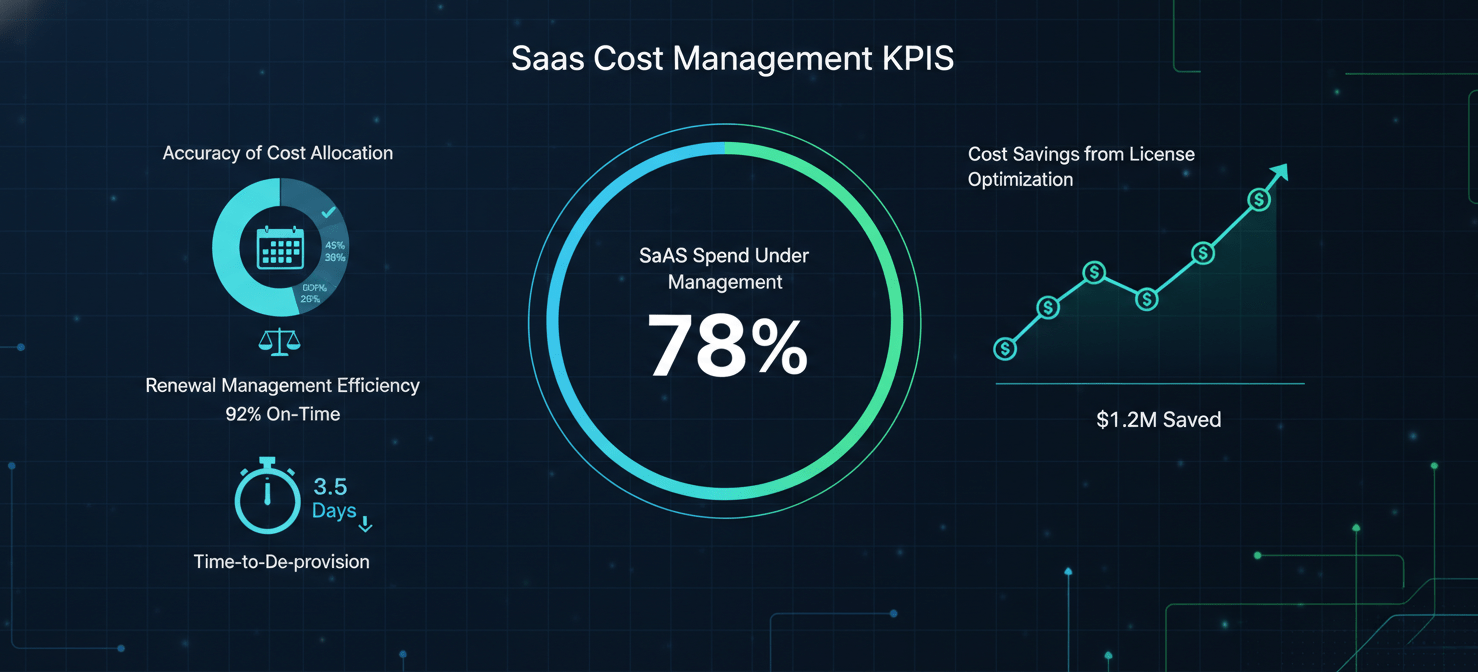
The success of your SaaS spend management program should be measured by a clear set of Key Performance Indicators (KPIs) that reflect FinOps principles. These metrics go beyond simple cost savings and demonstrate the program’s impact on financial transparency and operational efficiency.
Key KPIs to track include:
- SaaS Spend Under Management: What percentage of your total SaaS spend is being actively managed through the platform? The goal is to get this as close to 100% as possible.
- Cost Savings from License Optimization: Track the direct savings achieved by reclaiming unused licenses, downgrading plans, and consolidating redundant applications.
- Renewal Management Efficiency: Measure the percentage of renewals that are reviewed at least 60 days in advance. This indicates a shift from reactive to proactive contract management.
- Accuracy of Cost Allocation: How accurately can you attribute SaaS costs to the correct cost centers? This can be measured by the reduction in unallocated software expenses.
- Time-to-De-provision: How long does it take to reclaim all SaaS licenses from a departing employee? Reducing this time directly impacts both cost and security.
By tracking these metrics, you can clearly articulate the value of your SaaS spend management efforts to senior leadership and demonstrate a tangible return on investment.
In conclusion, gaining control over decentralized software purchasing is a fundamental goal for any FinOps practice. The chaos of unmanaged subscriptions not only inflates costs but also obscures the true financial picture of departmental operations. Implementing dedicated SaaS spend management tools provides the necessary discovery, optimization, and governance capabilities to transform this chaos into a well-managed portfolio. It’s less about pinching pennies and more about funding innovation; every dollar saved on a redundant software license is a dollar that can be reallocated to a project that drives real business value. The right platform doesn’t just show you what you’re spending—it gives you the data to spend it smarter.
If you’re ready to transform your SaaS chaos into a strategic asset, you can easily explore a Binadox trial to see the impact firsthand or arrange a personalized demonstration to address your organization’s unique requirements.
 7-day free trial