



Understanding the AI customer support cost is essential for any business looking to innovate its service model. As companies increasingly turn to artificial intelligence to handle customer inquiries, the question of expense becomes central. This isn’t just about software licenses; it’s a comprehensive calculation involving implementation, maintenance, and optimization. A clear grasp of these financial components ensures that your investment in AI enhances efficiency and delivers a strong return, rather than becoming an unforeseen drain on resources. Therefore, a detailed financial analysis is the first step toward a successful AI integration.
Key takeaways
- AI customer support solutions can range from free or low-cost plans ($15-$500/month) for small businesses to custom enterprise-level deployments that can exceed $150,000 for the initial build.
- Pricing models vary significantly and include per-resolution, per-conversation, per-agent, and flat-rate subscriptions, each impacting the total cost of ownership differently.
- On average, companies see a return of $3.50 for every $1 spent on AI customer service, with ROI climbing past 124% by the third year.
- A typical implementation timeline for an AI chatbot for a small to mid-sized business spans 8–12 weeks, from initial planning to launch and optimization.
The Business Case for AI in Customer Support
The primary driver for adopting AI in customer service is the potential for significant cost reduction and efficiency gains. Human-led support interactions come with substantial labor costs. In the US, a fully-loaded customer service agent can cost a company $60,000–$65,000 annually. On a per-ticket basis, a human-handled interaction averages between $6 and $12, whereas an AI-resolved issue can cost as little as $0.10 to $2.00. This stark difference in operational cost allows businesses to reallocate funds and human resources to more complex, high-value tasks.
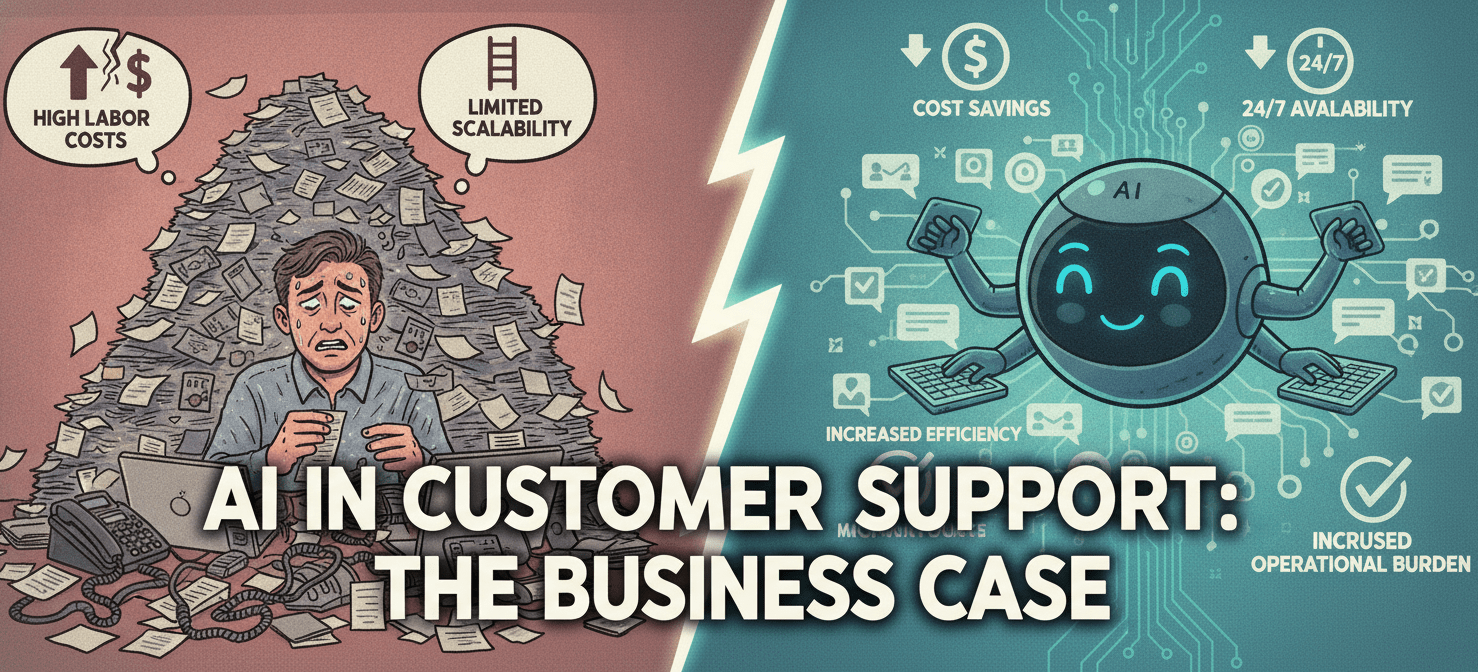
Furthermore, AI provides a level of scalability that is difficult to achieve with a human workforce alone. AI-powered chatbots and virtual assistants can handle massive volumes of inquiries simultaneously, 24/7, without a proportional increase in cost. This capability is crucial for businesses experiencing rapid growth or seasonal peaks in customer demand. For instance, an AI assistant can handle millions of conversations monthly, a workload that would otherwise require hundreds of full-time agents. As a result, companies can manage a 2-5x increase in ticket volume without needing to expand their support team proportionally.
Enhancing Customer Experience and Revenue
Beyond cost savings, AI directly impacts the customer experience, which in turn can protect and grow revenue. Modern consumers expect immediate responses, and AI delivers. By providing instant answers to common questions, AI significantly reduces first response times and overall resolution times. Some companies have seen first response times drop by as much as 97% after implementing AI. This speed and 24/7 availability lead to higher customer satisfaction (CSAT) scores, with reported improvements of 15-25%.
A better customer experience translates into improved customer retention. Faster, more efficient service reduces customer frustration and churn. In addition, AI can do more than just answer questions; it can be a revenue driver. For example, e-commerce bots can provide personalized recommendations and guide users through the sales funnel, turning a support interaction into a sales opportunity. This dual function of support and sales creates a powerful engine for growth, with some businesses attributing millions in profit improvements to their AI implementations.
The Cost of Inaction
In an increasingly digital world, failing to adopt AI in customer support carries its own set of hidden costs. Operational inefficiencies from manual workflows can lead to longer wait times, frustrated customers, and a higher workload for human agents. This often results in agent burnout, a significant issue in an industry with an annual attrition rate as high as 45%. The cost to replace a single agent can range from $10,000 to $20,000, making agent retention a critical financial concern.
Moreover, as competitors leverage AI to offer superior service, businesses that stick to traditional models risk falling behind. By 2028, it’s predicted that 70% of customers will start their service journey through a conversational AI interface. The market itself is expanding rapidly, with projections showing the AI customer service market growing to over $47 billion by 2030. The message is clear: inaction is not a neutral position. It is a decision that can lead to higher operational costs, a diminished customer experience, and a loss of competitive advantage.
Key Factors Influencing AI Customer Support Cost
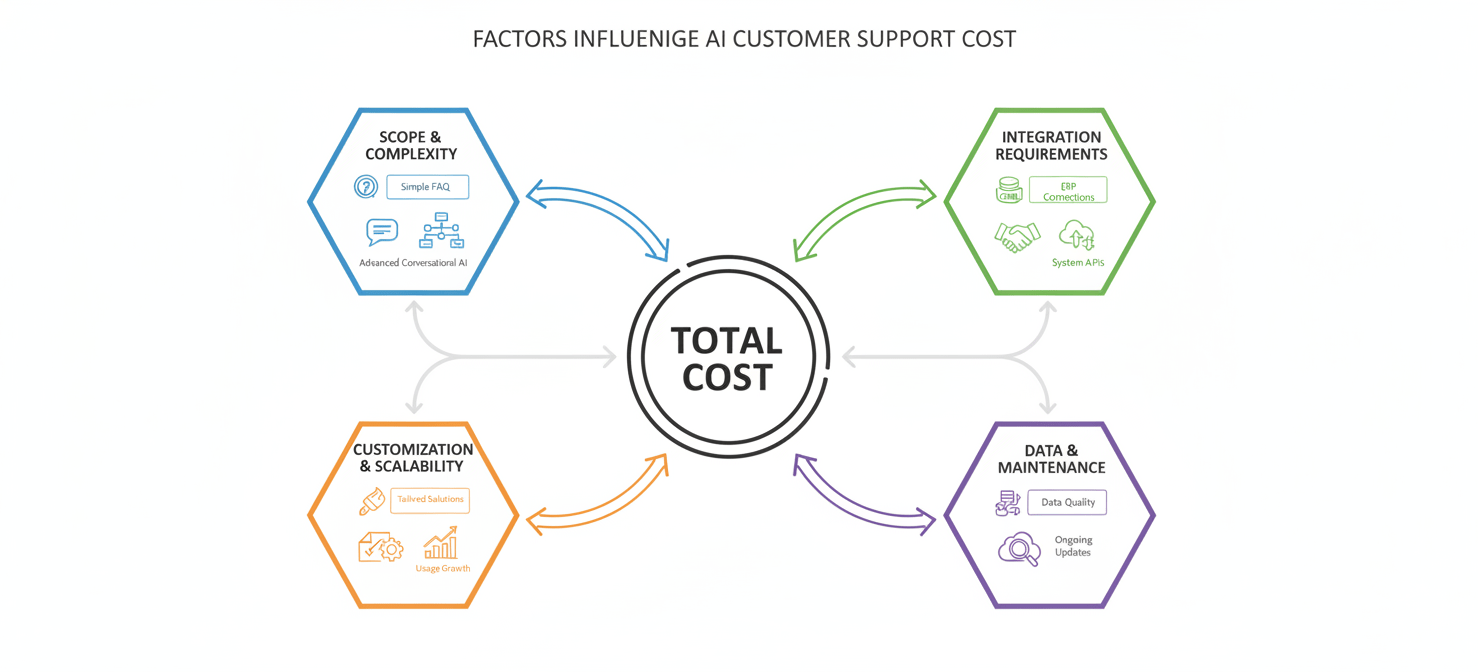
The cost of implementing an AI customer support solution is not a single, fixed number. Instead, it is influenced by a variety of factors that can cause the price to range from a modest monthly fee to a significant six-figure investment. Understanding these variables is crucial for accurately budgeting and selecting a solution that aligns with your business needs.
Scope and Complexity
The single largest determinant of cost is the scope and complexity of the AI agent’s functions. A simple, rule-based chatbot designed to answer a limited set of frequently asked questions will be far less expensive than a sophisticated, autonomous agent. Advanced AI agents that can understand context, perform multi-step tasks, and integrate with backend systems require more complex engineering and, therefore, a larger investment.
For example, a basic FAQ bot might be included in a low-cost subscription plan. However, an AI agent that can process a return, update an order in your CRM, and escalate a conversation to a specific human agent based on sentiment analysis involves a much higher level of complexity and cost. Custom development for such advanced features can range from $75,000 to over $150,000.
Integration Requirements
The need to connect your AI solution with existing business systems is another significant cost driver. Seamless integration with your Customer Relationship Management (CRM), e-commerce platform, and other internal databases is essential for the AI to provide personalized and effective support.
Simple integrations with common platforms like Slack or WordPress might be included in standard plans or incur a modest additional fee. However, custom integrations with proprietary or legacy systems require specialized development work, which can add thousands of dollars to the initial setup cost. The complexity of these integrations directly impacts the implementation timeline and overall expense.
Customization and Scalability
The level of customization required also plays a major role in the final price. Off-the-shelf solutions with limited customization options are generally more affordable. In contrast, a solution that needs to be tailored to your specific brand voice, workflows, and business rules will be more expensive.
Scalability is another key consideration. Your chosen solution must be able to handle your current volume of customer inquiries and grow with your business. Pricing models that are based on usage, such as per-conversation or per-resolution fees, are designed to scale. However, it’s important to forecast your future needs to avoid unexpected cost increases as your volume grows.
Data and Ongoing Maintenance
AI systems, particularly those that use machine learning, rely on large volumes of high-quality data to function effectively. The cost of acquiring, storing, and managing this data is a crucial factor. Additionally, ensuring data privacy and compliance with regulations like GDPR adds another layer of expense.
Finally, the cost of AI customer support does not end with implementation. Ongoing maintenance is essential to keep the system running smoothly. This includes monitoring performance, retraining the AI model with new data, and applying software updates. Annual maintenance costs for custom-built solutions can be as much as 15-20% of the initial development cost.
Common AI Chatbot Pricing Models Explained
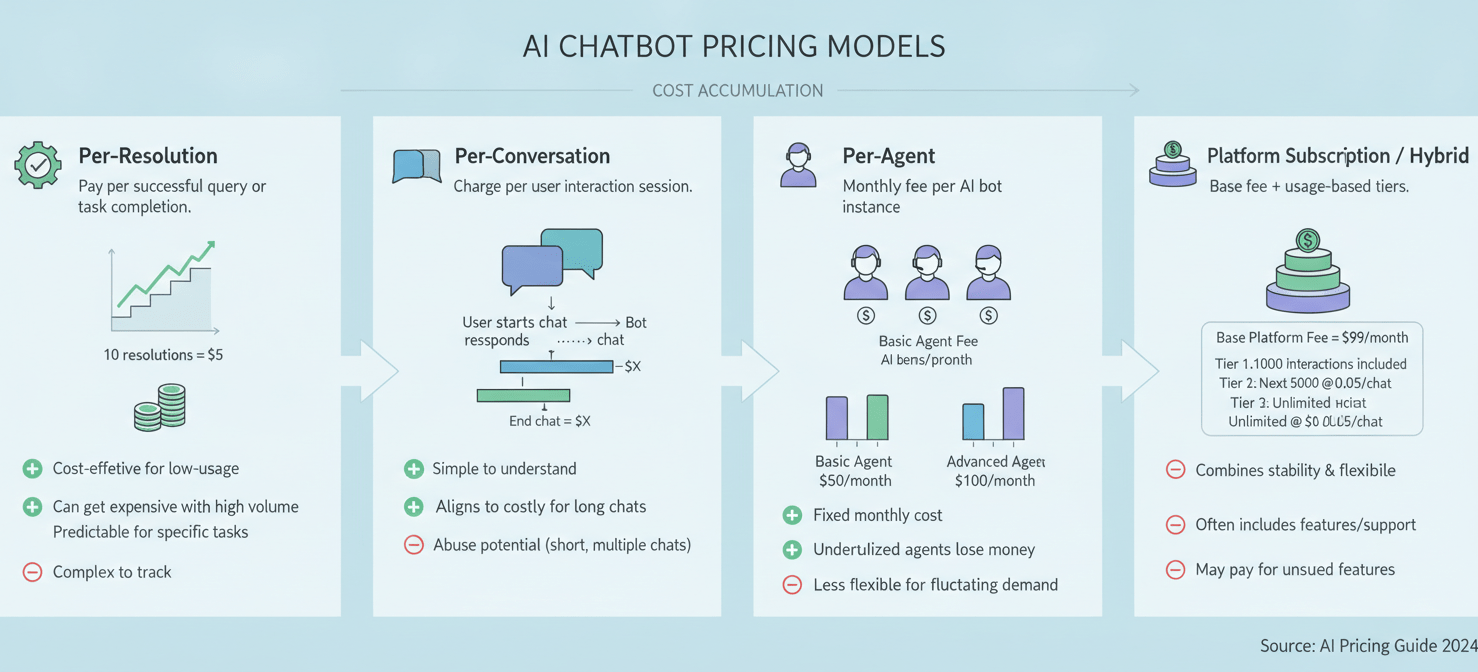
The pricing landscape for AI customer support can be complex, with vendors utilizing several different models. Each model has its own implications for budgeting and total cost of ownership. Choosing the right one depends on your company’s size, conversation volume, and predictability of customer inquiries.
Per-Resolution or Per-Outcome
In this model, you pay only when the AI successfully resolves a customer’s issue without human intervention. This outcome-based approach is appealing because it directly ties cost to value. Prices typically range from $0.40 to $2.00 per resolution. For example, a vendor might charge $0.99 for each fully automated resolution.
The main advantage is that you are paying for results, not just interactions. However, a potential downside is that as your AI becomes more effective and resolves a higher percentage of inquiries, your costs will increase proportionally. This can make budgeting challenging, especially if you experience unexpected spikes in customer volume.
Per-Conversation or Per-Session
This model charges for each conversation or session the AI handles, regardless of whether the issue was resolved. A session might be defined as a certain number of interactions within a specific timeframe. Costs can range from as low as $0.05 for entry-level tiers to over $2.00 for more advanced platforms.
This approach offers a degree of predictability, as you can estimate costs based on your average conversation volume. The drawback is that you may end up paying for interactions that do not lead to a resolution and still require human intervention. It is important to understand how a vendor defines a “conversation” to avoid unexpected charges.
Per-Agent or Per-Seat Subscription
Inherited from traditional software-as-a-service (SaaS) models, per-agent pricing involves a fixed monthly fee for each human agent who uses the platform. This model is common for solutions that assist human agents (a “copilot”) rather than fully automating interactions. Base plans can range from $49 to $115 per agent per month, often with additional fees for AI features. For instance, a platform might charge $115 per agent for the helpdesk software, plus a $50 per agent add-on for AI copilot features.
The primary benefit of this model is its predictability, making it easy to budget for. The main disadvantage is that the cost scales with the size of your team, not the volume of automated resolutions. This model may be less cost-effective for companies looking to achieve high levels of automation.
Platform Subscription Tiers and Hybrid Models
Many vendors offer tiered subscription plans that bundle a certain number of conversations or resolutions for a flat monthly fee. These plans can range from free or low-cost options for small businesses (e.g., $199/month for 200 conversations) to enterprise-level plans that cost thousands per month. This model provides predictable costs as long as you stay within your tier’s limits.
Hybrid models are also becoming increasingly common, combining elements of different pricing structures. For example, a vendor might charge a base platform fee plus a per-resolution fee for any resolutions that exceed the monthly allowance. While these models offer flexibility, they can also make it more difficult to forecast your total AI customer support cost.
Hidden Costs to Watch For
While vendors are typically upfront about their pricing models, several hidden costs can emerge during and after the implementation of an AI customer support solution. Being aware of these potential expenses is crucial for creating a realistic budget and avoiding unpleasant surprises down the line.
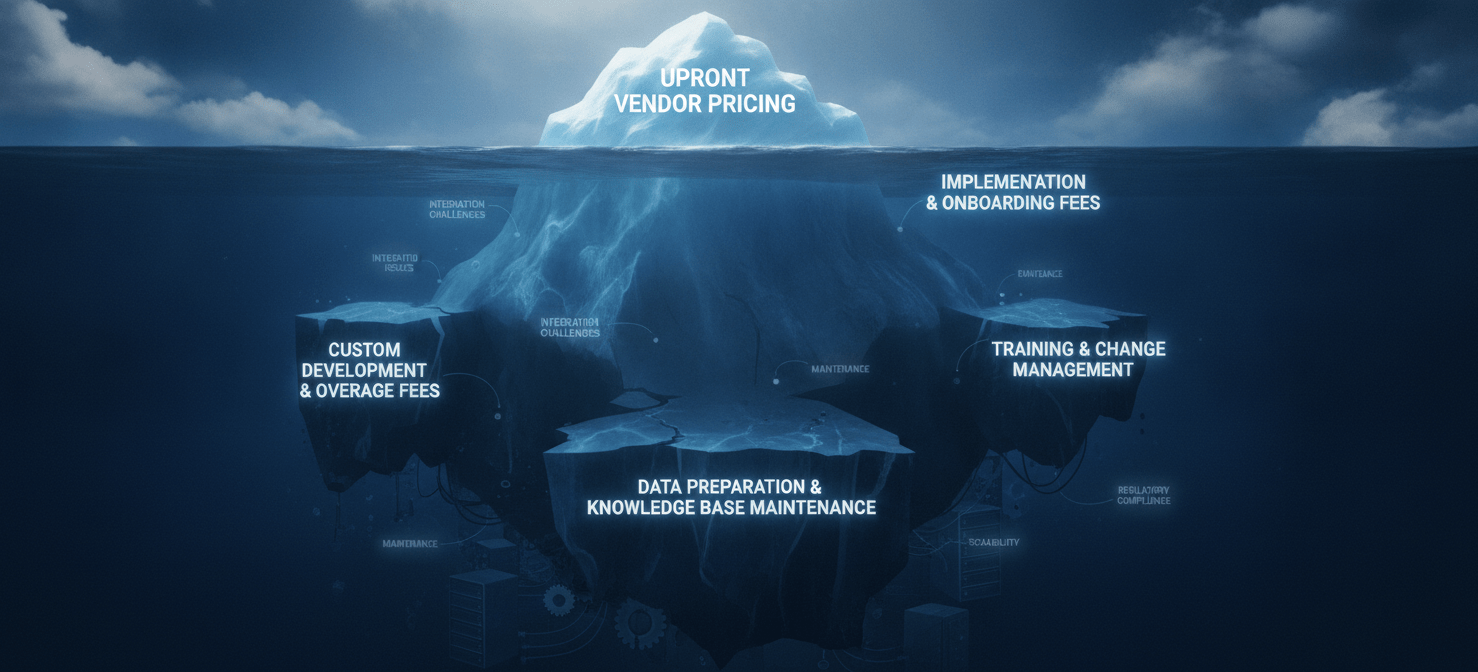
Implementation and Onboarding Fees
The initial setup of an AI solution is rarely as simple as flipping a switch. Many vendors charge one-time implementation or onboarding fees, which can range from a few thousand dollars to tens of thousands for complex enterprise deployments. These fees cover the technical work of integrating the AI with your existing systems, configuring the software to your specifications, and ensuring a smooth launch.
It is essential to clarify what is included in these fees. Does it cover custom integration work? What about data migration? Asking these questions upfront can prevent unexpected charges later in the process.
Training and Change Management
Your human support team will need to be trained on how to use the new AI tools effectively. This includes learning how to manage escalations from the AI, how to use AI-powered agent-assist features, and how to interpret the analytics provided by the platform. The cost of this training can vary significantly, from a few thousand dollars for a small team to over $50,000 for a large enterprise rollout.
Beyond formal training, there is also the cost of change management. Shifting from a human-only support model to a hybrid AI-human model requires a cultural shift. Some employees may be resistant to the change, and there will be a period of adjustment as new workflows are established. The associated dip in productivity during this transition is a real, albeit indirect, cost.
Data Preparation and Knowledge Base Maintenance
An AI chatbot is only as smart as the data it is trained on. Before you can even begin implementation, you may need to invest significant time and resources into cleaning, organizing, and formatting your existing data. This process, known as data preparation, is often overlooked but is critical for the AI’s success.
Furthermore, your knowledge base is not a static document. It must be continuously updated with new product information, policy changes, and answers to new customer questions. This ongoing maintenance requires dedicated staff time. If your knowledge base is out of date, the AI will provide incorrect or irrelevant answers, leading to a poor customer experience and negating the benefits of the system.
Custom Development and Overages
While many AI platforms offer extensive customization options, you may find that you need additional features or integrations that are not available out of the box. This will require custom development work, which can be expensive. A custom-built AI chatbot can cost anywhere from $30,000 to over $150,000.
Finally, if your pricing model is based on usage, you need to be mindful of overage fees. If you exceed the number of conversations or resolutions included in your plan, you will be charged for the excess, often at a higher rate. Unexpected spikes in customer volume can lead to a surprisingly large bill at the end of the month.
How to Choose a Cost-Effective AI Solution
Selecting the right AI customer support solution is a balancing act between capability and cost. The most expensive option is not always the best, and the cheapest may end up costing more in the long run due to its limitations. A strategic approach to the selection process can help you find a solution that delivers a strong return on investment.
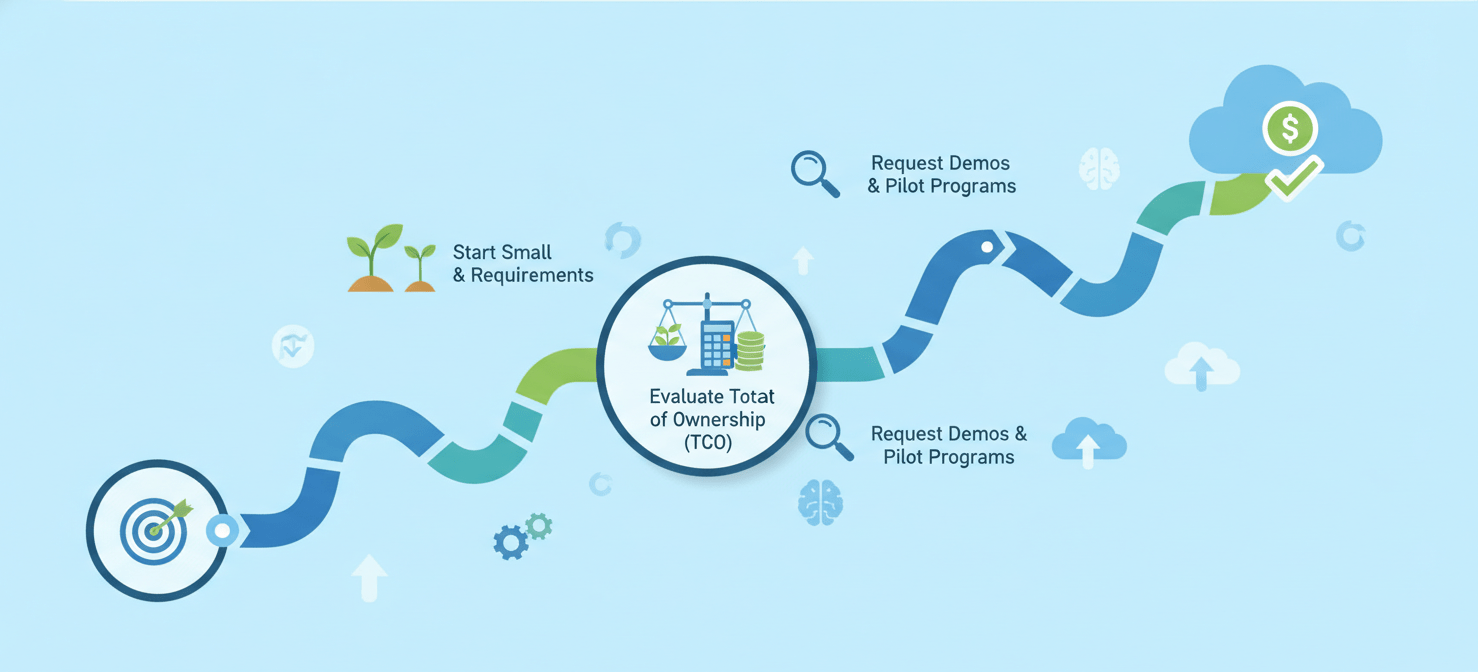
Define Your Goals and Requirements
Before you start looking at vendors, it is crucial to have a clear understanding of what you want to achieve with AI. Are you primarily looking to reduce costs by deflecting common inquiries? Or is your main goal to improve customer satisfaction by providing 24/7 support? Clearly defined goals will help you identify the features that are most important to your business.
Next, create a detailed list of your requirements. This should include:
- Key tasks for the AI: What specific questions and problems should the AI be able to handle?
- Integration needs: Which of your existing systems must the AI connect with?
- Channel support: Do you need the AI to work on your website, in your mobile app, on social media, or all of the above?
- Language support: How many languages does the AI need to be able to communicate in?
Having this list will allow you to quickly disqualify vendors that do not meet your core needs and focus on those that do.
Start Small and Scale
It can be tempting to try and automate everything at once, but a phased approach is often more cost-effective and successful. Start by identifying a narrow, high-volume use case. These are typically the simple, repetitive questions that take up a significant amount of your human agents’ time, such as “Where is my order?” or “What is your return policy?”
By starting with a focused deployment, you can prove the value of the AI and generate a return on investment more quickly. This also allows your team to get comfortable with the new technology and workflows in a manageable way. Once the initial implementation is successful, you can then gradually expand the AI’s responsibilities to more complex tasks.
Evaluate Total Cost of Ownership (TCO)
The sticker price of an AI solution is only one part of the equation. To make an informed decision, you need to evaluate the total cost of ownership over the long term. This includes not only the subscription or license fees but also all the potential hidden costs discussed earlier.
When comparing vendors, create a spreadsheet that accounts for:
- Platform fees: The base cost of the software.
- Usage charges: Any per-resolution or per-conversation fees.
- Implementation and onboarding costs.
- Integration fees.
- Training expenses.
- Ongoing maintenance and support costs.
This comprehensive view will give you a much more accurate picture of what each solution will actually cost your business over time.
Request Demos and Pilot Programs
Never purchase an AI solution without seeing it in action. Schedule demos with your top contenders and come prepared with a list of specific scenarios you want to see the AI handle. This is your opportunity to assess the user-friendliness of the platform, the quality of the AI’s responses, and the capabilities of the analytics and reporting tools.
If possible, ask for a pilot program or a free trial. This will allow you to test the solution in a real-world environment with a limited number of users. A pilot program is the best way to verify a vendor’s claims and ensure that the solution is a good fit for your business before you commit to a long-term contract.
Strategies for Managing and Optimizing Your Spend
Implementing an AI customer support solution is not a one-time project; it is an ongoing process of management and optimization. To ensure that you are getting the most value from your investment, you need to actively monitor performance, refine your approach, and control costs.
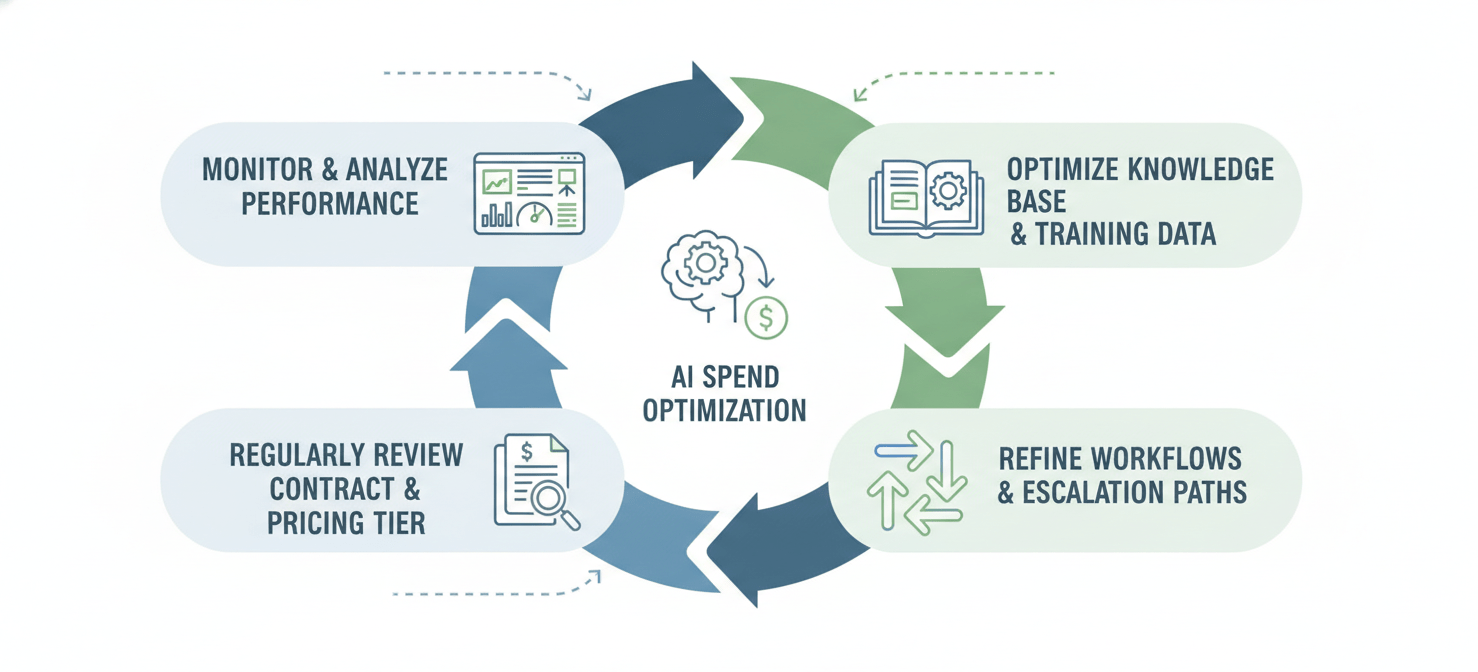
Continuously Monitor and Analyze Performance
To manage your AI customer support cost effectively, you must track the right metrics. Regularly analyzing performance data will reveal what is working, what is not, and where there are opportunities for improvement. Key performance indicators (KPIs) to monitor include:
- Resolution Rate: What percentage of inquiries is the AI able to resolve without human intervention? This is a primary indicator of the AI’s effectiveness and its impact on cost savings.
- Escalation Rate: How often does the AI need to transfer a conversation to a human agent? A high escalation rate may indicate that the AI is not properly trained or that it is being asked questions beyond its capabilities.
- Customer Satisfaction (CSAT): Are customers satisfied with their interactions with the AI? Post-chat surveys are a common way to measure this.
- Goal Completion Rate: If the AI is designed to guide users through a specific process (e.g., making a purchase), this metric tracks how often it succeeds.
By tracking these KPIs, you can make data-driven decisions about where to focus your optimization efforts.
Optimize Your Knowledge Base and Training Data
The performance of your AI is directly tied to the quality of its knowledge base. If you notice that the AI is frequently failing to answer a particular question, it is likely that the answer is either missing from the knowledge base or is not clear enough for the AI to understand.
Make it a regular practice to review the conversations that the AI was unable to resolve. This will help you identify gaps in your knowledge base. Create a process for continuously updating and expanding your knowledge base with new information. This iterative process of refinement is crucial for improving the AI’s resolution rate over time and, as a result, maximizing your return on investment.
Refine Workflows and Escalation Paths
Effective management of your AI solution involves more than just the technology itself; it also requires optimizing the workflows between the AI and your human agents. The goal is to create a seamless experience for the customer, even when a conversation needs to be escalated.
Ensure that your escalation paths are clearly defined and efficient. When the AI transfers a conversation to a human, the agent should have access to the full transcript of the AI interaction so that the customer does not have to repeat themselves. Regularly review these handoffs to identify any points of friction. By improving the collaboration between your AI and human teams, you can increase overall efficiency and reduce resolution times.
Regularly Review Your Contract and Pricing Tier
Finally, do not treat your vendor contract as a “set it and forget it” document. As your business evolves, your needs may change. Periodically review your contract and pricing tier to ensure that it still aligns with your usage and budget.
If your conversation volume has grown significantly, you may be able to negotiate a better rate or move to a higher tier that offers a lower per-interaction cost. Conversely, if you are consistently underutilizing the resources in your current plan, you may be able to move to a lower-cost tier. Proactive management of your vendor relationship can lead to significant cost savings over time.
Conclusion
Navigating the complexities of AI customer support cost requires a strategic and informed approach. It is not merely about purchasing software, but about making a calculated investment in a system that should yield significant returns in efficiency, scalability, and customer satisfaction. The initial outlay and ongoing expenses, from implementation fees to the nuances of various AI chatbot pricing models, must be weighed against the substantial cost of maintaining a purely human-led support team and the competitive disadvantage of inaction.
The key to managing this investment lies in a clear-eyed assessment of your specific needs, a thorough evaluation of the total cost of ownership, and a commitment to continuous optimization. By starting with a well-defined scope, monitoring performance through relevant KPIs, and actively refining your knowledge base and workflows, you can control expenses and maximize the value your AI solution delivers. Ultimately, a successful implementation is one where the AI customer support cost is not just a line item on a budget, but a strategic expenditure that strengthens your business’s operational foundation and its relationship with its customers. The future isn’t about replacing humans, but about building a smarter, more efficient partnership between them and their AI counterparts.
To truly grasp the potential savings and efficiency AI can bring to your customer support, consider exploring our platform with a free trial or connecting with our experts to book a personalized demo.
 7-day free trial