



As a FinOps lead, your world revolves around translating cloud operations into financial accountability. Every dollar of cloud spend must be visible, efficient, and aligned with business outcomes. While newer commitment models like Savings Plans offer flexibility, a sophisticated Reserved Instance (RI) strategy remains a cornerstone of effective cloud cost management. Developing a mature reserved instance management strategy is not just about buying discounts; it’s about creating a programmatic approach to maximizing their value through careful analysis, continuous monitoring, and strategic adjustments that directly impact your cost allocation and chargeback models.
This article provides a FinOps-centric framework for building and executing an AWS RI management program. We will move beyond the basics of “what RIs are” and focus on the operational cadence, KPIs, and automation required to drive meaningful savings and predictable cloud spend.
Key takeaways:
- A blended approach using both RIs and Savings Plans often yields the highest savings, with RIs covering stable, predictable workloads for maximum discounts.
- Effective RI management hinges on tracking two primary KPIs: RI Utilization (aiming for >95%) and RI Coverage.
- Leveraging the AWS RI Marketplace allows you to sell unused Standard RIs, turning a potential loss into a recovered asset.
- Automating RI analysis and purchase recommendations is critical for scaling your FinOps practice and reducing manual overhead.
Why RIs Still Matter in the Age of Savings Plans
With the introduction of AWS Savings Plans, many teams questioned the relevance of Reserved Instances. Savings Plans offer compelling flexibility, applying discounts to a committed dollar-per-hour spend across various compute services like EC2, Fargate, and Lambda. This flexibility is ideal for dynamic or evolving workloads. However, this flexibility comes at a cost—discounts are generally lower than what Standard RIs can offer.
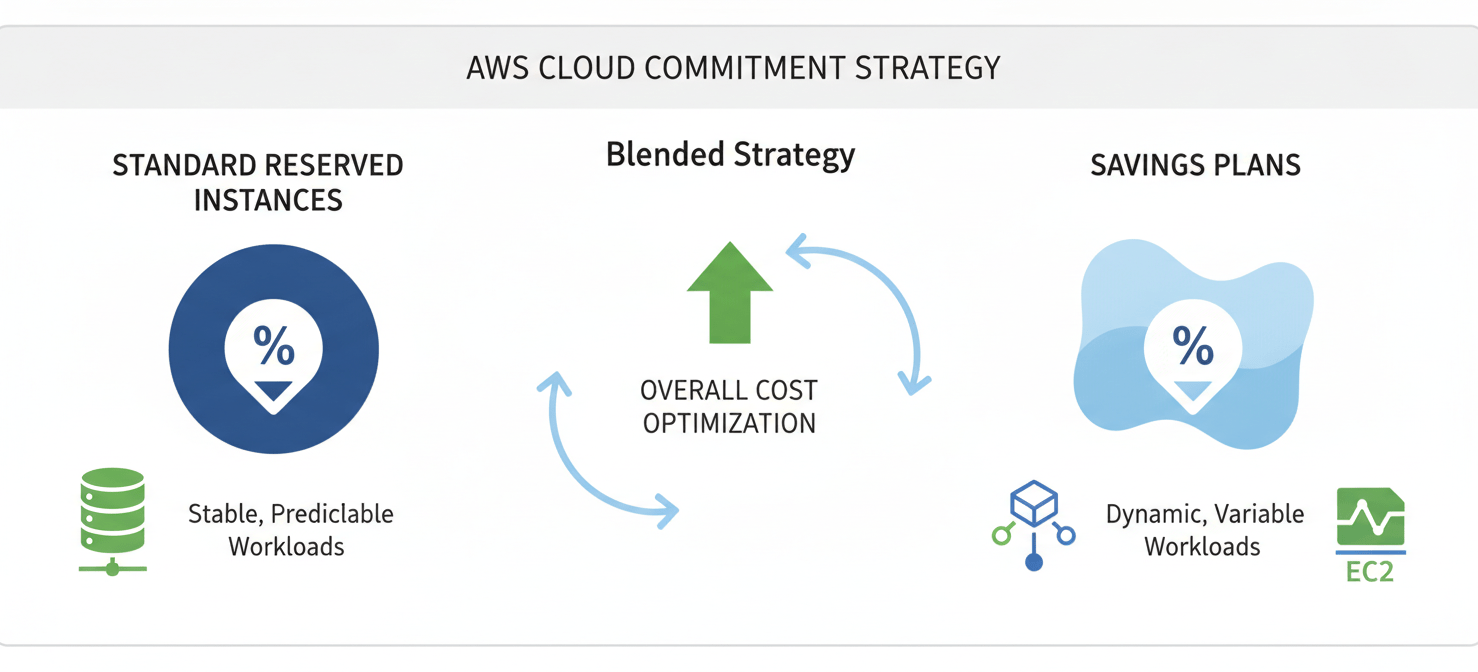
For a FinOps analyst, the choice isn’t about RIs versus Savings Plans; it’s about using them in concert.
The Case for a Blended Strategy
Think of your compute footprint as a layered stack. The bottom layer is your stable, predictable, “always-on” usage. These are your core production databases, essential application servers, and other workloads that run 24/7 with little variation. This is the sweet spot for Standard RIs. Because you can commit to a specific instance family in a specific region for a 1- or 3-year term, AWS offers the deepest discounts, often up to 72% compared to On-Demand rates.
The layers above this stable base represent more variable or transient workloads. This is where Savings Plans shine. A Compute Savings Plan, for example, provides a discount (up to 66%) that automatically applies across different instance families, regions, and even services like Fargate and Lambda. This protects you from commitment waste as development teams refactor applications or shift workloads.
By covering your stable baseline with Standard RIs and your variable usage with Savings Plans, you create a highly effective AWS commitment management portfolio that maximizes savings without sacrificing too much flexibility.
When to Choose Which RI Type
- Standard RIs: Use for maximum savings on workloads with a predictable, steady-state usage pattern. You must be confident that the instance family and region will not change for the duration of the term.
- Convertible RIs: Offer a lower discount than Standard RIs but provide the flexibility to change the instance family, operating system, or tenancy. These are a good middle ground if you anticipate architectural changes but still want to commit to a certain level of usage. The exchange process requires the new RI to be of equal or greater value.
Building Your RI Purchase Model
A data-driven purchase model is the foundation of any successful reserved instance management strategy. This isn’t a one-time purchase; it’s a cyclical process of analysis, forecasting, and execution.
Analyzing Historical Usage
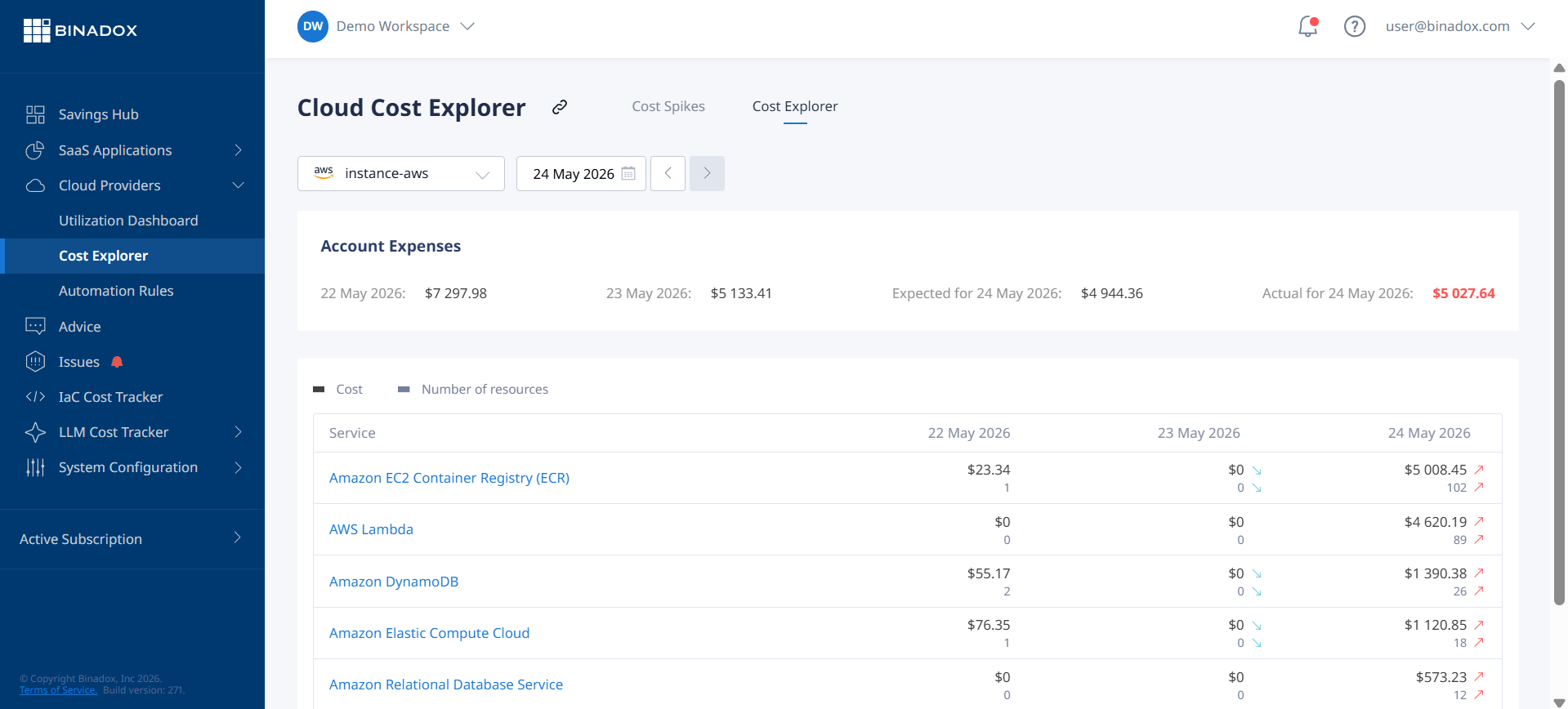
Your first step is to establish a clear baseline of your compute usage. AWS Cost Explorer is your primary tool for this analysis.
- Filter for On-Demand Usage: Start by filtering your EC2 running hours to show only On-Demand instances over the last 30-90 days. This represents your potential savings opportunity.
- Group by Key Dimensions: Group the data by Instance Family, Region, and Linked Account. This will reveal your most consistent areas of spend. For example, you might find that the
m5.largeinstance family inus-east-1accounts for a significant, steady portion of your On-Demand costs. - Identify the Stable Baseline: Look for usage that runs consistently, 24/7. This is your “waterline”—the minimum level of continuous usage that is safe to cover with RIs. Tools within Cost Explorer can help visualize this, and many third-party FinOps platforms offer advanced analytics to pinpoint this baseline automatically.
Forecasting and Purchase Recommendations
Once you have a solid understanding of your historical usage, you can begin to forecast future needs. AWS provides RI purchase recommendations directly within Cost Explorer. These recommendations are based on your past usage patterns and can be a valuable starting point.
However, as a FinOps analyst, you must enrich this data with business context.
- Consult with Engineering: Are there any planned migrations or application refactoring efforts that would change your instance requirements? A conversation with engineering leads can prevent you from buying RIs for an instance family that is about to be deprecated.
- Factor in Growth: Is the business planning to launch a new product or expand into a new market? This might require scaling up your infrastructure, and your RI purchases should reflect that anticipated growth.
Your goal is to build a purchase plan that covers your stable baseline while leaving a buffer for flexibility. A common approach is to cover 80-90% of your predictable baseline with RIs, leaving the rest to be covered by Savings Plans or On-Demand pricing.
Executing Your Reserved Instance Management Strategy
Execution involves more than just clicking “purchase.” It requires a clear process for procurement, allocation, and ongoing management.
Procurement and Allocation
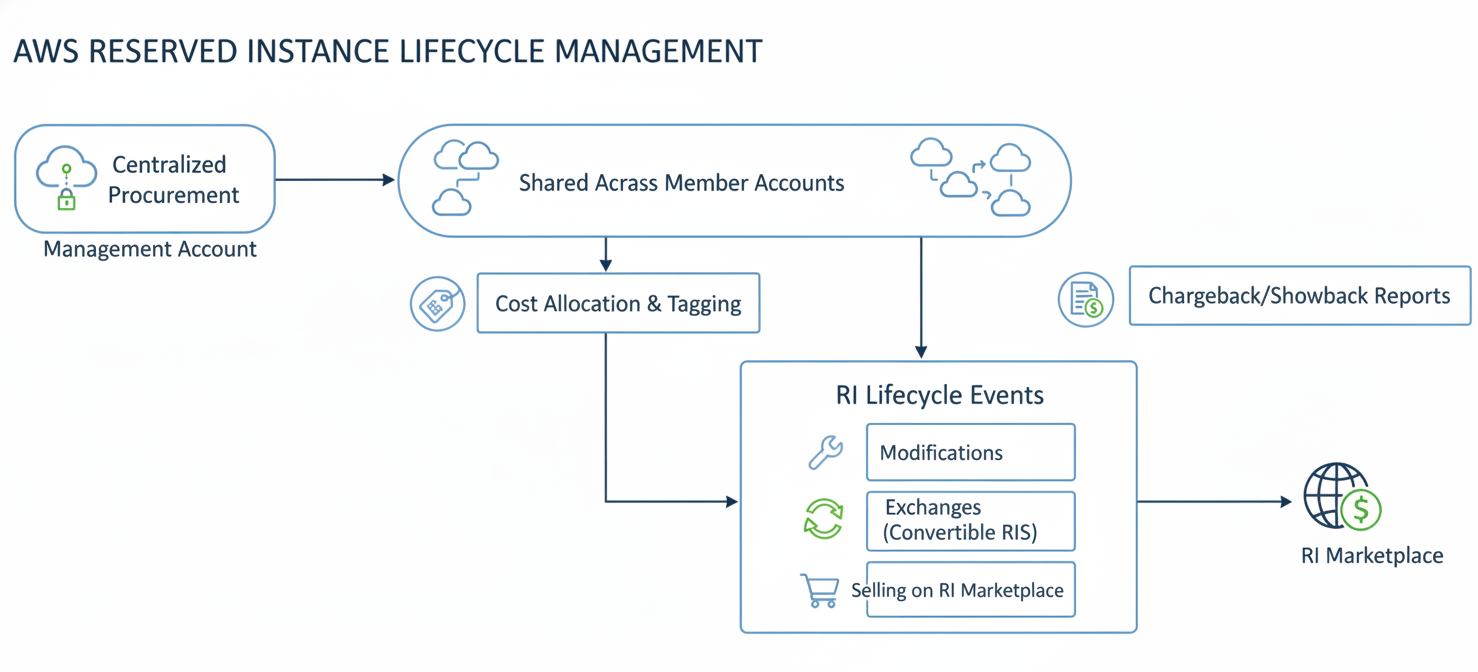
For organizations with multiple AWS accounts, a centralized procurement model is most effective. RIs purchased in the management account of an AWS Organization can be shared with member accounts. This allows you to aggregate demand across the entire organization to meet volume discount thresholds and ensure that RI discounts are applied where they are needed most.
Proper cost allocation is critical. Your chargeback or showback reports must accurately reflect which teams or business units are consuming the RI discounts. This requires a robust tagging strategy. By tagging resources and RIs with information like “Cost Center,” “Team,” or “Project,” you can use the AWS Cost & Usage Report (CUR) to attribute the savings accurately. This visibility ensures that teams who contribute to stable usage see the financial benefit of the RI purchases they enable.
Managing RI Lifecycle Events
Your RI portfolio is not static. Throughout the 1- or 3-year term, you will need to manage several lifecycle events.
- Modifications: For Standard RIs, you have some limited flexibility to modify the Availability Zone or instance size within the same family. This can be useful for adapting to minor changes in your deployment patterns.
- Exchanges: Convertible RIs can be exchanged for other Convertible RIs with different attributes. This is a powerful tool for adapting to significant architectural shifts.
- Selling on the Marketplace: If your usage patterns change and you no longer need a Standard RI, you can sell it on the AWS Reserved Instance Marketplace. This allows you to recoup some of your initial investment. AWS charges a 12% service fee on the sale. This is a critical mechanism for mitigating the risk of underutilization.
KPIs and Reporting for RI Management
To demonstrate the value of your FinOps efforts, you need to track and report on the right Key Performance Indicators (KPIs). For RI management, two metrics are paramount: Utilization and Coverage.
RI Utilization
RI Utilization measures the percentage of your purchased RI hours that were actually used. A low utilization rate means you are paying for discounts you are not consuming—a cardinal sin in FinOps.
- Target: Your goal should be to maintain an RI utilization rate of 95% or higher.
- Tooling: The AWS Cost Explorer has a built-in RI Utilization report that allows you to track this metric at both an aggregate and individual RI level. You can filter by instance type, account, and other dimensions to identify underutilized RIs.
- Action: When you identify an underutilized RI, your first step is to determine why. Is the underlying workload no longer running? Can the RI be modified to match a different instance? If not, selling it on the Marketplace may be the best course of action.
RI Coverage
RI Coverage measures the percentage of your total instance hours that were covered by RIs. This KPI helps you understand how much of your compute footprint is benefiting from discounted pricing.
- Target: The optimal coverage target varies by organization, but a common goal is to have 70-90% of your total EC2 usage covered by a combination of RIs and Savings Plans.
- Tooling: Cost Explorer also provides an RI Coverage report. This report is essential for identifying opportunities to purchase additional RIs or Savings Plans.
- Action: If your coverage is below your target, it indicates an opportunity to increase your savings. Use the RI purchase recommendations in Cost Explorer to identify the best candidates for new RI purchases.
You should establish a regular cadence for reviewing these reports—weekly for utilization and monthly for coverage—to ensure your RI portfolio remains aligned with your usage patterns.
Automating and Scaling Your RI Operations
As your organization’s cloud footprint grows, manual RI management becomes untenable. The complexity of tracking thousands of instances across hundreds of accounts requires automation.
Leveraging Tooling for Analysis
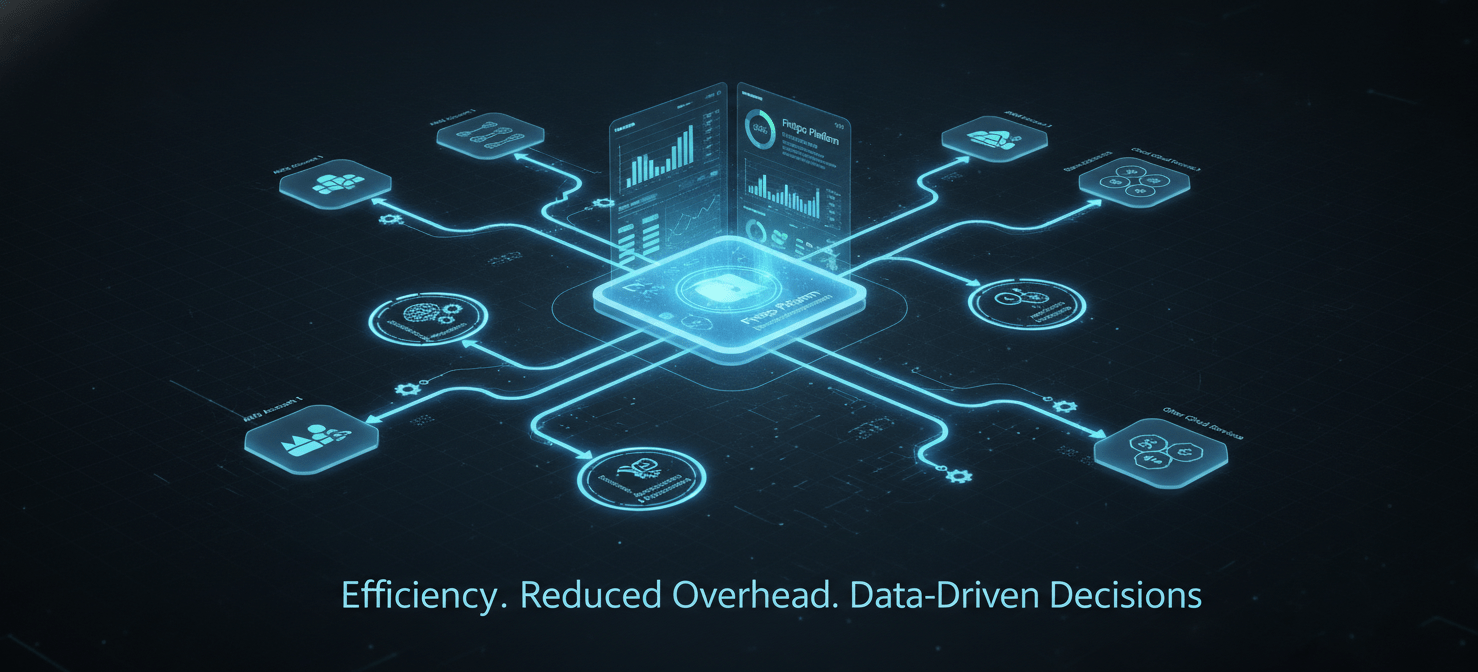
While AWS native tools are powerful, many organizations turn to third-party FinOps platforms to automate the analysis and management of their commitment portfolios. These tools can:
- Provide more sophisticated “waterline” analysis to identify the optimal RI baseline.
- Automate the process of exchanging Convertible RIs to align with changing usage.
- Offer “what-if” scenarios to model the financial impact of different purchase decisions.
- Continuously monitor for optimization opportunities, such as identifying RIs that could be sold on the Marketplace.
Creating an Operational Cadence
Automation is not a substitute for a well-defined process. Your team should establish a clear operational cadence for RI management. This might look like:
- Weekly: Review RI utilization reports and investigate any underutilized RIs.
- Monthly: Review RI coverage reports and assess the need for new purchases.
- Quarterly: Meet with engineering leadership to discuss upcoming architectural changes and adjust your RI strategy accordingly.
By combining powerful automation with a disciplined operational process, you can scale your FinOps practice and ensure that your AWS commitment management strategy continues to deliver value as your organization grows.
Conclusion
For the data-driven FinOps analyst, Reserved Instances are not a legacy discount model but a strategic lever for financial control. They offer the deepest savings available for predictable workloads, forming the bedrock of a mature cost optimization practice. A successful reserved instance management strategy moves beyond simple purchasing and embraces a full lifecycle approach—from data-driven analysis and forecasting to diligent tracking of utilization and coverage KPIs. By blending RIs with the flexibility of Savings Plans and embedding automation into your operational cadence, you can build a resilient and highly efficient commitment portfolio. This transforms cloud cost management from a reactive exercise into a proactive, data-informed discipline that drives tangible business value. The goal isn’t just to buy discounts; it’s to master the system that delivers them.
To effectively implement a data-driven, proactive RI strategy and truly master your cloud economics, consider how a specialized platform can empower your team; you can easily begin your free Binadox trial or book a demo to explore its full potential.
 7-day free trial